


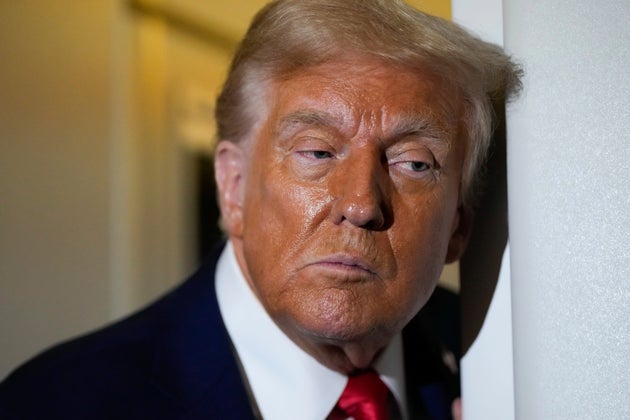
 US President Donald Trump
Donald Trump has claimed that taking paracetamol – or acetaminophen, as it’s known across the pond – in pregnancy is linked to rising autism rates. And scientists and researchers can’t believe what they’re hearing.
The US president initially teased the information at Charlie Kirk’s memorial over the weekend, saying: “I think we found an answer to autism.”
Since then, the president made an announcement at the White House in which he reportedly revealed: “Taking Tylenol [whose active ingredient is acetaminophen] is not good. I’ll say it. It’s not good.
“For this reason [the FDA] are strongly recommending that women limit Tylenol use during pregnancy unless medically necessary.”
Pregnant women in the US have been advised to only use the pain relief for high fevers. Trump also said doctors will be given new guidance advising mothers-to-be not to use paracetamol during their pregnancy.
Tylenol maker Kenvue told the BBC the science shows that taking acetaminophen does not cause autism and added: “We strongly disagree with any suggestion otherwise and are deeply concerned with the health risk this poses for expecting mothers.”
A leading charity supporting autistic people in the UK condemned the announcement.
Mel Merritt, head of policy and campaigns at the National Autistic Society, told HuffPost UK: “This is dangerous, it’s anti-science and it’s irresponsible.
“President Donald Trump is peddling the worst myths of recent decades. Such dangerous pseudo-science is putting pregnant women and children at risk and devaluing autistic people.
“Let’s be clear – painkillers do not cause autism and vaccines do not cause autism. Large-scale studies have shown that there is no robust, scientific evidence to support this claim. It’s nothing more than fear-mongering.”
Merritt called on the UK government and NHS “to stand by autistic people and to condemn this misinformation”.
“To do otherwise risks creating further fear, stigmatisation and harm,” she said.
Where has all this come from?
Earlier this year, US health secretary Robert F. Kennedy, Jr. suggested there is an “autism epidemic” which is “running rampant”.
“One in 31 American children born in 2014 are disabled by autism. That’s up significantly from two years earlier and nearly five times higher than when the CDC first started running autism surveys in children born in 1992,” he said.
At the time, the health secretary said he’d been tasked with identifying the causes of autism and teased they’d begin to have answers by September.
What is autism?
Autism isn’t an illness, but rather a difference in the way the brain works – as a result, people might interact with the world differently to those deemed ‘neurotypical’.
Some autistic people might find it difficult to communicate and interact with others, or find certain experiences overwhelming or too stimulating. Symptoms and severity can vary from one person to the next.
The NHS states: “Autism is not a medical condition with treatments or a ‘cure’. But some people need support to help them with certain things.”
Earlier this year, the National Autistic Society (NAS) suggested research should focus on improving the lives of autistic people – centring around their experiences, goals and needs – rather than focusing on the cause.
What do we know about autism’s cause(s)?
It’s really hard to say what causes autism – research points to a combination of genetic and environmental causes. Some studies point to toxic exposures and prenatal infections.
Professor Dimitrios Siassakos is an expert in the field of obstetrics and gynaecology at University College London, as well as an honorary consultant in obstetrics at University College London Hospital.
He said autism results “from several factors, often combined, particularly genetic predisposition, and sometimes low oxygen at the time of birth as a result of complications”.
What about the paracetamol link?
Professor Angelica Ronald, Professor of Psychology and Genetics at the University of Surrey, said there’s a lot of empirical evidence from many decades of robust research, conducted across a range of countries, “that does not support the claim that paracetamol causes autism”.
Studies in fraternal twins (ie. non-identical and created from two separate eggs and sperm), for example, have shown that if one twin has autism, typically the other doesn’t.
Prof Ronald noted: “If paracetamol caused autism, we would see both twins in a pair having autism. However that is not the case, typically one fraternal twin has autism and the other does not.”
The expert in genetics said molecular genetic research has also uncovered “hundreds of genes” that cause or influence the likelihood of developing autism.
“There are many forms of autism, some of which are caused by known genetic differences,” she added. “This evidence is also incompatible with the idea that paracetamol is a major cause of autism.”
Experts have also pointed to a Swedish study of 2.4 million births (1995-2019) published in 2024, which used sibling data and found no relationship between exposure to paracetamol in utero and subsequent autism, ADHD or intellectual disability.
Discussing the study, Dr Monique Botha, Associate Professor in Social and Developmental Psychology at Durham University, said: “This suggests no causal effect of paracetamol in autism ... There is no robust evidence or convincing studies to suggest there is any causal relationship and any conclusions being drawn to the contrary are often motivated, under-evidenced, and unsupported by the most robust methods to answering this question.
“I am exceptionally confident in saying that no relationship exists.”
Paracetamol in pregnancy – now what?
Ibuprofen isn’t recommended in pregnancy, which means paracetamol is one of the few remaining options for pregnant parents who struggle with pain.
There will undoubtedly be a lot of worried pregnant women off the back of these new reports.
Prof Siassakos is now concerned that undue focus on paracetamol risks preventing families from using, what he called, “one of the safest medications to use in pregnancy when needed”.
Dr Botha added that pain relief for pregnant women is “woefully lacking” and “paracetamol is a much safer pain relief option during pregnancy than basically any other alternative”.
The “fear-mongering” surrounding paracetamol and autism “will prevent women from accessing the appropriate care during pregnancy,” she added.
Dr Linden Stocker, a consultant in fetomaternal medicine at University Hospitals Southampton, said she’s been prescribing paracetamol in pregnancy throughout her career.
“Paracetamol has been well-studied in pregnancy, and there is no good evidence that it harms the unborn baby. It is also one of the longest-used painkillers we have used in pregnancy, and therefore the data we have on this drug is good,” she said.
“Some studies suggest that paracetamol use in pregnancy might be linked to behavioural problems in children, but these studies have unreliable findings.
“Overall, there is no proof that paracetamol exposure in the womb affects a child’s behaviour. Moreover, paracetamol has been used for many years to help women with pain in pregnancy.”
HuffPost UK has contacted the UK’s Department of Health and Social Care for comment and will update the article when we hear back.










 Bengali (Bangladesh) ·
  English (United States) ·