
 24 minutes ago
3


Anthropic’s IPO has acquired a price range, and the size of the proposed deal turns it into a major test of appetite for AI shares. The Claude developer’s amended prospectus puts the estimated offering price at $70–$78, with 825 million shares proposed for sale.
Multiplying the share count by the range implies a gross public offering of $57.75 billion–$64.35 billion, before fees and any additional underwriter shares. That is a calculation from the proposed terms, not money already raised and not a final valuation of the entire company.
Anthropic IPO terms bring the financing into focus
The amended SEC prospectus, filed November 10, remains preliminary. “The information in this preliminary prospectus is not complete and may be changed,” it states. The range is therefore a statement of proposed terms, not a completed sale or a promise about the first trading price.
Public-market demand will determine much more than the headline size. Investors will assess the price against the business, the capital it needs and the rights attached to the shares. An impressive fundraising total does not, by itself, establish an attractive return for a new shareholder.
For readers following AI through products rather than stocks, this marks a different kind of evaluation. A useful chatbot can win users without settling what its maker should be worth. The IPO asks investors to put a price on the company’s future cash-generating potential.
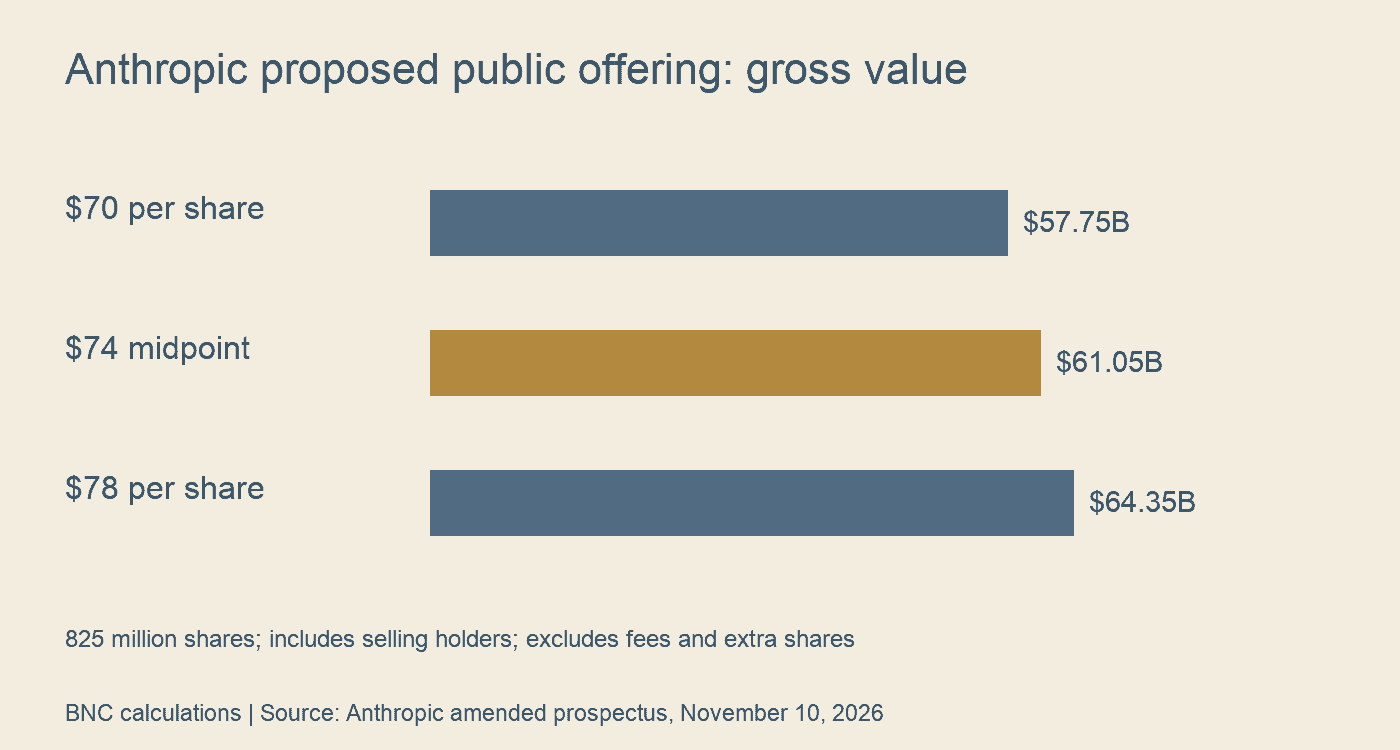 BNC calculations from the proposed share count and price range in Anthropic’s amended prospectus, linked above. Gross totals include selling shareholders and exclude fees and additional underwriter shares.
Who receives the proceeds matters
Anthropic proposes selling about 801.35 million shares itself, while existing holders would sell approximately 23.65 million. The company receives no proceeds from those holders’ sales. The full offering’s gross value should therefore not be described as cash going entirely into Anthropic’s accounts.
This distinction separates primary capital from secondary liquidity. New company shares can fund the business, while a sale by existing holders changes who owns an existing interest. Both can occur in the same transaction, but they serve different purposes.
When assessing any IPO, investors should also distinguish gross proceeds from net proceeds. Underwriting discounts and other transaction expenses affect how much money the company actually receives. A simple price-times-shares calculation is useful for scale, but it is not a substitute for the prospectus’s proceeds analysis.
The $26 billion strategic placement is separate
The filing also describes a $26 billion Class N private placement involving strategic partners, contingent on completion of the IPO and other conditions. This is a separate financing channel. It should not be folded into the public share count or presented as public-market demand already demonstrated.
Strategic and public investors may have different reasons to participate. A commercial partner may value a durable business relationship alongside a financial return. Public shareholders will primarily need to assess the economic exposure they are purchasing at the offered price.
That does not make strategic capital less real. It means the two sources of funding answer different questions. The existence of a committed partner transaction cannot tell readers how a broadly distributed public float will trade after the listing.
Buying shares does not mean buying control
Anthropic’s planned structure reserves 50.1% of voting power on general shareholder matters for a founder-controlled Class F share. Its Long-Term Benefit Trust would generally appoint a majority of the board. Public investors should understand those arrangements before equating an economic stake with conventional corporate control.
Governance affects how investors can respond if their priorities diverge from management’s. It matters most when difficult decisions arise: the pace of spending, the balance between product development and profitability, or choices about how the business pursues its mission.
A buyer can accept limited influence and still see an attractive investment. The important point is to price the rights actually offered rather than assume that every public listing brings the same shareholder powers. Ownership, voting influence and board appointment rights are related, but distinct.
Product momentum meets a stock-market test
The company has also just announced Claude Fable 5.2 and Mythos 5.2, describing stronger technical capabilities and faster output. That product release offers context for the growth story, though vendor-reported model improvements do not establish future earnings.
BNC’s analysis of the new Claude models and their practical limits examines the technology side. The investment question is how capability improvements translate into customer demand, pricing and the costs of serving that demand.
Better models can make a product more useful. They can also require businesses to keep investing to remain competitive. Investors need evidence about both the value delivered to customers and the economics retained by the provider.
What would change the picture next
The most useful next developments are revised terms, an effective registration statement and eventual confirmation of pricing and completion. Until then, a proposed Nasdaq symbol or an estimated range should not be mistaken for a stock already available in ordinary public trading.
The amended prospectus makes Anthropic’s financing plan more concrete. The decisive market test remains ahead: whether investors accept the price and governance terms, and whether the business can ultimately deliver returns that justify them.




 Bengali (Bangladesh) ·
 English (United States) ·