

Over the years, I have written about many unusual and fractured voting splits on the en banc Fifth Circuit. An en banc case decided last week made me think of another en banc case from last year.
Ethridge v. Samsung SDI
Let's start with Ethridge v. Samsung SDI, a personal injury case about exploding batteries. In May 2025, a divided three-judge panel (Jones, Oldham, King) ruled that the district court had personal jurisdiction over the defendant. Judge Oldham wrote the panel opinion, joined by Judge King. Judge Jones dissented, finding the district court lacked personal jurisdiction. The Defendant filed petitions for panel rehearing and en banc rehearing. In December 2025, the Fifth Circuit issued a very unusual order with two components.
The first component indicates that the three-judge panel granted the petition for panel rehearing, withdrew the panel opinion, and issued a four-page substitute opinion.
Andrew S. Oldham, Circuit Judge:
IT IS ORDERED that the petition for panel rehearing is GRANTED. The court's prior panel opinion is WITHDRAWN, see Ethridge v. Samsung SDI Co., 137 F.4th 309 (5th Cir. 2025), and the following opinion is SUBSTITUTED therefor.
Now, the panel reversed itself and found that there was not personal jurisdiction. What caused the change? The Seventh Circuit addressed the same question "with the benefit of jurisdictional discovery." The panel stated "After reconsideration in light of [the Seventh Circuit precedent], we affirm the district court's dismissal for lack of personal jurisdiction."
So far, nothing out of the ordinary. It is common enough for a panel to grant a petition for rehearing, especially if there is some relevant precedent from another circuit.
The second component of the order is strange. The body of the order is two paragraphs, followed by a * footnote.
Per Curiam:
The petition for rehearing en banc is DENIED because, at the request of one of its members, the court was polled, and a majority did not vote in favor of rehearing (Fed. R. App. P. 40 and 5th Cir. R. 40).
In the en banc poll, 5 judges voted in favor of rehearing (Jones, Smith, Richman, Ho, and Engelhardt), and 11 judges voted against rehearing (Elrod, Stewart, Southwick, Haynes, Graves, Higginson, Willett, Duncan, Wilson, Douglas, and Ramirez).*
* Judge Oldham's participation is not reflected because the panel granted rehearing. See Fed. R. App. 40(a) ("Panel rehearing is the ordinary means of reconsidering a panel decision; rehearing en banc is not favored."); 5th Cir. R. 40 I.O.P. ("Panel has control—Although each panel judge and every active judge receives a copy of the petition for rehearing en banc, the filing of a petition for rehearing en banc does not take the case out of the control of the panel deciding the case. A petition for rehearing en banc is treated as a petition for rehearing by the panel if no petition is filed. The panel may grant rehearing without action by the full court." (capitalization omitted; emphases added)).
A few things stand out.
First, if the petition for panel rehearing was granted, why did the order need to indicate the outcome en banc poll? The usual approach is to say the petition for panel rehearing is granted and the petition for rehearing en banc is denied. Indeed, very often, the panel modifies its opinion to block en banc review. But this order still indicated that there was an en banc poll, and that the poll failed by a vote of 11-5.
Second, this order raises some questions about timing. The Seventh Circuit's decision was issued in July 2025, about two months after the panel opinion. Was the en banc poll take before or after the Seventh Circuit decided its case? The order reveals that the poll was conducted at the request of one member of the court. Was the petition for panel rehearing initially granted or was it held pending the en banc poll?
Third, there are seventeen active members of the Fifth Circuit. The votes of sixteen members are listed. Yet Judge Oldham's vote is not indicated in the poll. I can't recall this ever happening before.
Fourth, the * footnote is something I have also never seen before. Judge Oldham explains that his en banc vote is not recorded because the panel retained control over the case in light of the petition for panel rehearing. Therefore, he apparently did not participate in the vote at all. I think Judge Oldham's position is incorrect. The Internal Operating Procedure rule states that the panel may grant rehearing in the absence of an en banc poll. But the rule does not state that a poll may not be called while a petition for panel rehearing is pending. An en banc poll can be called even if the petition for panel rehearing remains unresolved.
Indeed, Oldham's position would yield some difficult outcomes. Could it really be the case that so long as a petition for rehearing is pending, the en banc court is powerless to take any action? The en banc court does not need the panel's permission to call a poll. Of course, here the en banc vote failed, but that outcome is besides the point. Had the en banc poll succeeded, the panel opinion would have been vacated, the petition for panel rehearing would have become moot, and the case would have been reheard en banc. The original panel cannot hold a case hostage to keep it away from the full court.
I don't think my reading of the rule is idiosyncratic. The fact that the other sixteen active judges on the court voted, even as a petition for panel rehearing was pending, suggests that Judge Oldham stood alone.
The usual practice in the Fifth Circuit is to file both a petition for panel rehearing and a petition for rehearing en banc. It wouldn't be hard to research how often en banc polls were called when a petition for panel rehearing was pending. I suspect that scenario happens often. Granted, Judge Oldham does not believe in horizontal stare decisis and the rule of orderliness, so perhaps past practice is not the actual law.
What makes Judge Oldham's action here even odder was that his vote flipped on the personal jurisdiction issue. There is no mystery of what his views on the case were. Why not simply record his vote? Indeed, if he thought en banc rehearing was improper, he should have voted against rehearing. Or, Judge Oldham may have thought the entire vote itself was illegitimate, and he was boycotting the process altogether. In Ethridge, Jude Oldham was the only one. (Pardon my 90s rock reference.)
Holberg v. Guerrero
Fast-forward to last week. On August 14, the en banc Fifth Circuit issued an order in Holberg v. Guerrero. While the Fifth Circuit has seventeen active members, Senior Judge Higginbotham participated in the case, so there were eighteen members of the en banc court.
The order begins with, again, something I have never seen before.
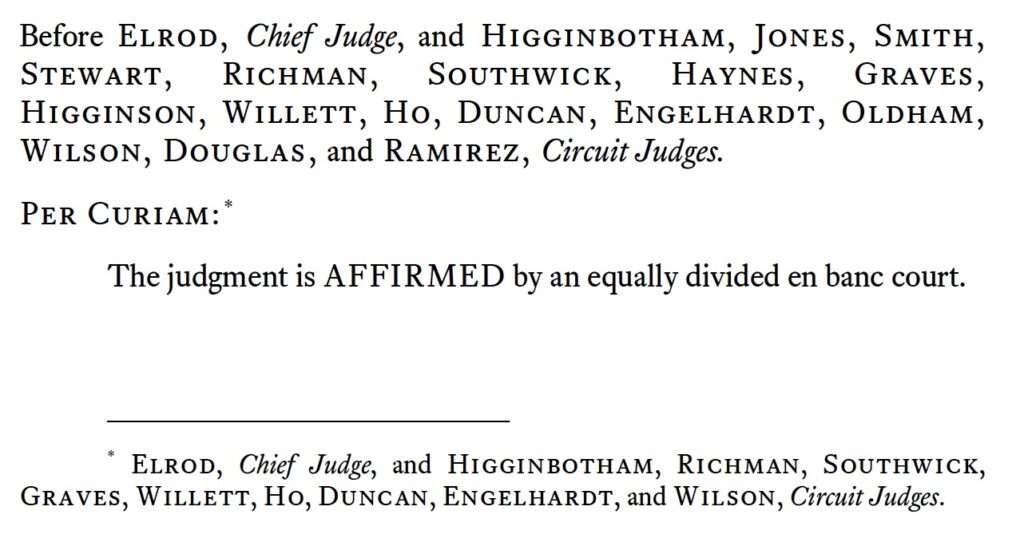
What is going on here?
First, the usual practice on the Supreme Court is to not indicate the votes when there is 4-4 split. For example, I'm pretty sure I know how the Supreme Court split in the Oklahoma Charter school case, but I can't be certain. In at least one Fifth Circuit case, B.W. v. City of Austin, the en banc Fifth Circuit indicated how the evenly-divided court split. Nine members of the eighteen member court signed a statement stating that the decision of the district court is affirmed. You can work backwards and count which nine members would not have affirmed the lower court's decision.
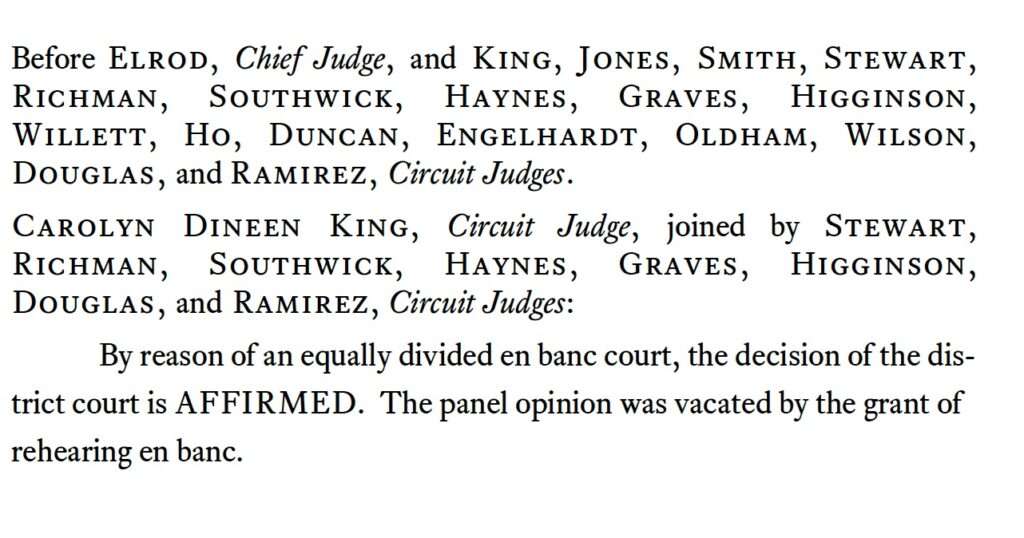
The key word here is "joined." That is, they joined that statement about affirming the court. By contrast, the star footnote in Holberg lists ten names, but doesn't indicate what they did. The word "joined" is missing. The footnote tells us absolutely nothing about what happened. These names are just listed as connected with the per curiam opinion. Does this footnote mean that ten members of the court agreed that the en banc court (with eighteen members) was equally divided? Does the absence of other names that mean that the other eight members of the court thought the court was not equally divided? Can the Fifth Circuit not even agree when they are divided? Do some judges think a majority opinion in fact exists?
Third, in B.W., the nine names that were listed were all judges who voted to affirm. That grouping makes sense. But in Holberg, the ten names who are listed voted differently. Of the ten judges listed in the footnote, five judges (Willett, Ho, Duncan, Engelhardt, and Wilson) joined Judge Oldham's separate opinion that would have affirmed the district court. The other five judges in the footnote (Elrod, Higginbotham, Richman, Southwick, and Graves) would have reversed the lower court. So even the five judges who are linked to the per curiam opinion didn't even vote in the same fashion on the merits. The listing of their names tell us what exactly?
Fourth, the nomenclature in past evenly-divided cases is that "the decision of the district court is AFFIRMED." I found the same notation in several other cases, including Thompson v. Connick (2009), which would ultimately be reversed by the Supreme Court. But in Holberg, only the "judgment" was affirmed. There is a difference between affirming a "decision" and affirming a "judgment." The former option provides support for the lower court's reasoning. The latter option merely assigns a judgment for the Plaintiff or Defendant. As I'll explain below, something strange was going on with respect to what the en banc court actually did with respect to the lower court decision.
Fifth, Judge Oldham's opinion is not styled as a concurrence. It is simply exists:
Andrew S. Oldham, Circuit Judge, joined by Judges Jones, Smith, Ho, Duncan, Engelhardt, and Wilson, and Judge Willett in all but Parts II.A.1 and III.B:
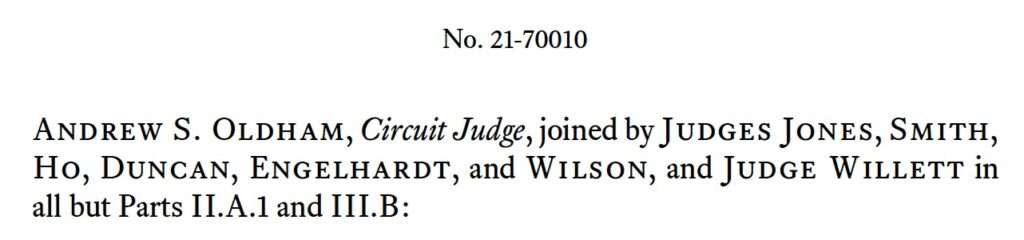
Usually when there is an affirmance by an equally divided court, the separate writings are styled as concurrences (those who vote to affirm) and dissents (those who vote to reverse). But what is Judge Oldham's opinion? It's a mystery.
This opinion reminds me of Justice Barrett's move in San Francisco v. EPA to style her opinion as "dissenting in part" when in fact she wrote a straight dissent. I speculated that Barrett was trying to create the perception that she agreed with the conservatives on some items, as a means of signaling she was not really voting with the liberals. Judges sometimes try to play fast-and-loose with the styling of opinions. Optics matter. But Barrett didn't fool anyone.
Sixth, Judge Oldham's opinion sounds an awful lot like a majority opinion. It includes this sentence:
Today we affirm the district court and hold that AEDPA bars Holberg's claims.
And the order concludes:
We hold Holberg cannot meet that standard.
AFFIRMED.
Who is the "we"? His opinion is not joined by a majority of the en banc court. The lower court's judgment was affirmed by an equally divided court by operation of law, not based on Oldham's AEDPA analysis. No new precedent is set. And the last line of the 46-page opinion states "AFFIRMED" in all caps. But Oldham's opinion can do no such thing. That is not the judgment of the court. The judgment (not the decision) of the lower court is affirmed by virtue of the tie vote.
This sort of language may have been an artifact from a time when Oldham had the. majority opinion. Often on the Supreme Court, when a Justice loses a majority, the opinion still retains clues of prior vote alignments. Judge Oldham could have left these artifacts in place. Or perhaps, as I suggested above, Judge Oldham disagrees that the court is evenly divided, and thinks in fact he has a majority, or at least a plurality? It's almost like a Schrodinger's Cat--the opinion is simultaneously a majority and not a majority opinion.
Seventh, why is Judge Oldham's opinion the lead opinion? As a general matter, concurrences are listed by seniority. Judge Oldham's opinion appears first in the document. Immediately after that opinion comes a concurrence from Judge Southwick. Judge Southwick has more seniority than Judge Oldham. Why would Judge Oldham's opinion come before Judge Southwick's concurrence? It doesn't matter that Oldham's opinions has more votes. Again, it is possible that Judge Oldham views his opinion as a majority opinion or a plurality.
It seems that the Oldham opinion purports to be a controlling opinion (it states AFFIRMED), and does not acknowledge that the court was evenly-divided. Indeed, the Oldham opinion reminds me of a SCOTUS opinion where a Justice started out in the majority and later lost the majority, but decided not to reformat the opinion. These artifacts were not taken out of the opinion. These strange dynamics led to the bizarre * footnote.
Courts are generally predictable bodies. Things make sense and follow patterns. When opinions don't make sense and do something new, there is evidence that stranger things happened.
The post Another Unusual Footnote In An En Banc Fifth Circuit Opinion appeared first on Reason.com.




 Bengali (Bangladesh) ·
  English (United States) ·