

In the sea, soft-bodied sea slugs crawl around without shells to protect them. Instead, they sport dazzling colors and flashy patterns to warn would-be predators that they’re toxic. Now, researchers have learned that many of these vibrant hues come from structures under the slugs’ skin.
These slugs, called nudibranchs (NU-dih-branks), are sometimes dubbed the “butterflies of the sea.” Their colors are “exceptionally bright,” says materials scientist and physicist Samuel Humphrey. He works at the Max Planck Institute of Colloids and Interfaces in Potsdam, Germany. Nudibranchs’ range of colors and patterns exceeds those of other ocean dwellers and is only like that of butterflies and birds, he says.
Not much was known about nudibranch colors, Humphrey says. But in nature, some of these colors — such as white, blue and purple — are hard to get from pigments. (Those are molecules that provide color.) That made Humphrey’s team suspect the slugs’ colors instead arise from light waves bouncing off structures on their bodies. Such structural color can create hues as intense as those seen on the sea slugs.
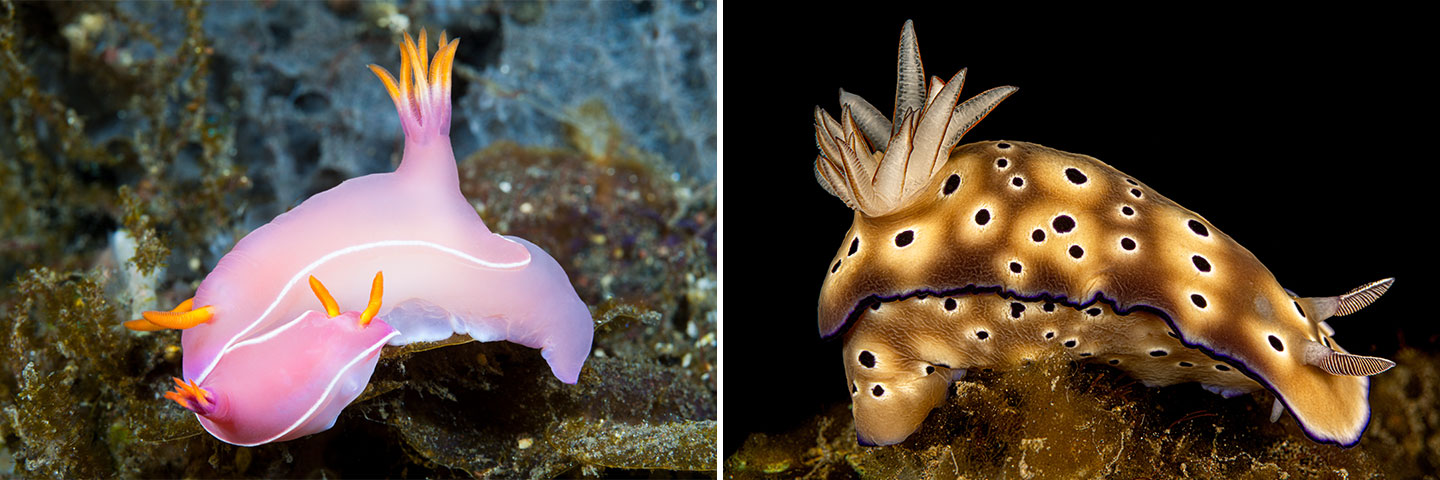 Two sea slugs — a Barbie-pink Hypselodoris bullockii (left) and a golden-speckled Hypselodoris tryoni (right) — use the same technique to wear wildly different hues.Left: Reinhard Dirscherl/Getty Images; Right: ifish/iStock/Getty Images Plus
Humphrey collected one species of nudibranchs off the coast of France. Others, he and his colleagues bought from aquarium shops. The researchers looked at the creatures under the microscope and saw tiny dots of colors that combined to create a shade. For instance, a nudibranch might look purple, but zoom in, and you may find specks of red and blue. “It’s a bit like mixing paints until you get the color you want,” Humphrey says.
Actually, he adds, “it’s better than that.” Sea slugs’ hues arise from specific wavelengths, or colors, of light bouncing off them and reaching our eyes. And the team found that, for a given color, nudibranchs reflect up to 80 percent of light that hits them. That makes their hues more vivid than those produced by pigments, which create colors by absorbing light. Losing light means losing brightness, Humphrey explains.
The researchers shared their results in the March issue of the Proceedings of the National Academy of Sciences.
With a powerful microscope, the team saw stacks of tiny plates under nudibranchs’ skin. The plates were crystals made of guanine. The thickness of the plates and the distance between them in a stack determined the colors that they reflected. That allows sea slugs to wear a rainbow of colors made of just one material.
The many tiny dots of color on sea slugs’ skin creates an effect akin to how TVs make images with many spots of only a few colors. This is called pixelation. “It feels like a thing that humans have invented,” Humphrey says. “But actually, evolution had invented it millions of years ago.”
Sea slugs’ style is spot on
 Humphrey et al/PNAS 2026 (CC BY 4.0)
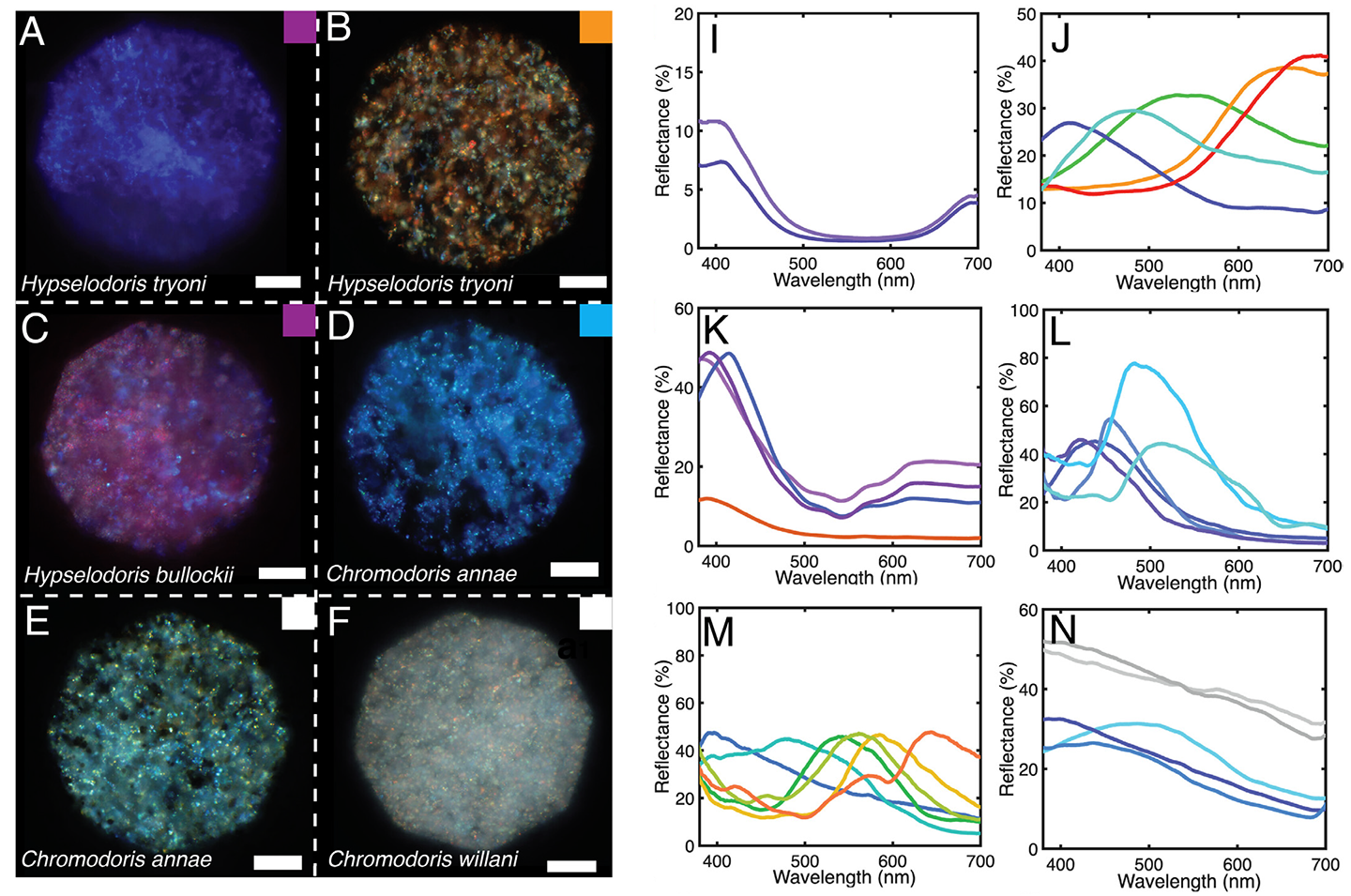
Microscope images revealed close-ups of nudibranchs’ skin (Figures A–F). These images show the many dots of different hues that make up a single area of color on the animals. Researchers also measured how these areas interact with light (Figures I–N). The graph in Figure I goes with the image in Figure A, Figure J goes with Figure B and so on. The graphs show the reflectance, or how much light reflects off differently colored spots to reach our eyes. Most colors have a specific wavelength at which the most light is reflected. For example, Figure C shows the pink region of Hypselodoris bullockii, which has some violet colored dots (Figure C). These dots reflect the most light at a wavelength of around 400 nanometers (Figure K).




 Bengali (Bangladesh) ·
  English (United States) ·