

Before the COVID-19 pandemic, in 2020, the Congressional Budget Office (CBO) did not include the $40 trillion mark in its gross national debt projections for the coming decade, forecasting a gross federal debt of $36 trillion in 2030. By 2022, the CBO expected the country to cross $40 trillion in 2030. A year later, that date had moved up to 2028, and by 2024, it had moved to 2027. The most recent report, from February 2026, projected that we would end the current fiscal year at $39.4 trillion. We have now surpassed the $40 trillion mark.
The last time the federal government had a budget surplus was in FY 2001. Since then, Congress and presidents have overseen deficit after deficit. The previous record holder for the most debt amassed was President Barack Obama, whose two terms saw a $13.2 trillion increase in the national debt, adjusted for inflation.
Eighteen months into his second term, President Donald Trump has already surpassed that. Adjusted for inflation, Trump's first term added $9.8 trillion in debt, and his second term has already added more than $3.5 trillion, bringing his total to $13.3 trillion—making him the president who oversaw the largest real increase in federal debt in history.
There's more to come. The CBO expects that by the end of 2028, the gross national debt will be $43.3 trillion, meaning that by the end of Trump's second term, he will have overseen a total of $7.1 trillion more in nominal debt. And the actual number will likely be higher: The CBO's forecast was done before Trump started his war with Iran, which is adding significant unforeseen spending.
Debt held by the public currently stands at about $32 trillion. Unlike gross national debt, that measure excludes intragovernmental debt—the debt the Treasury owes to federal trust funds and other government accounts. Setting aside those obligations, public debt is still roughly 100 percent of GDP.
Total debt amassed is not solely a presidential scorecard. Presidents don't have unilateral power and don't start from a blank slate. They must work with Congress, and they inherit entitlements, spending, and tax regimes. They also face external circumstances that may be beyond their control, such as recessions and pandemics.
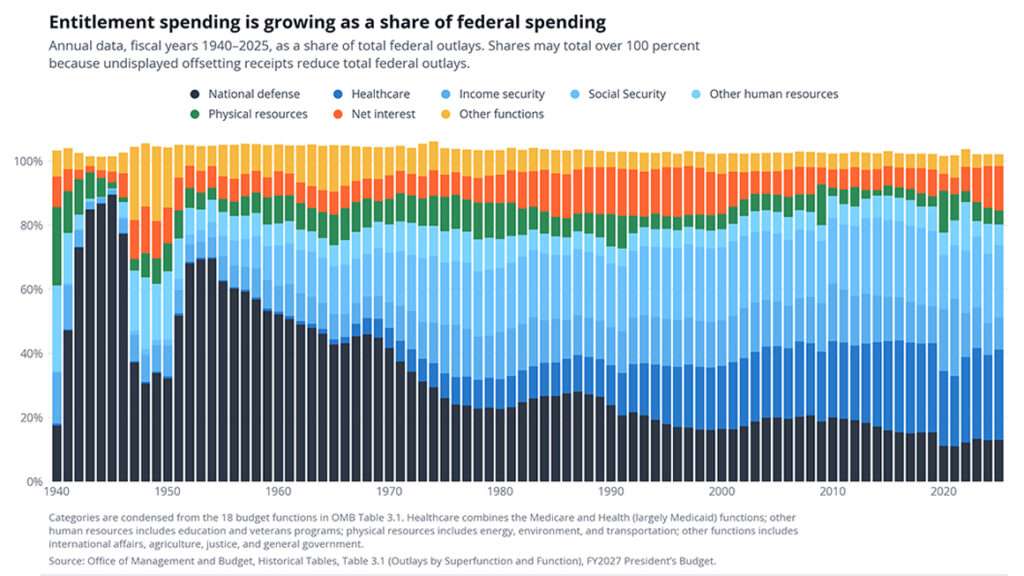
It is hard to blame presidents alone for the debt when the main source of spending growth is not discretionary, but long-established entitlement programs that no president or Congress has been brave enough to tackle: Social Security, Medicare, and Medicaid, which together account for about half of the federal budget today.
 Sources: Office of Management and Budget, Historical Tables, Table 3.1 (Outlays by Superfunction and Function), FY 2027 President's Budget
 Trump did not create—nor has he addressed—our entitlement programs. But many of his policies have contributed to the acceleration of the accumulation of debt. The CBO estimates that the One Big Beautiful Bill Act of 2025 increased projected deficits by $4.7 trillion over 2026–2035. Some of these deficits were expected to be eased by consumers paying Trump's tariffs, but that offset diminished after the Supreme Court struck down many of them.
Reason Foundation, the nonprofit that publishes Reason, synthesizes an array of government financial data in its annual Debtor Nation report. The largest spending category in the federal budget is Social Security, which accounted for 23 percent of net outlays in 2025. Social Security has promised more in benefits than it can finance. The middle fifth of the income distribution will receive about 50 percent more in benefits than they contributed over their lifetimes. This is becoming an impending problem as the worker-to-beneficiary ratio declines, moving from a relatively stable 3.2 to 3.4 from 1974 to 2008 to 2.6 in 2025.
Defense spending was to blame the last time the gross national debt exceeded 100 percent of GDP. America's last record was in 1946, when the country reached a debt-to-GDP ratio of 119 percent due to World War II. In 1945, the military accounted for 90 percent of all federal spending.
Despite America's constant involvement in wars abroad, defense has declined from our largest spending category to just another line item. Military spending exceeded $900 billion in 2025, but the federal budget has grown so much that it now makes up only 13 percent, with veterans' benefits adding another 5 percent.
Decades of deficits have led us to a reality in which interest expense on the debt represents a larger share of net outlays than the military. (For perspective, the Department of Defense is the single largest employer in the country.)
The national debt is unfair to future generations, leveraging the state's coercive power to force the people of the future to pay for services enjoyed by the people of the present. But beyond fairness, a more immediate concern is its costs and sustainability.
Americans have come to treat deficits and rising debt as normal. Unlike previous episodes of extraordinary borrowing, there is no plan to reverse course. Each debt milestone now arrives faster than the last.
The post America Hits a New Debt Record at $40 Trillion and Counting appeared first on Reason Magazine.





 Bengali (Bangladesh) ·
  English (United States) ·