

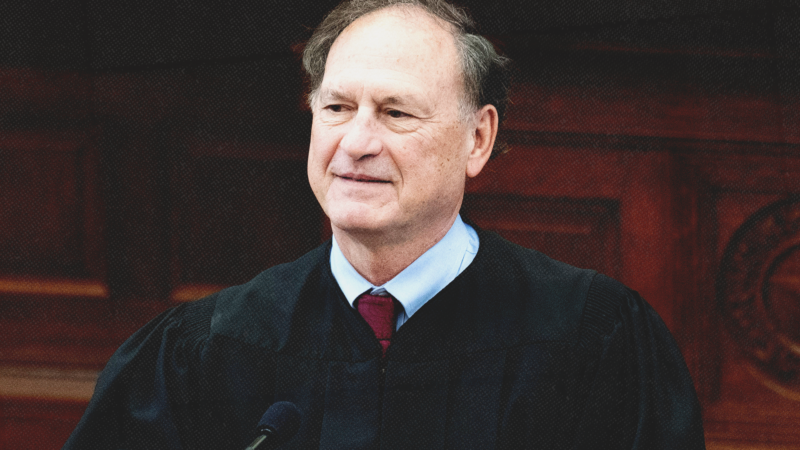
U.S. Supreme Court Justice Samuel Alito recently took to the pages of The Wall Street Journal with an article adapted from his new book, So Ordered: An Originalist's View of the Constitution, the Court and Our Country. In the piece, Alito dubbed himself a "practical originalist" and a "working judicial originalist." But as he proceeded to actually detail his legal views, they sounded much more like the results-oriented "living constitutionalism" that originalists are supposed to oppose.
Consider what Alito had to say about the landmark gun rights case McDonald v. Chicago (2010). At issue were two closely intertwined questions. First, does the Second Amendment right to keep and bear arms apply against state and local governments, just like it applies against the federal government? And second, if the Court did find that the amendment applies against the states, what is the proper constitutional means for applying it?
The historical evidence in the case all pointed in the same direction: The most thoroughly and consistently originalist way of applying the Second Amendment against the states was via the Privileges or Immunities Clause of the 14th Amendment.
But Alito rejected that originalist approach then and still rejects it now. To make his current case, Alito has enlisted the aid of the late Justice Antonin Scalia, who vocally opposed the Privileges or Immunities Clause argument during the McDonald proceedings. "Why did Scalia, a former law professor, say that?" Alito wrote in the Journal. "Because accepting the Privileges or Immunities argument would have opened a can of worms. Libertarians, social conservatives, progressives, socialists and others could all make a pitch for whatever rights they favored."
Of course, any judicial decision in support of a constitutional right may open a can of worms. If the Supreme Court strikes down one state's infringement on freedom of speech (or the right to keep and bear arms, or the right to be free from unreasonable searches and seizures, or any other constitutional liberty), it necessarily risks opening a can of worms, because other people in other states whose rights may have been similarly infringed would now have a handy SCOTUS precedent to cite when they file their own constitutional grievance against the allegedly offending government.
But what's wrong with that? If the Constitution demands that the government stop acting in a certain way, why should a self-professed originalist put his fears about opening a can of worms ahead of his judicial duty to follow the constitutional text where it leads?
In the McDonald case, Scalia and Alito each gave short shrift to historical evidence about the original meaning of the 14th Amendment because they worried about libertarians and others "mak[ing] a pitch for whatever rights they favored." That approach by Scalia and Alito sounds like results-oriented judging and not like any kind of principled adherence to the Constitution's original meaning.
Alito's apparent penchant for results-oriented judging is also evident in his positive invocation of the right-wing law professor Adrian Vermeule, who has argued that conservatives should abandon originalism entirely because originalism sometimes leads to libertarian results. "Libertarian assumptions central to free-speech law and free-speech ideology" must be discarded, Vermeule has argued, because they have led to the idea "that government is forbidden to judge the quality and moral worth of public speech." According to Vermeule, "libertarian conceptions of property rights and economic rights will also have to go, insofar as they bar the state from enforcing duties of community and solidarity in the use and distribution of resources."
Citing Vermeule, Alito has now argued that "practical originalists" must not be "allergic to any evaluation of results." Like Vermeule, Alito seems to think that the Constitution is only worth following faithfully when it leads to results that he happens to find worthy.
If that now counts as a kind of originalism, all I can say is that the term no longer means what it originally meant.
The post Alito's 'Practical Originalism' Doesn't Sound Very Originalist appeared first on Reason Magazine.





 Bengali (Bangladesh) ·
  English (United States) ·