
 20 minutes ago
2


AI has become the most frequently cited financial-stability risk in a survey published with the Federal Reserve’s latest report, bringing the technology boom’s financing and market connections into sharper focus.
The November 13 Financial Stability Report says 87% of 23 market contacts surveyed in September and October cited AI, compared with 50% of 20 contacts in the spring. The concerns span valuations, cyber events and complicated financing arrangements.
For crypto investors, the significance lies in those channels of transmission. A shock does not need to originate inside Bitcoin to influence the people, lenders and trading infrastructure around it.
What the Fed AI risk figure actually measures
The report describes the survey box as a summary of respondents’ views. It says those views “should not be interpreted as representing the views of the Federal Reserve Board.”
That distinction prevents an eye-catching statistic becoming something it is not. An 87% response rate for a particular concern is not an 87% chance of a crisis, and the small sample is not a representative poll of all investors.
The collection period also matters. The answers were gathered before November’s latest market and corporate developments. They show concerns already present among financial professionals, rather than a measured reaction to the most recent headlines.
These are different survey groups at different times. The increase is a useful change in reported concern, but it cannot establish how each individual respondent changed their mind.
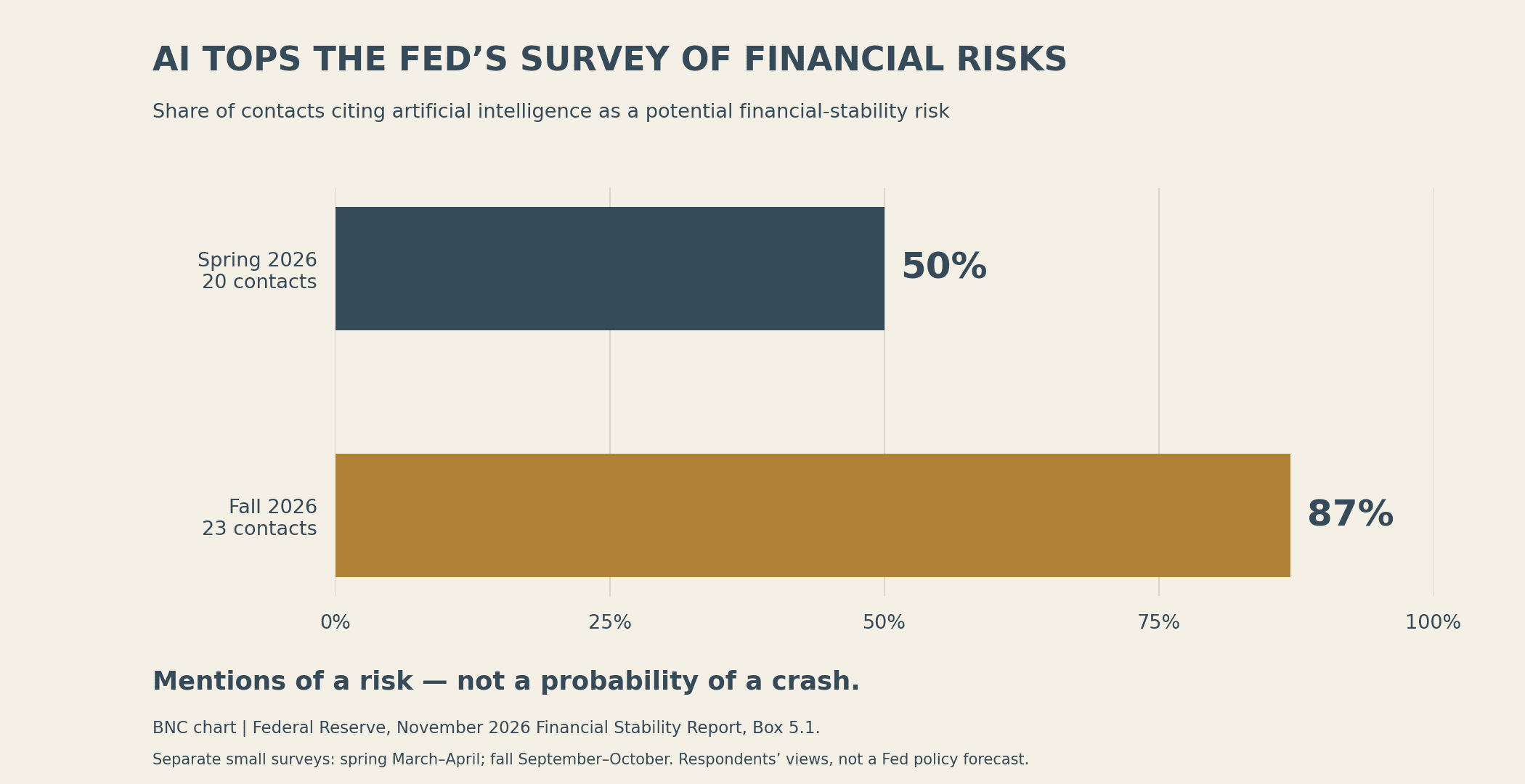 BNC chart from the Federal Reserve’s November Financial Stability Report. Separate small surveys: 20 contacts in spring, 23 in fall. Percentages measure mentions, not crash odds.
The financing question is bigger than whether AI works
A separate section of the report puts advanced-computing-related debt issuance above $680 billion by October 2026, compared with $130 billion in all of 2023. The figures concern issuance, rather than the same-period growth rate or the total value of the AI industry.
The investment question is therefore broader than model quality. A useful technology can attract spending that is poorly timed, too expensive or financed on terms that leave little room for disappointment. Strong demand and weak investment returns can coexist.
Consider a data-centre project that must pay lenders before customers deliver the expected cash. If deployment is delayed, the financing cost continues. A contract can support confidence in eventual demand while still leaving a cash-flow problem in the intervening months.
BNC’s CoreWeave earnings analysis offered a company-level example: rising revenue alongside substantial interest expense. The relevance is the relationship between growth and funding costs, rather than a claim that one company’s results establish a system-wide problem.
Why a technology shock can reach unrelated assets
One potential route is portfolio rebalancing. An investor facing losses in one position may reduce another to raise cash or meet a risk limit. That sale says something about the investor’s balance sheet, but not necessarily about the second asset’s fundamental prospects.
Another route is credit. If lenders reassess the risk of ambitious infrastructure projects, the cost or availability of financing can change. Companies dependent on fresh funding are more exposed to that adjustment than firms able to finance operations from existing cash generation.
For Bitcoin, those are reasons to monitor the broader financial setting. They are not proof that every AI stock decline must trigger a cryptocurrency sell-off. The size of the connection depends on who holds the positions, how they are financed and what other buyers are prepared to absorb.
Cyber risk is also a market-functioning issue
The Fed’s May financial-stability discussion had already described how attacks or software failures at financial institutions and third-party providers can impair services, weaken confidence and propagate through interconnected systems. The concern predates the latest survey.
That is particularly relevant to markets whose users depend on exchanges, custodians, cloud services and payment routes. A blockchain continuing to produce blocks does not ensure that every customer can reach an account, obtain a price or transfer money through an intermediary.
The practical question is where a critical dependency sits. If several firms rely on the same service, a disruption can reach them simultaneously. Resilience depends partly on alternatives, recovery arrangements and the ability to operate while one link is unavailable.
What investors should look for next
More useful evidence than another general warning would be clearer disclosure of borrowing terms, guarantees, customer concentration and the gap between construction spending and operating cash flow. Those details make it possible to judge who can withstand a disappointing quarter.
On the market side, distinguish a broad reduction in risk from an asset-specific reassessment. Prices, financing conditions and actual fund flows can help test that distinction when compared over matching periods. A correlation observed during one stressful week is not a permanent law.
The new survey does not settle whether AI is overvalued or predict the next crisis. It establishes that market contacts increasingly see the boom as a financial question as well as a technological one. For crypto readers, following the money and the dependencies may now be as useful as following the models.





 Bengali (Bangladesh) ·
 English (United States) ·