
 2 hours ago
2
2 hours ago
2 
Avigayl Sharp’s Offseason is a deeply internal debut, charting the bounds of a violent, unpredictable world through its truth-seeking (and perpetually dishonest) narrator. The novel follows an unnamed woman during her year as an instructor at a remote all girls school, where she’s filling in for an older male teacher on leave for an unspecified reason.
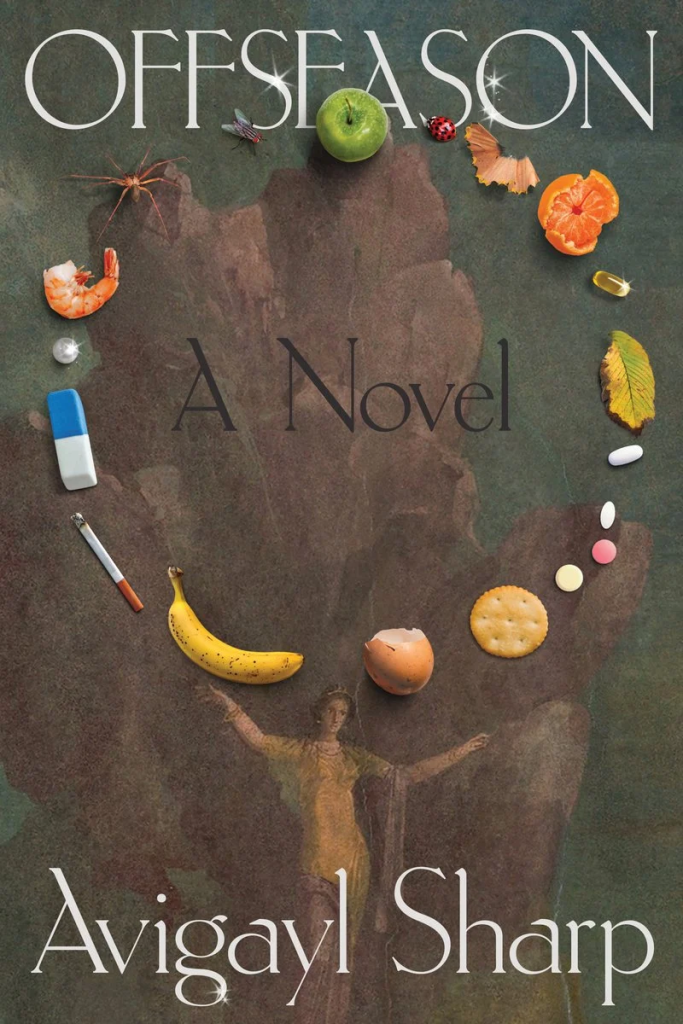
Through her interactions with administrators and students, the narrator’s idiosyncratic worldview comes into relief. She fixates on the victimization of students—those manipulated and adultified by the very authority figures who are meant to guide them—and recalls the “multiple pedophiles and ephebophiles” (adults with sexual interest in mid-to-late adolescents) who ran unchecked at her own high school. At the same time, she nurtures an idyllic admiration for Joseph Stalin, focusing on his difficult upbringing and childhood mistreatment rather than his autocratic reign. Her family relationships are similarly warped; through her contentious (albeit humorous) relationships with her mother, sister, and father, we come to understand how the narrator has been shaped by both personal and intergenerational traumas.
Offseason is a character study, but it’s also a love letter to literature. The narrator teaches Charles Dickens with unbridled (and occasionally inappropriate) excitement. She projects onto a younger female student, and recommends literature as the antidote to her imagined turmoil. She throws herself into books, turning away from the pain and violence in the world, but Offseason still manages to bring it to the surface. In reading, we’re reminded that this contrast—the potential to harm and heal in turn—is the very thing that makes us alive.
I had the wonderful opportunity to meet with Avigayl Sharp in person at Stories and Books Cafe in LA’s Echo Park. We discussed literature, sincerity, and trauma-plotting infamous historical figures over the din of a bustling cafe.
Lennie Roeber-Tsiongas: Like Offseason, your short story “Animals in the Dark” is set at an all girls school. What drew you to this setting? What were you thinking about when you were trying to render it?
Avigayl Sharp: After my MFA, I was working at a girls’ school. I never taught, but I worked as an administrative assistant. There are weird things that obsess you as a writer and that emerge out of necessity. A character needs to have a life, a job, and a material world that they operate within. So in a way I was searching for something that could serve a purpose, and it felt like a very functional decision. At the same time there’s something about the way that large groups of girls operate with one another and with older authority figures that began to really preoccupy me. I was interested in reversals of authority. I also love campus novels, especially weird campus novels. I love The Prime of Miss Jean Brodie. I love Lucky Jim, you know, all these novels where there are teachers behaving in insane and erratic ways.
LRT: It was very interesting to see the books that came up throughout. At one point the narrator recommends Lolita to a student she suspects of being groomed by a male teacher. I was thinking about this canon of literature while reading—Lolita, My Dark Vanessa, Disgrace, among others. Were there other books from that canon that you were thinking about while writing?
To know someone is sort of to unknow them.
AS: Nabokov was big for me. Lolita and Pale Fire, and Pnin was another that I didn’t put in the book because I decided not to directly reference super campus-y novels.
I’m interested in characters who put on a voice and narrativize their own lives to themselves and to the readers. Then, it’s through the cracks and slippages in their story that you come to understand reality. So Nabokov was a huge influence in that way. Muriel Spark was also really important for me and important for the book. She’s both extremely comic and also cold and serious and fierce at the same time.
LRT: I was intrigued by how you handled the older male teacher, Thomas. When the reader learns that he’s taken a leave from the school we’re guided to assume one thing, but he ends up being a different kind of character than we might have initially suspected. In thinking about relationships where abuses of power can happen, was there something you felt was missing from the existing canon that you wanted to show in more complexity?
AS: I mean, it’s an interesting question. One thing that I was thinking about was projection. I’m interested in the way that we can experience harm by seeing harm everywhere. We do live in an extraordinarily violent world.
What was important to me with the Thomas character is setting up this idea that there’s a mystery that you can get to the bottom of. The narrator has this preoccupation with getting to the bottom of things. She also has this conviction that she knows more about the world around her than anyone else, and this fear of the mysteriousness of other people. I wanted to write a book in which one thing that hopefully happens by the end is that the narrator and also the reader know certain characters less well than they do at the beginning—their mystery increases.
LRT: It feels true to life that someone would become more opaque over time, rather than more legible.
AS: I think people can appear transparent to us before we know them, and that to know someone is sort of to unknow them. In a way the book is a classic bildungsroman because the narrator receives a moral education and gains a moral sight, I hope. She has an extreme anxiety and ambivalence around questions of victimhood—who is a victim and who is an aggressor—and a longing to remain on one side of the line. I was also interested in the association of victimhood with moral purity, and as a result, her belief that she can be cleansed by never growing up.
LRT: Instead of teaching multiple books to her students, the narrator spends the whole year teaching Charles Dickens’ Bleak House. Both that book and the topics of her class discussions relate to the city, but Offseason takes place in a small beach town that empties out for half the year. Why Bleak House?
AS: Some things are just the timing. I read Bleak House shortly before I started the novel. I hadn’t read a lot of Dickens, and I ended up having a transformative experience with this book. It was just a book that contained every kind of novel within it. It’s so ambitious. So funny and bizarre. It’s a mystery. It really is every kind of book. And I was thinking about the novel as a form, and I thought that this kind of obsessive commitment to literature at its most excessive would be a funny fixation for the narrator to have. [Bleak House is] a book that’s ironic about a lot of the things that it’s also serious about.
LRT: I have to ask about a figure that looms over this book: Stalin. The narrator’s fixation with him is revealing. I saw connections to her relationship with family and also her volatile one with truth. What were you thinking about by including this fixation and how did it connect to the narrator’s other relationships?
I wanted to write a book about the past that only looked at the present.
AS: [Stalin and the narrator’s mother] are tied inextricably because her mother was born in the Soviet Union. There is an identification with the aggressor, and a fantasy around a type of power that could really bend the world to its will. But of course, she’s also trauma-plotting Stalin all the time. She has a longing to create a story around Stalin that can fit into a narrative arc of victimhood. In addition to the familial history aspect, I think it comes from an inability to confront the failures of the left. The book is interested in communism and utopian socialism, but the narrator also can’t look at failure and loss. She can’t accept Stalin as a figure of extraordinary violence. There are times when she turns toward it and then she looks away because she longs to maintain a fantasy in which the Soviet Union worked. I think she has a desire to map the world in a very rigid way and to maintain her status as a victim in a victim lineage, but one who can forgive. She can be at the bottom, but she also really sympathizes with these figures that she imagines as aggressors. She sympathizes with the pain they feel over the powers and the violence that their families have enacted. When she has to face the complexity of the world, it’s extraordinarily painful for her. She has to reconfigure the story that she’s been telling herself, and she does not want to do that.
LRT: The novel is structured around each semester, but there’s an interlude where the narrator visits home and we see more of her relationships with family and a traumatic experience from her teenage years. How did you write this interlude section and how did you want it to function?
AS: I was very interested in writing about trauma—the experience of trauma, the lingering effects of trauma—without ever giving the readers information about what this traumatic experience is. I wanted to create the sensation of reading to find out what happened, because I think we have a cultural obsession with understanding what exactly happened to someone, how bad was it, what did it mean, etc. I’m interested in psychoanalysis, and in understanding an experience through the symptoms that emerge around it. There’s a way that the preoccupation with what exactly happened can allow us to move away from what is actually traumatic about an experience. There’s also a question of privacy in the book. There are themes that the narrator is too open about, but there are also things that remain hidden.
LRT: Yes, exactly. She doesn’t give us the satisfaction of being able to slot her experience into a hierarchy of pain.
AS: As a reader you only know what she is now. That was really important to me. I knew I wanted to write a book about the past that only looked at the present.
LRT: This is more of a structural question. How did your experience of novel writing differ from writing short fiction? What was the process of crafting this novel specifically?
It’s a book that has a very sincere belief in the transformative power of literature.
AS: It was so different. I spent a long time not knowing if I would ever write a novel because I love short fiction. I think it doesn’t get enough love. As a writer in institutional settings, there’s a lot of you gotta write a novel. I was like, I won’t do what anyone tells me to. The problem is that I actually love the novel as a form so much. When I started to write the novel, I realized how you have to reinvent the form. There’s no container; you have to create the container that your book needs to become itself. There are three sections, the first section and the third section are mirror images of each other, and there’s a hinge in the middle. As I was writing the first section of the book, there came a point where I realized that the narrator had too much control. Certain ways that I figured to structure the book were attempts to throw things in her path so that she was unable to exert this narrative control as strongly. I wanted it to feel like you think you understand the type of book you’re reading, and then it becomes a different type of book, and then becomes a type of different book again.
LRT: It’s funny, at the end I was trying to figure out if the book is hopeful or not. And I think it might be more accurate to say it’s a book that feels open to possibility.
AS: Yes, yes. Maybe open is a better word. It’s definitely a book that’s about the novel, but not just the novel. I think it’s a book that has a very sincere belief in the transformative power of literature.
LRT: There’s a certain amount of repetition in the prose—which is so funny and sharp and pointed, with so much dishonesty and slips of truth—but was that decision to repeat certain images or ideas coming from any particular place?
7 Campus Novels That Break the Mold
Rich kids behaving badly, professors on power trips, and academia at its absolute messiest
AS: Yeah, it was. I do think that the book is constructed musically with leitmotifs. I am drawn to that kind of patterning, but I’m also interested in repetition, compulsion, the sense that we are acting out the same things over and over again and that this can be terrifying and that it can also be beautiful and that the way we change happens through repetitions that vary slightly. We repeat stories about our lives, and we repeat certain lexical ways of speaking. In the second section, there’s a lot of repetition with the family. My hope is that it modulates between being horrible at certain points and also, at other moments, there’s a beauty in that cycle.
LRT: What do you think readers will be most surprised by in terms of what’s on the page vs. the description of the book?
AS: I think it’s both more funny and more dark. But I also think it’s a very sincere book. It’s a comic book, but not ironic.
The post A Campus Novel For a Post-Ironic World appeared first on Electric Literature.




 Bengali (Bangladesh) ·
  English (United States) ·