
 8 hours ago
2


|

|


For decades, the tax code rewarded keeping kids dependent as long as possible. For most high-income families, that’s no longer true. Once a child turns 18, claiming them is worth little or nothing to most readers of this site, while not being able to claim them can unlock a full standard deduction, a family-size HSA, education credits, low-bracket Roth conversions, and more. The goal is to help young adult kids climb the tax independence ladder as far and as early as is practical while being mindful about what it costs. The biggest opportunities fall in a fairly narrow window, roughly ages 18 to 23. By 24, the kiddie tax ends on its own.
Fair warning: this post goes deep into the weeds. I know many of you love that, but the deeper we go, the greater the chance that a rule has changed or that one of us (you or me) misunderstands how it applies to a particular family. I’m not a CPA or a tax attorney, so talk with the tax professionals in your life before acting on any of it.
A Quick Word About Priorities
At White Coat Planning, nearly every client with children lists some version of the same goal: “Help our kids get ahead.” How much help is the right amount to maximize a good head start without ruining them—the sweet spot between Economic Outpatient Care and Die With Zero—is a matter of philosophical differences for each family. This column is simply about tactical minutiae to help those wanting to make the most of the current rules, not about how much help you “should” provide.
My one piece of philosophy on this topic is one you have heard before at WCI. Namely, our first job as parents is to never become an economic burden to our children. We should put on our own oxygen mask before assisting other passengers. The tiebreaker between retirement savings and 529 contributions should be retirement (we can borrow for college but not for retirement). Between our own taxable account and an UTMA, choose our own. From a position of strength, we can offer a strategic hand up rather than a reactionary handout.
Now, into the weeds we go.
Claiming Your Adult Kid Isn’t Worth Much Anymore
Before the Tax Cuts and Jobs Act (TCJA), each dependent came with a personal exemption: $4,050 in 2017, worth about $1,340 a year in tax reduction to a family in the 33% bracket. TCJA zeroed out personal exemptions starting in 2018, and the One Big Beautiful Bill Act (OBBBA) made that permanent.
For most WCIers, the only value in claiming an adult child is a $500 credit for other dependents. Even that $500 credit is gone for married filers at about $410,000 of MAGI (or higher if you have younger children, about $500,000 with two, due to Child Tax Credit rules). Five hundred dollars a year is nice, but weigh it against the case I am about to make for not claiming your adult kid.
While many non-WCIers may still find value in claiming their adult kids as dependents—and even though we are accustomed to thinking claiming dependents is a good thing—my invitation is that once your kid turns 18, go against the cultural grain. Stop trying to keep them as your dependent and start asking how far up the tax independence ladder they can climb.
More information here: The Kiddie Tax 12 Things I Learned From Doing My Own Taxes as a KidThe Tax Independence Ladder
“Tax independence” is really three separate rungs:
Stop claiming them. You leave your child off your return, even if they still technically qualify as your dependent. The education credits can shift to them. (Reason #1 below) Make them a non-dependent. No one can claim them. This unlocks the full standard deduction, a family-size HSA, the student loan interest deduction, and Section 127 plans. (Reasons #2-5 below) Get them out of the kiddie tax. This is a separate test from dependency, and the hardest rung for a college student to reach. It opens the 0% capital gains bracket and low-bracket Roth conversions for their 530A Trump accounts. (Reasons #6-7 below)Most families reach the rungs in order, but each is its own legal test. The difference between Rungs 2 and 3 is where most of the confusion lives, so let’s start there.
2 Tests, Not 1: Dependency vs. the Kiddie Tax
The kiddie tax isn’t a separate tax. It’s a set of rules that taxes a child’s unearned income at the parents’ marginal rate. For a dependent child with no earned income in 2027, the first $1,400 is tax-free, the next $1,400 is taxed at the child’s rate (10% for interest, ordinary dividends, and Roth conversions; 0% for qualified dividends and long-term gains), and everything above $2,800 is taxed at the parents’ rate.
The kiddie tax applies to a child with more than $2,800 of unearned income who has at least one living parent, doesn’t file a joint return, and at the end of the year is:
Under 18; or 18, with earned income that doesn’t exceed half of their support; or 19-23, a full-time student, with earned income that doesn’t exceed half of their support.Notice that whether you can claim the child as a dependent is not on that list. The two tests even define support differently:
Dependency asks whether the child provided more than half of their own support. That can include wages or savings they actually spend on support, loans in their name used for support, and gifted money they spend. The kiddie tax asks whether the child’s earned income exceeded half of their total support, regardless of how it was spent.Put the two tests side by side, and you get four possible outcomes. Just because your child isn’t your dependent doesn’t mean they’re out of the kiddie tax, and the reverse is true, too:
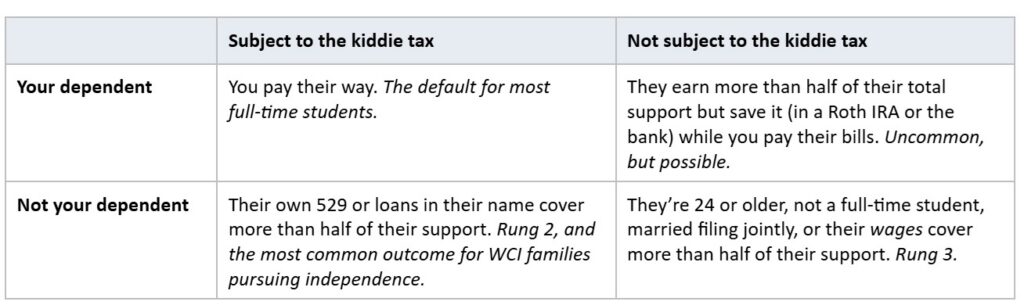
For college students, the bottom-left box is where the action is. Loans in your child’s name or their own 529 (more on that later) can make them a non-dependent, but they stay subject to the kiddie tax until 24 unless their wages exceed half of their total support. At a school with a $70,000 cost of attendance, that takes more than $35,000 of earned income, and few full-time students get there. For most college students, the realistic target is Rung 2, and Rung 3 arrives at 24 (or earlier for kids who aren’t full-time students, who work a lot, or who marry and file a joint return).
Rung 1: Stop Claiming Them
Reason #1 – The Education Credits Can Move to Your Kid
The American Opportunity Credit (AOTC) is worth up to $2,500 per student for up to four years of college. The Lifetime Learning Credit (LLC) is worth up to $2,000 per return for any year of college, graduate or professional school, or job-skills courses. You can’t claim both for the same student in the same year, and with phaseouts starting at $160,000 for married couples, most WCI parents can’t use either.
What many people miss is that your child doesn’t need to be tax-independent to claim these credits. Per IRS Publication 970, if you don’t claim an eligible student on your return (even if you’re entitled to), only the student can claim the credit, and tuition you pay counts as paid by the student.
The catch is that for students still under the kiddie tax rules, the credit only helps if they owe tax. The AOTC is normally 40% refundable (up to $1,000) but not for a student who meets the kiddie tax age, support, and living-parent conditions above, even one with no unearned income. The LLC is never refundable. A student with no tax liability gets nothing.
That’s why the AOTC pairs so well with Reason #7: a Roth conversion from a Trump account or realized gains in an UTMA can create the tax the credit absorbs. One coordination rule to keep in mind is that expenses covered by a tax-free 529 distribution, scholarship, or employer educational assistance can’t also count toward the credit, so pay at least $4,000 of qualified expenses from another source to capture the full AOTC.
Rung 2: Make Them a Non-Dependent
Reason #2 – The Full Standard Deduction
This is perhaps the most valuable, and least discussed, benefit of tax independence. A child who can be claimed as someone’s dependent gets a standard deduction of the greater of $1,400 or their earned income plus $500 [2027]. A child who can’t be claimed gets the full $16,600.
That extra deduction shelters unearned income, too, and it blunts the kiddie tax even for a child who’s still subject to it. The kiddie tax applies only to “net unearned income,” which can never exceed the child’s taxable income. If the standard deduction wipes out taxable income, there’s nothing left for the kiddie tax to touch.
Example: A 20-year-old full-time student with no earned income does a Roth conversion of her Trump account that adds $16,600 of taxable income. Her parents are in the 35% bracket.
If she can be claimed as a dependent: $13,800 is taxed at her parents’ 35% rate and $1,400 at her 10% rate (her $1,400 standard deduction covers the rest), for about $5,000 of federal tax due. If she can’t be claimed as a dependent: Her $16,600 standard deduction reduces her taxable income to zero. Federal tax: $0.The same math applies to UTMA interest, dividends, and realized gains. Each year your child is a non-dependent with no other income, roughly $16,600 of unearned income can be realized without federal income tax. Above that, a child still subject to the kiddie tax pays at your rates, which is why Rung 3 matters.
Reason #3 – Their Own Family-Size HSA Contribution
I’ll assume you already know why HSAs are great. What’s less known is that a young adult covered by your family HDHP, has no other health coverage, and can’t be claimed as anyone’s dependent can open their own HSA and contribute up to the full family limit ($9,000 in 2027). This is completely separate from your own family contribution because your non-dependent kid is now HSA-eligible in their own right. You can even gift them the money, as HSA contributions don’t require earned income.
Do that from 19 through 25 (the ACA lets them stay on your plan until 26), and leave it invested until 65. Those seven contributions could grow to over $500,000 in today’s dollars. It’s tax-free for medical expenses at any age, and after 65, it can be spent on anything as ordinary income without penalty. That’s why Dr. Jim Dahle, WCI’s founder, calls an HSA a “Stealth IRA.”
[AUTHOR’S NOTE: Throughout this post, investment projections assume a 5% real (after inflation) annual return, so every figure is in today’s dollars.]
Reason #4 – The Student Loan Interest Deduction
The student loan interest deduction lets a borrower deduct up to $2,500 of interest on qualified student loans. It phases out starting around $180,000 of MAGI for married couples (around $90,000 single) in 2027, so most WCI parents can’t use it, and a child who can be claimed as someone’s dependent can’t use it either. A non-dependent child with modest income can—even when you make the payments—because interest someone else pays on the borrower’s behalf is treated as paid by the borrower.
Reason #5 – Section 127 Educational Assistance Plans
If you own a business that legitimately employs your adult child, a Section 127 educational assistance plan can pay up to $5,400 in 2027 for their tuition, fees, books, supplies, or student loan payments. The business deducts it, and your child excludes it from income.
The catch is that no more than 5% of the plan’s benefits can go to owners of more than 5% of the business, their spouses, and their dependents, and for this test, a child under 21 is treated as owning whatever their parents own. So, for an owner’s child, the practical sweet spot is 21 or older. They need to be a legitimate employee paid reasonably for real work—not your dependent, and not treated as a more-than-5% owner under the attribution rules. That makes Section 127 a fit for the end of undergrad and for all of graduate or professional school.
Two more hurdles. First, the plan can’t favor highly compensated employees, and your child counts as one at any age, because that definition attributes a parent’s ownership to children with no age cutoff. The plan must be offered to your other eligible employees on a nondiscriminatory basis. For a practice with staff, price that in (it may also be a nice recruiting perk) and know that a plan where your child is the only participant invites scrutiny. Second, it must be a separate written plan, with notice to employees and no option to take cash instead. If your practice has no employees besides your family, get a professional opinion before relying on this; the rules don’t clearly address that case.
Example: A parent in a combined 42% bracket employs their 21-year-old part-time, and the business’s plan pays $5,400 of tuition. Without the plan, giving their child $5,400 takes about $9,300 of pre-tax income. With it, the business pays $5,400 of pre-tax dollars, an after-tax cost of about $3,100. The family saves about $2,300 a year. Just remember that tuition paid through the plan can’t also count toward the AOTC.

|

|


Rung 3: Get Them Out of the Kiddie Tax
A child escapes the kiddie tax when any of these is true at year’s end:
They’re 24 or older They’re 19-23 and not a full-time student They’re 18-23 and their earned income exceeds half of their total support They’re married filing jointly They have no living parentOnce there, all of their income is taxed at their own rates, which opens two big opportunities.
Reason #6 – The 0% Capital Gains Bracket
UTMA and UGMA accounts are irrevocable gifts your child takes full control of at the age set by state law. Many families use them as flexible “20s funds” for a car, travel, wedding, or home down payment. Until your child reaches Rung 3, keep these accounts invested in tax-efficient assets and consider harvesting gains each year up to the amount that avoids parent-rate tax (about $2,800 for a dependent, or roughly $16,600 for a non-dependent with no other income) to keep raising basis. Watch for state tax as you harvest. Jim recently harvested gains in his eldest’s UTMA, and he got frustrated with himself for forgetting he would owe Utah 4.5% of the gains.
Gifting appreciated shares works similarly. Your child assumes your cost basis and holding period, so when they sell, the gain is theirs. A child who is out of the kiddie tax and has no other taxable income can realize up to $67,650 of long-term gains at a 0% federal rate in 2027 (the $16,600 standard deduction plus the 0% bracket, which runs to $51,050 of taxable income).
Example: Parents in the top capital gains bracket pay 23.8% federal tax on long-term gains. They gift stock with a $50,000 unrealized gain to their 24-year-old medical student, who has no other income. If the parents sold, they’d owe $11,900. Their daughter owes $0 of federal tax. That’s $11,900 saved, plus or minus any difference in state tax.
Three caveats:
A gift worth more than $20,000 per donor ($40,000 from a married couple) in 2027 means filing a gift tax return (Form 709), not owing gift tax. Any amount above the $20,000 annual limit simply reduces the giver’s lifetime exemption of about $15.5 million [2027 — visit our annual numbers page to get the most up-to-date figures] Don’t prearrange the sale. If there’s an understanding that your child will sell right away and hand the proceeds back, the IRS can ignore the gift and treat the sale as yours. Once it’s their money, it’s their money. You can hope they use it for what you expected, but it’s not guaranteed.Reason #7 – Low-Bracket Roth Conversions of Trump Accounts
Jim has written about Trump accounts here and here, and we discussed them on the podcast here and here. The short version is that starting July 4, 2026, you can contribute up to $5,000 a year until the calendar year your child turns 18. There’s no deduction, but growth is tax-deferred. Beginning January 1 of the year your child turns 18, the account follows traditional IRA rules and can be converted to a Roth IRA.
Your after-tax contributions are basis, and they convert tax-free. The growth, plus any $1,000 federal pilot deposit or employer contributions, is taxable as ordinary income upon conversion.
If you contribute $5,000 a year from birth, the account could hold $150,000+ by the time conversions are allowed. This is made up of roughly $90,000 of your contributions and $60,000 of taxable growth. Converted and left alone in a Roth, it could reach about $1.5 million by your child’s mid-60s. Not bad for $90,000 of contributions!
The question is how cheaply that $60,000 of growth can be converted, and the answer depends on the rung. Note that Trump account conversions are pro-rated. Each conversion carries a proportional share of your contributions (which come out tax-free) and taxable growth. How much tax is owed depends on dependency and kiddie tax status:
Still claimable as a dependent: Nearly everything above $2,800 a year is taxed at your rate. Non-dependent but still subject to the kiddie tax (Rung 2): Each year, create up to $16,600 of taxable conversion income at $0 federal tax, plus $9,000 more if they’re making the HSA contribution from Reason #3. In AOTC years, the full $2,500 credit is nonrefundable for a student subject to the kiddie tax, so it can absorb the tax on about $7,100 more at a 35% parental rate. Out of the kiddie tax (Rung 3): Fill the 10% and 12% brackets. Creating $68,625 of taxable conversion income in 2027 keeps every dollar at or below 12%, for an average federal rate under 9%. Married filing jointly: A student who marries and files a joint return is out of the kiddie tax early. With a $33,200 standard deduction and brackets twice as wide, a couple with no other income can create about $137,000 of taxable conversion income in 2027 at 12% or less. More information here: My Children’s Inheritance Economic Outpatient Care and the Aspiring Millionaire Next DoorHow to Get Your Child Off Your Return
Are you getting excited yet?!? Are you feeling the deep burn of personal finance nerdiness to get your kid off your tax return? If so, here’s how the dependency rules actually work. A child is your qualifying child only if they meet all five of these tests:
Relationship: Your child, stepchild, foster child, or sibling (including half- and step-siblings), or a descendant of any of them. Age: Younger than you, and under 19 at year’s end or under 24 and a full-time student (no age limit if permanently and totally disabled). Residency: Lived with you for more than half the year (time away at college counts). Support: Did not provide more than half of their own support. Joint return: Didn’t file one, unless only to claim a refund.A child who isn’t your qualifying child can still be your dependent as a qualifying relative. Two tests matter most: their gross income must be under $5,400 [2027], and you must provide more than half of their support.
Remember, the goal here is to fail one of these five tests without landing in the qualifying relative category instead. The easiest test to fail is the support test. In practice, there are two ways out:
Full-time students under 24 must provide more than half of their own support. If they do, you can’t have provided more than half, so the qualifying relative route fails, too. Kids 19 or older who aren’t full-time students aren’t your qualifying child no matter who pays, but they remain your qualifying relative if you provide most of their support and their gross income is under $5,400. Realized capital gains count toward gross income, so harvesting $5,400 or more of gains in a UTMA can clear that bar.What Counts as Support
Support includes food, lodging (at fair rental value if they live with you), clothing, education, medical and dental care, recreation, transportation, and similar necessities. Only money actually spent counts. Wages that your child saves in a Roth IRA or a bank account don’t count as support they provided. Scholarships received by a full-time student are left out of the calculation entirely, which shrinks the total your child needs to cover.
Your child’s share includes their wages and savings spent on support, loans in their own name, and money gifted to them that they spend. That’s one reason UTMA assets and gifted securities are a cleaner source of child-provided support than a parent-owned 529: they’re legally the child’s.
A loan your child is solely responsible for counts as their support, and a Parent PLUS loan counts as yours. Many tax pros treat a loan you co-sign as parental support, too.
The Big 529 Support Question
For many WCI families, tuition is the largest support item, so the biggest question is whether a distribution from a parent-owned 529 counts as support from the child or from the parent. If total support is $50,000 and $25,001 of tuition comes from the 529, is your child now independent?
We don’t know! Isn’t that bonkers? The IRS has never said, and tax pros have pointed out the gap for more than a decade. The CPAs I trust in the WCI community were split when I emailed them to weigh in. Here’s how the two camps see it:
Child’s support: Under IRC 529(c)(2), a 529 contribution is a completed gift to the beneficiary, and the student receives the Form 1099-Q when funds go directly to the school. Parent’s support: 529(c)(2) addresses gift and generation-skipping tax, not ownership. The parent controls the account, changes the beneficiary if they want, and has the ability to take back the money (and buy a boat, if they’re willing to pay the tax and penalty). The conservative position is parental support.For now, this is a call for you and your tax professional. For what it’s worth, when this came up in the comments on our HSA for your kids post, Jim said, “I treat 529s as kids’ money. I guess if the IRS started talking differently, I’d just make them the 529 owner and beneficiary. Then, it’s definitely non-parental.”
Transferring ownership to your adult child raises two questions:
Is it a gift? The IRS hasn’t answered this either! But the original contribution was already treated as a completed gift to the beneficiary, so moving ownership to that same beneficiary arguably transfers nothing new for gift tax purposes. The income tax side is murky, too. As Kitces’ Jeff Levine has noted, the IRS has never addressed it at all, and in practice, plans that process the change without reporting a distribution generally aren’t challenged. Does your plan allow it? Most do. Some permit an ownership change only when the owner dies or becomes incapacitated, and plan rules change. Read your plan’s current program description first.If the transfer is respected for support purposes, it could help get your child to Rung 2 (not Rung 3), and once they own the account, they control it and can do anything they want with it.
More information here: Paying for Financial Planning — Is It ‘Worth It?’ Here’s How Much We Make, Save, and Spend as ‘Moderate Earners’What Tax Independence Costs
Before you rearrange your family’s finances, count what you give up:
Possibly $500 each year. That’s the credit for claiming an adult dependent. For married couples, it’s gone by about $410,000 of MAGI, or later if you have younger kids (about $500,000 with two), since it phases out together with the Child Tax Credit. Head of household status, if you’re a single parent and this child is your only qualifying person. A child who provides more than half of their own support isn’t your qualifying child, which could drop you from a $24,900 standard deduction to $16,600 and narrow your tax brackets. Your HSA’s ability to pay their medical bills. Once they aren’t your dependent, your HSA can no longer pay their medical bills tax-free (their own HSA can). Control. UTMAs, gifted stock, and a transferred 529 become theirs to spend as they choose. Financial aid. Tax independence doesn’t make a student independent for FAFSA purposes (that generally requires being 24, married, a graduate student, or meeting a handful of other criteria). Meanwhile, assets and income shifted to your child, including realized gains and Roth conversions, can count more heavily against aid.For some WCI families, the tax benefits can be substantial. For others, the lost benefits, financial aid consequences, or loss of control may outweigh them. Like most things in personal finance, it’s a trade, not a free lunch.
Adding It Up: 1 Child, All 7 Reasons
So, what’s all of this worth in cold, hard cash?
Meet Emma. Her parents are married physicians with $700,000 of MAGI. They’re in the 35% federal bracket and high enough that their long-term gains are taxed at 23.8%. They own a practice with staff. Emma is born in 2027, so assume that year’s rules stay in place (indexed for inflation) and read every number in today’s dollars. Federal income tax only.
Family A claims Emma as a dependent through age 23 and does things the usual way. Family B transfers the 529 to Emma at 18. Between it and federal loans in her name (which also pay at least $4,000 of tuition a year so she can claim the AOTC), she provides more than half of her own support and is nobody’s dependent from age 19 onward.
[AUTHOR’S NOTE: This is a deliberately optimized example, not a typical family: $700,000 of income, a large taxable account of appreciated stock to give away, a practice with staff that can run a Section 127 plan, and a 529 transfer that lets Emma provide more than half of her own support.]
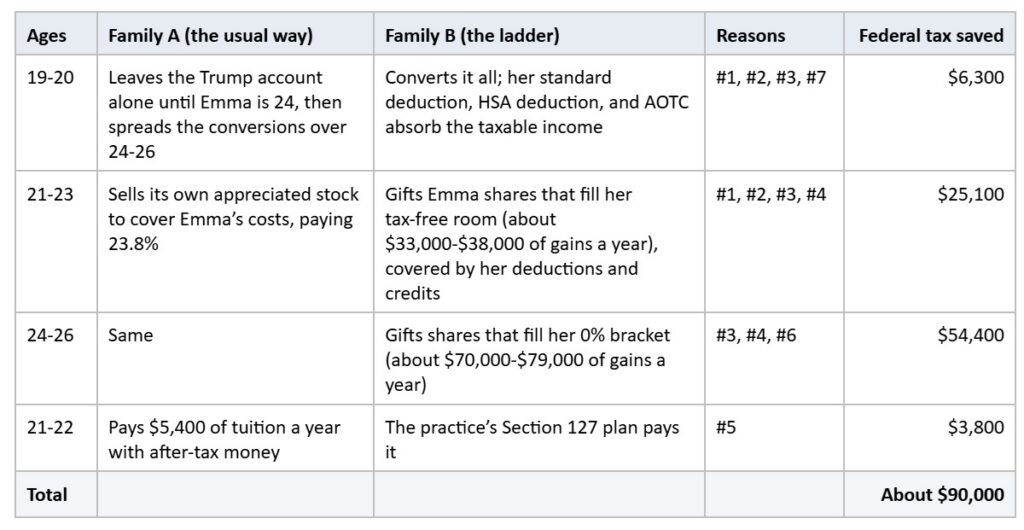
Along the way, Emma contributes $9,000 a year to her own HSA (ages 19-25), works part-time at the practice for $6,000 a year (21-22), and deducts the student loan interest her parents help her pay. Emma decides whether to sell the gifted shares, and she can reinvest what she doesn’t spend.
On top of that, Emma’s HSA ($63,000 of contributions) could grow to about $515,000 by age 65, tax-free for medical costs. That growth isn’t counted above.
In a high-tax state like New York, add roughly another $11,000 of state tax savings.
A few things the table doesn’t show:
Some reasons do their work inside other rows. Each deduction makes room for another dollar of gifted gain that Emma pays nothing on and that her parents would otherwise pay 23.8% on. Take away the education credits, and the family pays about $11,500 more. Take away Emma’s HSA deduction, and it pays about $16,200 more. Take away the student loan interest deduction, and it pays about $3,100 more. More than half of the total doesn’t depend on tax independence at all. Age alone gets Emma to Rung 3 at 24, so the $54,400 row is available to any family. It’s here because most families never use it. The result depends on how much appreciated stock the family can give away. If Emma’s parents gifted only $30,000 of gains a year, the total would be about $53,000. Family B gives up almost nothing in tax. At $700,000 of income, the credit for other dependents is already gone, and head of household status doesn’t apply to a married couple. The real cost is control: Emma owns the 529 and the gifted shares.For Emma’s family, that’s roughly $90,000 of federal tax they don’t pay. Invested tax-efficiently, those savings could grow to roughly $400,000-$500,000 over the next 30-35 years. If Emma has siblings, most of this repeats for each of them. Each child gets their own standard deduction, credits, HSA, and 0% bracket, as long as the family has enough appreciated stock to go around.
Putting It Together
For each child between 18 and 23, work through these questions every year, ideally before December, while you can still change the outcome:
Is your MAGI above about $410,000 (or about $500,000 if you have two younger kids)? If so, claiming this child is likely worth $0. Who pays for college, and from which accounts? That decides whether your child provides more than half of their own support. How much does your child earn compared with their total support? That decides the kiddie tax. Are you a single parent relying on this child for head of household status? What unearned income will your child have this year, and can you match it to the rung they’re on? Is your child on your family HDHP with no other coverage?Getting this right means coordinating two or more tax returns over five or six years, and the answers shift as your kids’ school, work, and accounts change. Whether that feels worth it to you is subjective, and reasonable people arrive at different conclusions.
If you love this as much as I do, I hope this was a helpful framework. If you don’t love this as much as I do but want to hang out with someone that does, that’s exactly why we started White Coat Planning. If you’d like a copilot to map your family’s path up the ladder, we’d love to help.
What do you think? Would it make sense for you not to claim your kids as dependents? What questions do you have about this entire topic?
White Coat Planning (including StudentLoanAdvice.com) is a division of Extraordinary Trust LLC. The information provided is for educational and informational purposes only and should not be construed as personalized financial, investment, tax, or legal advice. Readers should consult with qualified financial professionals regarding their individual circumstances. Financial planning involves risks and uncertainties, and no recommendation can guarantee a specific outcome. For additional information, please review full disclosures.
The post 7 Reasons to Get Your Kids to Tax Independence appeared first on The White Coat Investor - Investing & Personal Finance for Doctors.

|

|







 Bengali (Bangladesh) ·
 English (United States) ·