
 9 hours ago
2

The post 19 Linen Closet Ideas That Survive the First Towel Grab appeared first on Penny Pinchin' Mom.
You organized that linen closet once, stacked everything just so, and felt good about it for exactly one day. Then someone grabbed a towel from the middle of the stack and the whole thing slid sideways. I used to shove mismatched sheets onto one shelf and call it done, until I spent ten minutes every Sunday hunting for a matching pillowcase before guests arrived.
These linen closet organization ideas all tackle the spot where closets fall apart: the grab. A guest set ready to grab means no scrambling when company calls, a second guest bundle covers back-to-back visits without a laundry scramble, and off-season bedding stored in its own pillowcase stops bulky comforters from swallowing the shelf. Shelves, still standing after everyone’s used them.

Top Shelf
1. Guest Sets, Ready to Grab
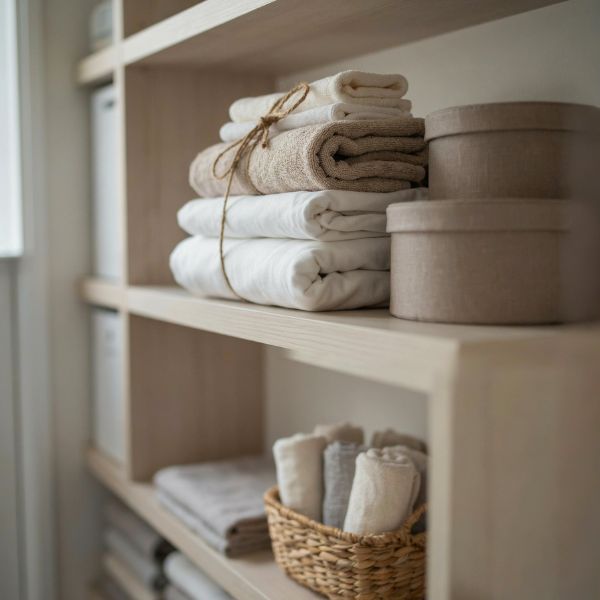
A guest set only works if it leaves the closet in one armload. Bundle a flat sheet, a fitted sheet, two pillowcases, one bath towel and one hand towel together, and park the whole thing on the top shelf where it won’t get raided on a Tuesday morning. $0, because you already own every piece of it.
If you want it to look finished, a lidded fabric bin runs about $8 to $15 at Target or Walmart, though it varies by store. One bundle per guest bed is plenty.
Here’s why it still works in week two: the top shelf sits outside the daily grab zone. Nobody reaches up there for a shower towel, so the set stays complete until a guest actually needs it.
2. A Second Guest Bundle for Back-to-Back Visits
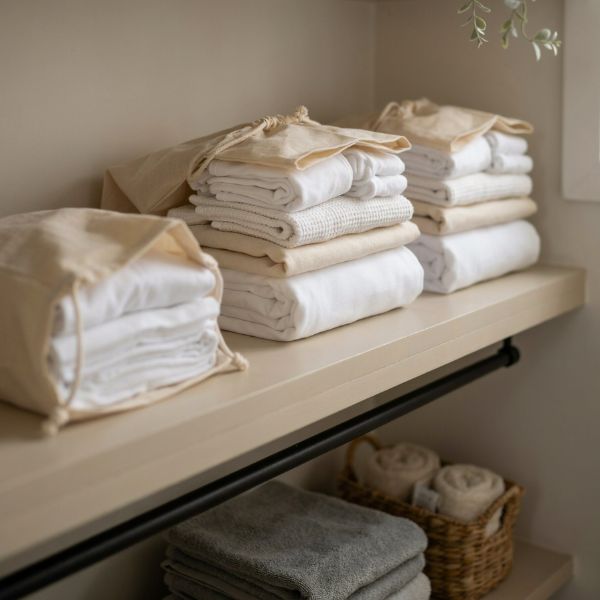
Hosting two rounds of company in one month is where a single guest bundle falls apart. You strip the bed Sunday, the sheets go in the wash, and Wednesday’s guest arrives to a bare mattress and a frantic dryer run.
Keeping two bundles up top fixes it. $0 again, since most of us have an extra sheet set already living somewhere in the house. Stack them front to back, not side by side, so you always pull the front one.
Back when all three kids were home and the holidays meant cousins on every available mattress, I learned fast that one spare set is not a system. Two bundles means the second guest never waits on a load of laundry, which is exactly the kind of thing that keeps a closet functioning after real use.
3. Off-Season Bedding, Stored in Its Own Pillowcase
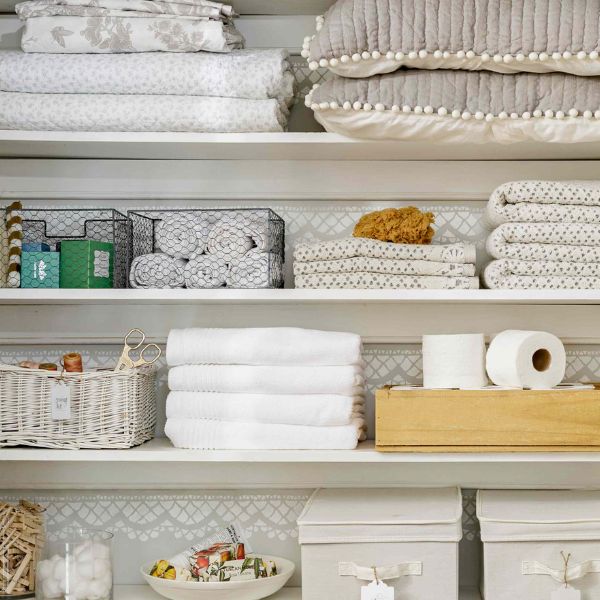
Flannel sheets in July and the lightweight summer quilt in January are both taking up prime real estate for no reason. Fold each off-season set and tuck it inside one of its own matching pillowcases, then send the whole packet to the top shelf. $0, and it uses a pillowcase you’d otherwise be folding into the stack anyway.
Two or three packets is typical for most houses: winter sheets, a heavy quilt, maybe an extra blanket.
The pillowcase does the work a bin would do, keeping dust off and keeping the set from unraveling into loose fabric every time something shifts up there. Six months later, it comes down as one tidy packet instead of four separate pieces you have to re-match. (If the washing and restocking side of this is its own headache, the laundry room organization ideas post covers that cycle.)
4. Zippered Storage Bags for the Bulky Winter Bedding
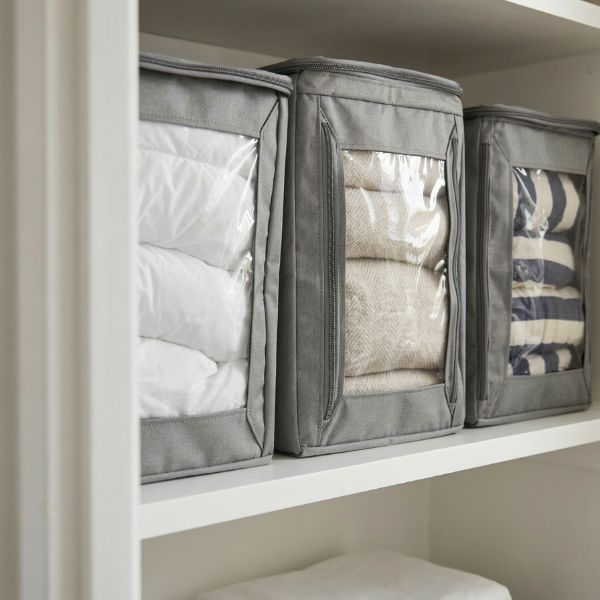
Some things genuinely won’t fold into a pillowcase. A king-size down comforter or a heavy wool blanket needs a zippered storage bag with a clear window, and those cost around $8 to $12 each at Walmart or Target depending on size. Two or three bags handle most households.
Already have one from a move or a mattress delivery? Use it. The point is the zipper, not the brand.
Vacuum-seal versions compress further, but skip them for down and wool, which need some loft to recover properly. A standard zippered bag is the safer choice for anything you actually want to sleep under next winter.
What makes this hold up past week one is simple: a zipped bag can’t spill. Nothing slides off it, nothing gets shoved into it, and the top shelf stays a closed system until the seasons flip.
5. Tag the Bag So You Don’t Have to Open It
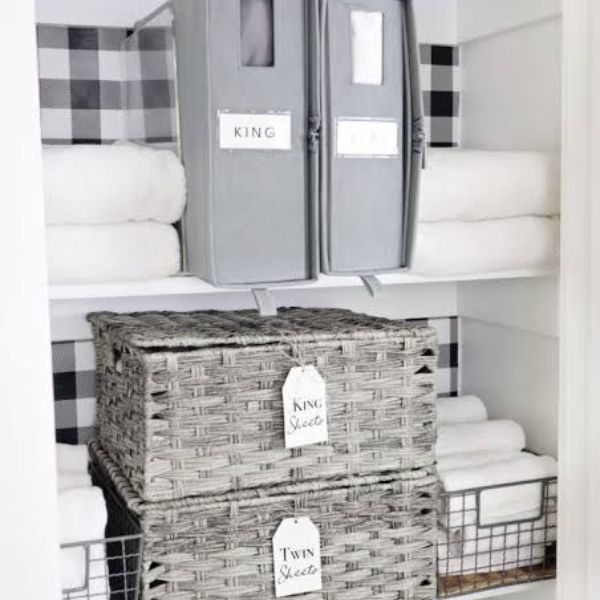
Clear windows help right up until two bags look identical from the floor. Write what’s inside on a strip of painter’s tape and stick it to the front of each bag or bundle: “queen flannel, winter,” “spare king quilt.” $0 with tape and a marker you already have in a kitchen drawer.
Add the room name if the set belongs to a specific bed. Three words is enough. Nobody needs a paragraph on a storage bag.
The reason this one sticks is that it kills the guessing step. You’re not dragging four bags down off the top shelf in October to find the flannel, which means the top shelf never gets emptied onto the hallway floor and restacked badly in a hurry.
6. Shelf Labels So Everyone Puts It Back
Labels are the difference between a closet you organized and a closet that stays organized. Put a strip of painter’s tape on the front edge of each shelf and write what belongs there. $0, and the tape peels off clean when the system changes.
Pick one organizing logic and commit: by bedroom (“Guest Room,” “Main Bed”) or by item type (“Bath Towels,” “Sheet Sets”). Both at once confuses everybody, including you.
Want something that looks less like a moving box? Label maker tape or stick-on chalkboard labels come in under $8 at Target.
I started labeling when my kids were old enough to put their own laundry away, and the labels did the teaching for me. Anyone who can read a shelf edge puts the towel back in the right spot, which is the whole reason the closet survives the first week.
7. Keep the Heavy Things Off the Top Shelf
The top shelf should hold light, rarely-touched things: guest bundles, off-season packets, maybe a spare set of pillowcases. Heavy stacks up high are hard to pull down one-handed, which is exactly how an armload of towels ends up on the hallway floor at 7 am.
$0 to apply, since this is a sorting decision, not a purchase.
If the top shelf in your hallway closet is genuinely out of reach, a folding step stool runs about $15 to $25 at Walmart and tucks flat against the closet wall or behind a bedroom door. One is enough.
Weight placement is what keeps the whole closet stable long term. When the top shelf holds nothing anyone has to wrestle with, nothing up there gets disturbed, and the shelves below stay the ones doing the daily work.
Eye Level
8. One Shelf Per Bedroom
If your closet has four shelves and your house has three bedrooms, assign them. Primary bedroom on one, kids’ or guest rooms on the others, towels on the last. Nothing to buy, so this one is $0.
Small linen closet organization usually means you don’t have a shelf to spare, and that’s fine. Split one shelf down the middle with a divider and run two bedrooms on it, left side and right side, instead of stacking them front to back where the back row disappears forever.
The reason this one survives is that it removes the decision. When someone puts clean sheets away, there’s exactly one correct spot, and it takes about two seconds to find it without opening a single bundle.
9. How Many Sets Do You Need?
The guideline most people land on is two to three sheet sets per bed and two bath towels per person, plus a couple of guest towels set aside. That’s a starting point, not a rule. A household that runs laundry twice a week needs fewer sets than one that does it every other Sunday, and a house with small kids and a stomach bug needs the third set badly.
Cost: $0. This is a counting exercise, not a shopping list.
Doing the math once is what keeps the closet from refilling itself. When you know your number, the extras that have been crowding the shelf become easy to move along, and the stacks stay the height you folded them to.
10. Towel Folds That Stay Stacked
Everyone grabs a towel. Nobody refolds. Fix the fold and the problem mostly goes away.
Lay the towel flat, fold it lengthwise in thirds, then fold it in thirds again, or in half if your shelf is short. You end up with a compact rectangle with one clean folded edge facing out. That edge is what holds the shape when someone yanks the one underneath. Cost: $0.
A towel folded in half out of habit loses its edge fast, and that’s usually the one you can spot leaning sideways in the stack within a day or two.
Towel organization works long-term when the fold does the holding, not the person. A thirds-folded towel pulls out of a stack without dragging the next three with it, which is the whole point.
11. Short Stacks
Four to six towels per stack. Not ten. A tall stack has enough weight on top that pulling one from the middle shifts everything above it, and that’s the moment the whole column slides sideways onto the sheets.
Short stacks side by side hold their own shape, and you can see what’s in each one without lifting anything. Cost: $0, and in a narrow hallway closet it actually gains you usable room, because two short stacks fit where one leaning tower used to sprawl.
This is the one that shows up a week later. A tall stack collapses the first time someone’s in a hurry. A short stack gets pulled from a dozen times and still looks like you folded it that morning.
12. Shelf Dividers From What You Own
Walk through the house before you buy anything. A magazine file turned on its side makes a vertical slot that holds three or four rolled towels upright. A sturdy shoebox does the same for washcloths. And a tension rod mounted low across the back of a shelf gives stacked sheet bundles something to lean against so they stop sliding off the back edge.
Cost: $0 if you’ve got any of those. If you’d rather buy, magazine files cost around $5 to $8 each at Target or IKEA, and two or three will divide a standard shelf.
A tension rod pulled out of a junk drawer works just as well as a matched system bought specifically for the job, which is the whole argument for checking what you already own first.
Dividers hold up because they physically stop the slump. A stack can’t spread into its neighbor if there’s a wall in the way.
13. Towel Rotation
Clean towels out of the dryer go to the bottom of the stack. Used-and-washed ones come back on top of those. That’s it, that’s the whole towel rotation. Cost: $0.
Without it, the same two towels on top get grabbed every single day while the four underneath stay stiff and untouched for a year. Then you’ve got two thin towels and four that feel brand new.
A busy weekend with company pulls towels fast, and rotation is what keeps that bottom layer worth grabbing instead of sitting there untouched.
It keeps working because it’s a habit attached to laundry you’re already folding, not a separate chore you have to remember.
Lower Shelves
14. Bath Mats in Their Own Bin
Bath mats don’t stack with towels. They’re thick, they hold damp longer than anything else in the closet, and they knock a tidy stack sideways the second someone digs underneath for one. Give them a lower shelf and a container you already own: a plastic dishpan, a retired laundry basket, even a sturdy box with the flaps cut down. $0 if you shop your own house. If you’d rather buy, a fabric storage bin comes in under $15 at Walmart or Target. Two or three folded mats fill one bin.
Anything happening on the bathroom side of the door, including the mat currently on the floor, belongs in How to Organize The Bathroom.
It holds up because nobody has to disturb a towel stack to find a mat, which is how most stacks fall apart in week one.
15. Beach and Pool Towels, Bundled Out of the Everyday Rotation
Beach towels are oversized, usually loud-colored, and they ruin the look and the function of a neat bath towel shelf. Pull them out entirely and bundle them on a lower shelf inside a reusable grocery tote you already have. $0. One tote per household handles four to six beach towels, and on pool day the whole bag leaves the house in one grab instead of six separate pulls off a shelf.
Fold them loosely. These aren’t the towels that need a crisp edge, and jamming them in tight makes people avoid putting them back.
Keeping them out of the daily towel organization means the everyday stack only ever holds everyday towels, so it stays the same height all summer.
16. Kids’ Towels at Kid Height
My grandkids are at the age where they want to do everything themselves, and the closet used to fight them on it. Their towels sat on the eye-level shelf, which meant either I came running or they climbed.
Move the kids’ towels to the lowest shelf they can reach, two per child, in an open basket or just stacked bare. $0. An open basket beats a lidded bin here, because a lid is one more step between a wet kid and putting something away.
A child who can reach a towel can also put it back, which is the entire point. That’s the difference between a system that survives one week and one that survives a summer of sprinkler afternoons.
17. Paper Goods and Backups, Boxed and Boundaried
If a 12-pack of toilet paper has ever gone missing behind a stack of pillowcases, this one’s for you. Paper goods expand to fill whatever shelf they touch, and they’re the usual reason the linens underneath get crushed.
Pick the lower shelf farthest from the everyday towels and give the backups a hard edge: a shoebox, a shipping box trimmed down, or a tote bag standing open. $0. One spare pack of toilet paper and two boxes of tissue are a reasonable working backup for most households.
A visible boundary also tells you at a glance when you’re running low, so the restock happens on a normal shopping trip rather than an emergency one.
18. Tablecloths and Napkins, Rolled Instead of Folded
Folded tablecloths crease exactly where you don’t want them, and a towel stack sitting on top presses those creases in permanently. Roll them instead, around an empty wrapping paper tube or a paper towel roll, and lay them flat on a lower shelf. $0, using what’s already in the recycling bin.
Cloth napkins go in a shallow box or a shoebox lid next to them, flat and stacked, eight to twelve to a box.
It holds up because there’s no ironing standing between you and a set table. Nobody re-folds a tablecloth carefully on a Tuesday, but anybody can slide a roll back onto a shelf.
19. Blankets, Rolled on the Shelf
Back when we were hauling the kids camping every summer, the extra blankets lived in whatever grocery bag was closest. Rolling them changed how often we actually used them.
Roll each blanket tight and stand or lay them in a row on a lower shelf. $0. Three or four rolls fit a standard shelf width, and because each roll is its own unit, pulling one doesn’t drag the rest down with it the way a folded stack does.
If the shelf is deep or you’d rather corral them, a woven basket totals maybe $15 to $25 at Walmart or Target.
Rolls survive real use because there’s no “correct” refold to get wrong. Anyone can roll a blanket back into a row.
A Closet That Survives the Grab
That sideways slide after one towel grab isn’t bad luck. It just means the system wasn’t built for real hands pulling from real shelves. Once you organize around the grab instead of around how it looks on day one, the whole closet holds its shape.
Start with Short Stacks if towers keep toppling; try Shelf Dividers From What You Own if things keep sliding into each other, or set up Guest Sets, Ready to Grab if you’re tired of scrambling when company calls. You don’t need new shelves or a weekend project to make this stick. Pick one shelf, fix the thing that bugs you most, and let the rest follow. You’ve got this.
The post 19 Linen Closet Ideas That Survive the First Towel Grab appeared first on Penny Pinchin' Mom.





 Bengali (Bangladesh) ·
 English (United States) ·