

Hello and welcome to another edition of Free Agent! Don't forget to take the trash out this week, or you might end up in Jordan Spieth's way.
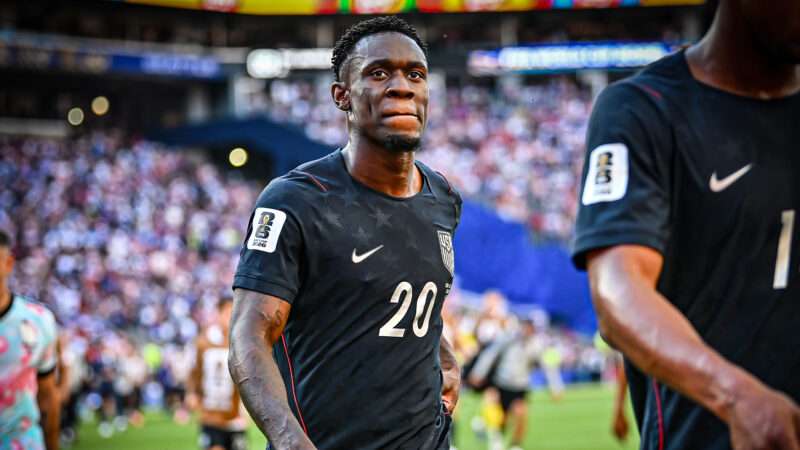
A week after I was licking my wounds because of Germany's upset loss in the round of 32, I'm licking my wounds again today because of America's loss in the World Cup round of 16—again. Unfortunately your humble, pessimistic newsletter writer had this take ready to go in case of a loss. But I think you'll find it to be a long-term optimistic take. At the end, you'll find some talk about the surprisingly dominant topic of the last couple days—the suspended suspension of U.S. striker Folarin Balogun.
Locker Room Links
Not what you'd have guessed for soccer: Republicans are more engaged in the World Cup than Democrats, with 43 percent of the GOP closely following the tournament to Democrats' 38 percent (independents come in at 33 percent). The NBA is testing a new rule at the Summer League games where a single free throw could be worth one, two, or three points depending on the type of foul. Paul Finebaum: willing to sell his soul for the SEC, but not for a Senate run. What does creative destruction have to do with golf? Nobel laureate Peter Howitt explains in an interview with The Golfer's Journal. Elsewhere in Reason, check out this week's episode of the Reason Roundtable: "Can You Hate the Government and Still Love America?" (including some World Cup discussion). Like me, ABS is broken.Fog at Wrigley Field broke ABS pic.twitter.com/d84Wj3itwu
— Jomboy Media (@JomboyMedia) July 5, 2026
How the U.S. Can Win a World Cup
Welp, after eight years of looking forward to hosting the World Cup, two years of excitement about our fancy coach, and weeks of hype about the team's performance against mediocre teams, the U.S. team's time at the men's World Cup ends as it usually does—with a loss in the round of 16.
While others kick off the blame game, let's look forward to the inevitable question: Can the U.S. ever win the men's World Cup, and how can it get to soccer's mountaintop?
In the short term, both the tournament expansion to 48 teams and the expansion of the knockout rounds to 32 teams help second-tier teams like the United States. (Unfortunately, similar expansion on the women's side hurts the top-tier U.S. women's team.)
With 48 teams in the World Cup, the U.S. should never have to worry about failing to qualify again. When the World Cup had 24 teams, the U.S. went 1 for 3 in qualification (and automatically qualified as hosts in 1994), but with expansion to 32 teams, the U.S. went 6 for 7 in qualification. With 48 teams, and surely more to be added in the future, the U.S. should breeze through qualification (unless the process changes from a relatively nonrandom group stage to a more random knockout system). As for the knockout rounds, deciding the champion by a single-elimination process to see who can win five matches in a row benefits teams of second-tier quality, who might be able to get hot and go on a winning streak with a little bit of luck. It's like how March Madness doesn't always reward the best team in the country, but at the very least a pretty good team will win it all (like No. 3 seed Connecticut in 2011, or No. 7 seed Connecticut in 2014, or No. 4 seed Connecticut in 2023—wow, UConn is really lucky).
Of course, the U.S. would still have a better shot at winning if it became a top-tier team. People can, and have for years, debated the pay-to-play youth sports system, the lackluster college-sports pathway, the lack of quality in MLS, or what if America's elite athletes (LeBron James, etc.) played soccer instead of other sports. But two things that would definitely help are more capitalism and more immigration (yes, my libertarian bias is showing).
Consider that each national soccer federation decides how much to pay players for playing in international matches, and how much they get in bonuses for reaching different stages of the World Cup. Also, FIFA has a generously lax system for letting players decide what country they want to play for. The U.S. Soccer Federation could attract better players by simply offering them more money than other national federations are able to pay them.
This would not necessarily help the U.S. get the best of the best players in the world—it's not like the U.S. missed an opportunity to get Kylian Mbappe, Lionel Messi, or Lamine Yamal. The national eligibility rules are lax but not a total free for all—anyone born in the U.S., or with at least one American parent or grandparent, or enough years of U.S. residency, could play for America. The U.S. could have swiped talent like Jonathan David (born in Brooklyn, he instead plays for Canada and scored a hat trick against Qatar) or even Trent Alexander-Arnold (his mother is an American citizen—he plays for England and didn't make their squad, but would almost certainly have been picked for the U.S. squad had he chosen to play for us).
If you expand the American talent pool via immigration, the amount of soccer talent with an American connection increases substantially. Studies have shown that teams with more foreign-born players, and with more diversity, play better. Eight teams in the World Cup had rosters entirely with native-born players—only one of them, Colombia, is still alive (bye bye, Brazil!).
Thankfully, though the narrative around the declining American fertility rate is fair, the U.S. population is still growing more quickly than the top-tier countries competing for World Cup titles (except for England, which is actually growing at twice the rate of the U.S., largely because of immigration). Also, it is increasingly immigrants to the U.S. boosting that growth by having babies at a higher rate than native-born Americans.
Of course, the money the U.S. Soccer Federation would use to woo eligible players with higher payouts has to come from somewhere—but the U.S. Soccer Federation has strong revenue from sponsorship (possibly even stronger than some of the revenues for major soccer countries). This is where more capitalism comes in: As soccer grows, and as the U.S. economy grows while the Europoors can't figure out air conditioning, there will be more and more sponsorship dollars backing the men's and women's U.S. soccer teams.
All of this won't just matter for player recruitment, though—it will also help with coaching recruitment and sporting innovation. One reason Western European countries are so good at soccer is that the sport's best and brightest coaches, analysts, and tacticians are all clustered in the same region. They trade best practices back and forth, but also have the most pressure to compete at the highest level. If the U.S. can weaken that network by bringing more talent here, it will put a dent in one of Europe's most enduring advantages.
None of this is going to happen overnight, and possibly not even within a decade. But if the U.S. again hosts the World Cup in 2038, which I think it will because of our collective wealth and because of FIFA's rules against the same continent hosting the World Cup within eight years, then it will be a massive opportunity for the U.S. men's team to exploit homefield advantage and make a deep run toward a World Cup title.
Should Folarin Balogun Have Been Allowed To Play?
I was shocked to see the all-consuming discourse over whether U.S. striker Folarin Balogun should have been allowed to play against Belgium after picking up a red card in the prior U.S. match. FIFA took what felt like an unprecedented step to overturn the standard one-match suspension for a red card. To neutral fans, it looked a lot like FIFA bent the rules to appease the host country (even though FIFA altered four other match bans that would have otherwise kept players out of 2026 World Cup games—but some of those alterations also looked corrupt).
It's possible this happened because of unprecedented interference from President Donald Trump—no matter that British Prime Minister Keir Starmer also got involved in a World Cup matter this weekend, too. I wish politicians didn't get involved in sports, and perhaps they're just claiming credit for things that FIFA was going to do anyway. Either way, FIFA maintains rules that basically say "We can do whatever we want," including "we can get mad at politicians for interfering if we want."
Meanwhile, Reason's Eric Boehm found it ironic that if Trump had his way on birthright citizenship, Balogun would not be an American citizen—but Trump went out of his way to advocate for Balogun anyway. (For FIFA's purposes, being born here would be enough to make Balogun eligible for the U.S. team, regardless of citizenship). Our colleague Matthew Petti also wrote that Trump's intervention was emblematic of his foreign policy: "He treats cheating as a virtue. And it doesn't even work."
At The Volokh Conspiracy blog (hosted by Reason), law professor Paul Cassell makes detailed and persuasive cases that the red card was incorrect and the penalty was justly suspended.
Most of all, I was amused that everyone got so worked up about something that only slightly increased our odds of winning (not enough, clearly!).
The funniest thing about the Balogun situation is the massive freakout over something that has, according to sportsbooks, increased the US's odds of winning from 52% all the way to 55%.
— Jason Russell (@JRussellMI) July 6, 2026
Perhaps FIFA would be wise to do away with the red tape (sorry for the pun) that started all of this: the practice of automatically tying a one-match suspension directly to a red card. Instead, an independent committee could quickly review conduct after a match and issue suspensions as they see fit. A questionably soft red card like Balogun's need not result in a match suspension—and other conduct that was perhaps missed in the moment could still be punished with a suspension if the committee felt it was warranted.
See how easy that is? Turns out flexibility is better than hard-and-fast rules.
Replay of the Week
I'm officially on Team England—but for now, let's say goodbye to this World Cup's favorite Cinderella story, Cape Verde. (Don't miss the call in Spanish.)
SIDNY LOPES CABRAL DELIVERS AN INSANE GOLAZO EQUALIZER FOR CAPE VERDE IN EXTRA TIME!
JOHN STRONG WITH THE FOX CALL! 

 #WorldCup pic.twitter.com/XtFgO3LdIB
— Awful Announcing (@awfulannouncing) July 4, 2026
That's all for this week. If you're sick of soccer, time to get back into baseball and enjoy the real game of the week, the Martha's Vineyard Sharks against the Mystic Schooners.
The post The U.S. Could Eventually Win a Men's World Cup—With Enough Immigration and Capitalism appeared first on Reason.com.


![BREAKING: Three oil tankers struck in Strait of Hormuz now – [VIDEO]](https://therightscoop.com/wp-content/uploads/2017/12/oiltanker-620x300.jpg)


 Bengali (Bangladesh) ·
  English (United States) ·