
 1 hour ago
7
1 hour ago
7 
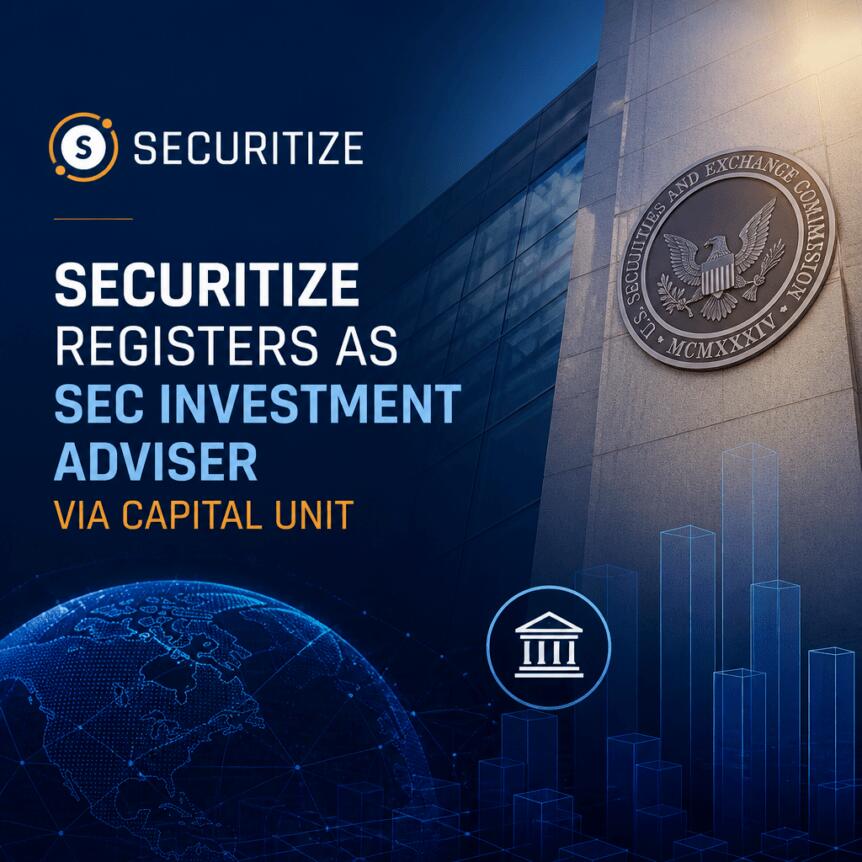
Securitize, the tokenized-assets platform, said its subsidiary Securitize Capital has registered with the U.S. Securities and Exchange Commission (SEC) as an investment adviser—an update that expands the firm’s regulated advisory offering for institutional clients.
The company framed the move as a way to deepen regulated investment-advisory capabilities around onchain capital markets, building on an existing lineup of market infrastructure and financial-services licenses already held within the Securitize group.
Key takeaways
Securitize Capital’s SEC investment adviser registration adds formal advisory capabilities to the firm’s current regulated business stack. The subsidiary previously operated as an exempt reporting adviser and is now subject to additional disclosure, compliance, recordkeeping, and examination duties. Securitize says the change is meant to support institutions designing and managing investment strategies that use tokenized, onchain capital markets. The registration complements existing regulated entities at Securitize, including an SEC-registered broker-dealer, alternative trading system, transfer agent, and fund administration services.What the SEC investment adviser registration changes
According to Securitize, Securitize Capital’s SEC registration broadens how the subsidiary can serve institutional investors. The key operational shift is that the business is no longer relying on exempt status—meaning it must comply with the Investment Advisers Act’s baseline requirements for regulated advisers.
Securitize said the company previously operated as an exempt reporting adviser. Under the Investment Advisers Act, that status generally implies more stringent expectations around disclosure, compliance, recordkeeping, and SEC examination. For institutional participants, those obligations matter because they shape governance, supervisory controls, and documentation standards that regulators typically look for in adviser oversight.
The firm also positioned the upgrade as an expansion of “investment advisory capabilities” tied to Securitize’s broader infrastructure. In practice, that means institutions may be able to engage with Securitize not only as a platform for tokenization and related market services, but also through a more explicitly regulated advisory channel.
A regulated platform built around tokenized capital markets
Securitize said the adviser registration is being added to existing regulated businesses within the group. The company cited an SEC-registered broker-dealer, an alternative trading system, a transfer agent, and fund administration services—capabilities that are often described together in tokenization business models because they can support issuance, custody/transfer mechanics, trading venues, and ongoing fund administration.
By bringing adviser registration under the same umbrella, Securitize is effectively tightening the regulatory alignment across multiple layers of its tokenized-asset ecosystem. That matters for institutions deciding whether they want exposure to tokenized structures under familiar compliance frameworks, rather than relying on a less standardized set of arrangements across different vendors.
Industry scale and the broader push for RWA infrastructure
Securitize also reiterated its market position in the “tokenization” category. The company described itself as the largest tokenization platform by onchain asset value, citing around $4.8 billion in tokenized assets across funds from BlackRock, Apollo, KKR, VanEck, Hamilton Lane and other asset managers.
This context is important: as the real-world assets (RWA) sector continues to develop, competition is increasingly about more than token issuance. Platform operators are trying to combine issuance rails with trading, transfers, and governance that fit within U.S. financial regulation. Securitize’s move suggests it wants to add another leg to that structure—advisory oversight—while keeping the rest of its regulated-services suite in place.
NYSE listing follows a merger, while the stock faces pressure
The registration comes as Securitize’s public-company status continues to play out. Securitize began trading on the New York Stock Exchange under the ticker SECZ on July 2 after completing a business combination with Cantor Equity Partners II.
Following the listing, the article notes that the shares have fallen about 46% from their first-day closing price.
While the SEC investment adviser registration is a regulatory milestone, it may also be read by investors as part of a broader effort to strengthen institutional credibility and expand monetizable services. At the same time, the stock’s drawdown since the NYSE start date underscores that market participants may be watching not only compliance progress, but also whether that compliance translates into durable demand and measurable business growth.
What to watch next
For institutions and market participants, the immediate question is how Securitize Capital’s adviser status will expand real advisory workflows—particularly how compliance, oversight, and recordkeeping will be implemented as clients engage with tokenized strategies. For investors, the next signal to track is whether the additional regulated capability converts into higher adoption, clearer revenue drivers, and continued traction across its tokenized-asset partnerships.
This article was originally published as Securitize Registers as SEC Investment Adviser via Capital Unit on Crypto Breaking News – your trusted source for crypto news, Bitcoin news, and blockchain updates.




 Bengali (Bangladesh) ·
  English (United States) ·