
 4 hours ago
6
4 hours ago
6 
I first encountered M Lin’s writing during our second year of graduate school in the MFA program at Brooklyn College. Her stories were, on my first reading, luminous and unpretentious, chronicling the often conflicting sexual, emotional, and political desires of women from China’s millennial One-Child Generation. Her debut collection, The Memory Museum, is a nostalgic but unflinching expansion of this vision, and a compelling examination of how China’s stratospheric growth has fractured the relationship between its theoretically collective past, uncertain present, and globalized future.
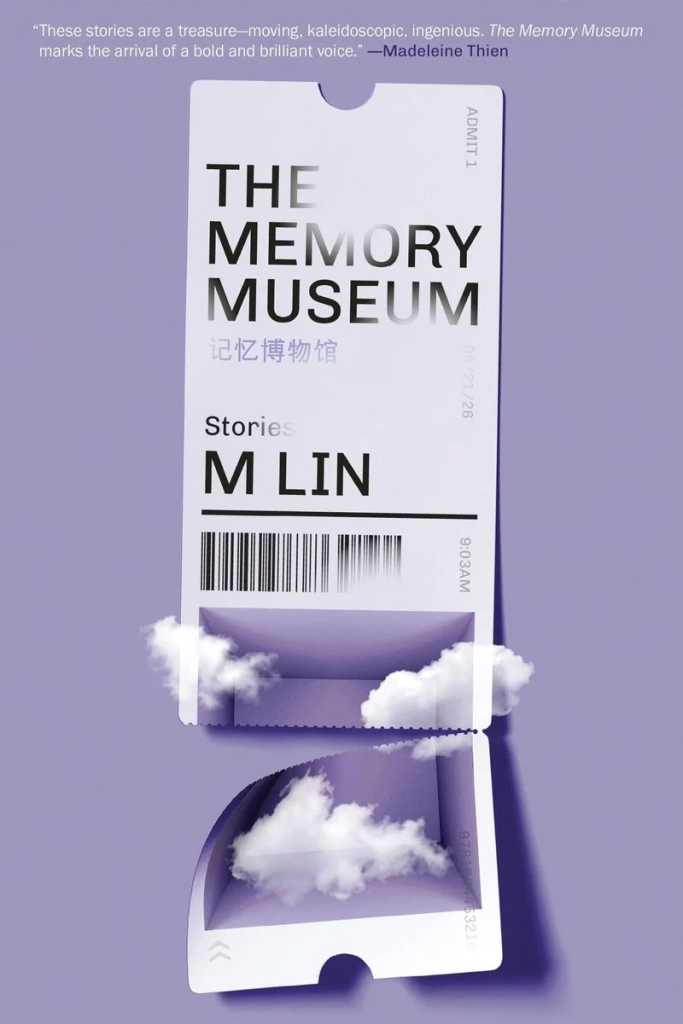
What I was most struck by, when reading these stories, is the way they engage with this fluidity of cultural identity through the shifting and unpredictable lens of female desire. In “Shangri-La,” for example, a young immigrant from a provincial Chinese city embarks on a reckless and passionate affair with her working-class Chinese masseur. In “Magic, or Something Less Assuring,” a woman whose marriage has been severely fractured by political differences during the pandemic goes on a “divorce honeymoon” to Morocco with her husband. And in the collection’s titular story, a young woman living in a futuristic society finds solace in accessing long-buried memories of her late parents’ political activism and tortured past. M’s willingness to discuss these changing perspectives in our interview is a testament to her talents as a writer and interpreter of her own work.
As I sat cross-legged in my apartment on a foggy morning in San Francisco, I called M, who is based in Manhattan, over Zoom. While our conversation was wide-ranging, M and I had spoken earlier about the need to discuss the female perspectives in the collection. The interview reflects our mutual interest in these protagonists’ efforts to forge their own cultural and artistic identities apart from those thrust on them in China and the U.S.
Rebecca Bihn-Wallace: Despite taking place in vastly different settings and over different time periods, these stories feel thematically linked in the way that they center female desire, or lack of desire—whether sexual or creative or political. Can you talk about the role that these kinds of desires play in the collection?
M Lin: I think the way that the characters show up as desiring something comes from their feeling at odds with or unsatisfied by the present, by the lives that they have. In the first story of the collection, “Scenes from Childhood,” a woman is very old, and in her last years of her life, she is alone with no family and all these childhood memories. She has this desire to be surrounded by her loved ones again, and she’s able to reach that through the act of remembering. And in the second story, “Magic, or Something Less Assuring,”the woman obviously wants a divorce, even though she doesn’t know if it’s the right thing to do. It’s not that she doesn’t love her husband anymore, but for other reasons their life can’t go on together.
I think these women’s desires come from their continued engagement with their own lives—which is a weird thing to say, because who is not engaged with their life? But right now, especially in China, there is one part of you that is based on what other people think you should do—your family, your parents, the culture—and the other part is that people in China are retreating from this, almost retreating from capitalism. I think the women [in my stories] are not choosing the path that was expected of them, and they aren’t choosing to give in and completely lose control of their lives. Despite the hostile environment around them, they’re still trying to fulfill themselves in some way. And that is not an easy thing to do in the age of declining mental health and world chaos.
Fiction has the power to ask the what-ifs.
RBW: Can you talk about the role of sexual desire in the stories? For example, “Shangri-La” is an inversion of the stereotypical dynamics between men and Asian women. How do these stories subvert that expectation, and disrupt the perception of what a relationship or a sexual connection between a man and a woman should look like?
ML: It was one of my intentions to write against the stereotypes of Asian women as being docile or submissive, which I think in a sexual context is one of the biggest stereotypes Asian women face. At the same time, Asian men are desexualized, so Asian men and women exist on two extremes of the spectrum. “Shangri-La” is also about the stereotype of richer men having affairs with women of a lesser financial background. I think [the story] is very aware of how its narrative subverts those sexual and power dynamics. But of course, I didn’t write “Shangri-La” in order to do that; the origin of the story is a phenomenon I’ve observed in New York, where often you see that the massage therapists in [Chinese massage parlors] are mostly men. And it’s also about class—I was thinking about how I’m a Chinese immigrant and the people who work there are as well, but in New York they’re rubbing my feet. This is what I think makes fiction so interesting, because it has the ability to imagine what can happen [between people]. Fiction has the power to ask the what-ifs.
RBW: Can we talk about conflicting creative and professional desires in the collection? In “Tough Egg,” there’s this conflict between the narrator’s desire to address fertility in her screenplay, and the reality of male-domination and censorship within the Chinese film industry. She knows that unless she gets a male name attached to her project, it won’t get off the ground. That conflict between the desire to be creative and the sacrifices that it demands interested me, especially when you’re working within a society that’s patriarchal, whether it’s Western or Chinese.
ML: Creativity is of course limited by our experiences and by reality, but it also has the ability to triumph, to go beyond those limits. I think people who call themselves artists engage with their life in a specific way. In the case of “Tough Egg,” the character is working with both the limits of the female body and having to consider motherhood, as every woman does. There are also the limits of censorship and the limits of the male-dominated industry. I think those limits are what makes her work really meaningful for her—she’s finding the space to create freedom for herself. It’s kind of what makes her effort worthwhile.
RBW: Another thing we see in these stories is that politics are really at the root of a lot of the relationship conflicts, particularly in terms of perspectives on the role of the Chinese government during the pandemic, or US-China relations. Can you talk about the role this plays in stories like “Magic, or Something Less Assuring,” or even the political rebellions taking place in “No Prairie Fire Can Destroy All the Weeds”?
ML: The way the Chinese government functions is very much how a patriarch would function in a traditional Chinese family. So the state and the intimate relationships, such as a family or a romantic relationship, are very much intertwined. Even though I believe this is true everywhere in the world, the personal being political and the political being personal is especially true in China, because your life changes overnight if the government has a new policy. A lot of people are apolitical, because they know they can’t really do anything about that.
Creativity is limited by our experiences and by reality, but it also has the ability to go beyond those limits.
And to go back to your question, I think we just live in such polarizing times that even in the U.S., we see couples or families arguing or coming apart because of different political beliefs. I am exploring with these narratives the relationship between what you believe and what or who you love. Can you love a person even if you don’t agree with them? That is a question for individuals and on a much larger scale, for us as a country and as a planet—how we find ways to move into the future without agreeing on every little thing. You know, this is probably what politicians are figuring out on a daily basis. The emotional and intellectual parts of a person don’t always line up.
RBW: On that note, can you talk about the push-pull dynamics that a lot of the characters experience in terms of their relationship to the US and China and the porousness that we see in those national identities? For example, in the story “Yulan,” this passage was really striking to me:
“In the American context, the theories and identity labels Yuchen constantly navigated tired and in many cases confused her. It was not that she doubted them; it was that she believed in them so firmly that she was unable to admit her own feelings, unable to stop performing for herself and others, unable to reconcile her own life with what she believed to be true.”
ML: I think this passage must be true to my own feelings. For anyone who goes between the US and China, or the US and Europe, the political context of the conversations that are happening are very different. The US is the only country that started from immigrants coming from different places; other countries have been around for much longer and are more homogeneous because of that. But in the US, race is a prominent, everyday aspect of life that you have to constantly navigate, especially as a person of color. In China, I never thought about race and people don’t talk about race because everyone is Chinese, even though there are nuances within one’s identity as a Chinese person, and there are a lot of different ethnic minorities. But in the US, sometimes the identity politics can feel exhausting. And being a feminist can feel exhausting because it’s always you against the world. You are trying to live by your beliefs, but the reality is always an uphill battle. And sometimes you fantasize about not having to fight every little fight.
For the character of Yuchen, she has her own career as an artist and photographer, when she could probably just as easily be a mother with a child. [In the story], she’s trying to imagine if she could be happy being that, if she didn’t have her creative impulses and her feminist beliefs. The less you know, the more you might be okay with what you’re given.
RBW: The role of family, particularly in the lives of your female characters, has a duality to it. It’s this source of memory and longing, but in another sense, it’s a source of tension and even a kind of oppression, where the generational differences between the One-Child Generation in China and their parents are stark. For example, in stories “Tough Egg” or in “Lucy,” the expectations that the parents have of the children are just not ones that they can really fulfill. I found the push and pull between asserting oneself as a human being and then functioning within a larger family unit very interesting.
ML: The tension between the individual and the family and the generational differences is something that I think about a lot, and I’m happy to hear that it came through in these stories. Because of how much China has developed over the past three or four decades, the generational difference—the leap from my parents’ generation to mine—is maybe equal to four or five generations in the West. And as I was saying, the parallel between the family structure and the structure of the country means that families have this supreme control over their children, and the government has control over the citizens. Even though this relationship might sound horrible at first glance, to the narrator in “Lucy,” it has its “upsides.” You can feel very taken care of.
RBW: My parents aren’t like this, but with a lot of American parents there’s more of the “sink or swim model” where, once you’re 18, it’s like, “Okay, figure it out.” [Laughs] And that’s just not something that the Chinese seem to do as much.
ML: You feel like you have backup, a safety net, but at the same time, because [your family] is providing you with that, they feel they have the right to comment on everything.
The personal being political and the political being personal is especially true in China
Cutting ties with your parents is a sensational thing to do in China. In the West, if you do that, people might be like, “What horrible things did your parents do to you?” But in China it’s like, “What’s wrong with you? You are not a filial child.” No matter what happened to you or what you did, you’re not allowed to do that. And I think what’s interesting is that—this applies to my personal experience, and my core readership of Chinese people who live overseas—my characters, especially Lucy, are already defying tradition and the family structure by moving to a foreign country. As an only child, that is an even more severe thing to do. How will Chinese family culture and structures adapt to this much more globalized and mobilized world? That’s still an ongoing exploration, and I’m actually working on it in my novel.
China Is Too Big to Fit Inside One Reality
The short stories in Te-Ping Chen’s “Land of Big Numbers” encapsulates the surrealism of modern-day China
RBW: That segues perfectly into my last question. I found “The Memory Museum” to be a very haunting, evocative, disturbing story in all the best ways. And I wondered if you could talk about the future world that you envision in the story, and what potentially inspired the speculative elements.
ML: There are two competing visions for the future in The Memory Museum as a collection. In the first story, “Scenes from Childhood,” in the future that the narrator is speaking from, the world is burning and there’s very little habitable land. China has become its own island, and with the narrator being overseas, she’s not able to contact her family. All of that is maybe closer to my vision [of the future] in real life. But the final, titular story, “The Memory Museum,” envisions a competing and completely different reality for China. It’s a utopian imagination of what China could become, and it came from a place of despair after I wrote the protest story, “No Prairie Fire Can Destroy All the Weeds,” where the last section specifically took the story to a dark place. If that logic were to continue, the path for China is very dark. But in fiction, we have so much more freedom and space; I can imagine not only how badly everything can go, [but how well]. So I just started thinking, what is my best vision of what China could be? So that’s where the speculative context and setting came from. I have been thinking about memory so much, and how memories are being erased by the current government. So I wanted [the setting of “The Memory Museum”] to be the perfect future I could imagine.
The post Reckoning With the Desires of China’s One-Child Generation appeared first on Electric Literature.




 Bengali (Bangladesh) ·
  English (United States) ·