
 22 hours ago
12
22 hours ago
12 
When I call my pal Lindy West, she answers from the road. She’s driving down Interstate 69 (nice) through some rural stretch of Indiana and tells me she just passed a billboard for the Uranus Fudge Factory and General Store, with the tagline: “The best fudge is in Uranus!” Because of course it is.
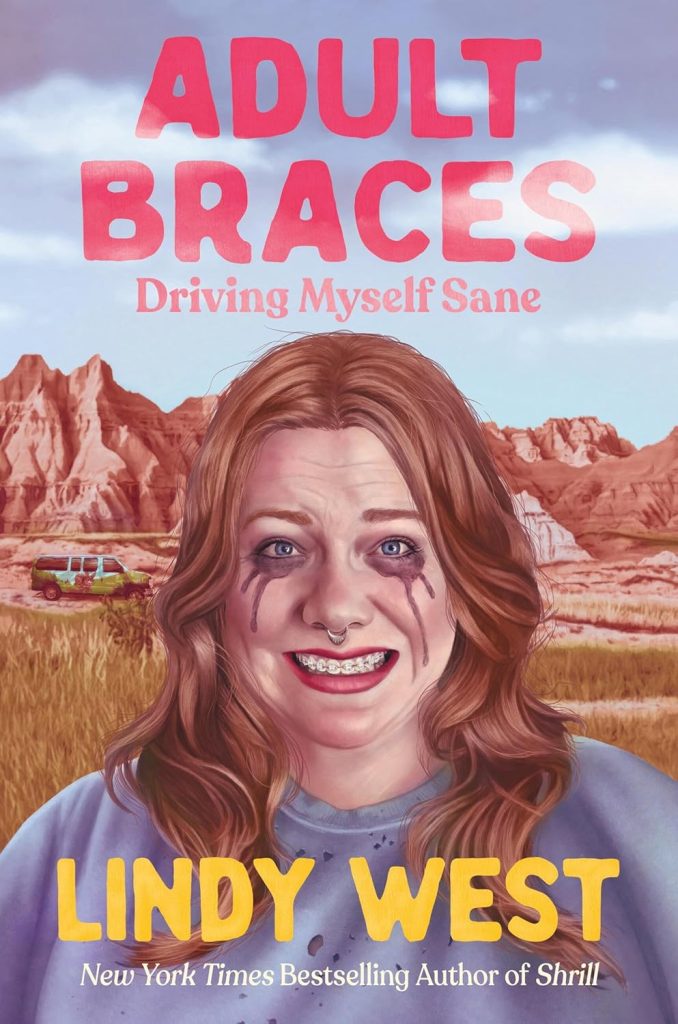
She’s currently on tour, which she’s turned into a full-blown road trip—renting a van and committing to all the requisite rituals of extended life on the road. When we talk, she’s en route to Detroit for the first of two nights of events with our mutual pal—and my biological mother—Samantha Irby.
But this is—by now, famously—not West’s first road trip.
Her new book, Adult Braces, is about an even bigger journey: the one she takes to reclaim herself. After the public triumph of Shrill, she found herself in private crisis—her marriage on shaky ground, depression creeping in, and a sense that the “Lindy” everyone else saw didn’t match the one she actually was. Over the course of the book, West takes a road trip through kitschy tourist destinations (and traps), awe-inspiring natural wonders, and unexpected campground epiphanies. Along the way, she experiments with hiking, journaling, and venturing far beyond her comfort zone. All of this happens while she reckons with what love, fidelity, and partnership mean to her—including her path toward polyamory, which no one is talking about online at all!
What emerges is a memoir that is equal parts laugh-out-loud and deeply revealing: a story of a woman learning to be the navigator of her own life, even when the road—and the heart—is messy, absurd, and full of unexpected detours.
Greg Mania: Lindy, the book is out. You’ve arrived. Again. How does this particular arrival feel?
Lindy West: It feels surreal! I worked on this for so long and now it’s out there and it’s not mine anymore! Readers get to do with it what they will, which is always scary and exhilarating and really, really rewarding.
GM: So much of this book is about reclaiming agency—does letting it go out into the world feel like another version of that?
LW: Kind of. I thought it would be. I expected it to feel easier, more therapeutic, to release it into the world. But I’ve actually found myself feeling a lot more protective and defensive, which I think is a response to the backlash. There’s this dynamic that comes up in conversations like this: I wrote something, and then a lot of people had a mixed bag of takes—some of them really cruel and, frankly, offensive—and many of those people didn’t even read the book. Then, if I say, “Hey, that sucks that you did or said that,” there’s this second wave of people who respond with, “Well, you wrote a memoir and put it out there.” It’s so strange that people think that’s some kind of ultimate gotcha. I can still have an opinion about how people are talking about me. What’s been hard is that so many of those takes strip me of my agency. So it’s definitely been a challenge to stay grounded in the agency I do have and just let it be. I’m trying—and I’m mostly succeeding—because I do believe in myself and in my own strength and autonomy.
GM: You became such a public symbol of confidence and self-possession after Shrill, but Adult Braces starts from a much more vulnerable place. When did you first realize that the “Lindy everyone else saw” and the Lindy you were actually living with had drifted apart?
I can still have an opinion about how people are talking about me.
LW: Probably in 2020, when we were all trapped at home with our thoughts. I started going to therapy in 2019 but I was still in crisis mode at that point, because so many different parts of my life were broken. It wasn’t until lockdown that I had a chance to sit with what I’d learned and begin to try little experiments to feel better and more whole. Things like hiking, journaling, meditating, gardening, building a new routine, all the cliché stuff we were doing. Turns out, that stuff really works!
GM: When you say “that stuff really works,” what do you think it was actually doing for you?
LW: I think it was getting me out of my head—and out of my phone and my computer—and back into my body. Not to sound like someone who drones on about how phones are bad, because I love my phone; it’s a dear friend of mine. But there’s this vortex—honestly, like the one I’m in right now—where what’s happening on your phone feels like it’s just sucking you in. Being outside, using my body, getting dirty, feeling aches and pains, writing on paper—just being a person in the physical world—feels like such potent medicine for getting out of my head, which can sometimes be a scary place to be. There are certain things that just ground you in who you really are. It sounds like a cliché, but it’s true—and it works.
GM: Did it ever feel like you’d lost yourself—or like you’d outgrown a version of yourself that used to fit?
LW: I definitely lost myself, but I don’t feel like I outgrew an old version of me. Maybe I outgrew an old version of my life. But it’s more like I’d never bothered to stop and think about what I wanted my life to look like. And that’s because I didn’t know who I was; I wasn’t confident, and I didn’t necessarily think I deserved to choose my own life. I was like, “You guys pick first, I’ll take whatever falls out of the truck!” I always looked to other people to tell me who I was. I still do it. In some ways releasing a book and waiting for the response is a version of that, which I have to fight. Because I think at some point I realized that looking externally for validation or self-definition never works. You get trapped forever in the question, because the only person who can answer it is you.
GM: Once you set out on the road trip, you started recording voice notes to yourself along the way. What did speaking your thoughts out loud—in real time—give you that silent reflection didn’t?
I always looked to other people to tell me who I was. I still do it.
LW: It made it much harder to do any posturing. Even in my journal, I sometimes find myself imagining someone else reading it and then I pull back or try to sound more sophisticated than I am. Recording the voice memos—which I was fairly certain would never be heard again, even by me, because I’m lazy and who wants to wade through 20 hours of rambling voice memos?—while driving the van and navigating and looking at bison, I didn’t have the motivation or the bandwidth to try and be cool. And I got such a special, unvarnished account of the trip as a result.
GM: You write about interrogating your own patterns—especially around codependency and your initial resistance to nonmonogamy. What surprised you most about the beliefs you realized you’d be carrying into your marriage?
LW: I was really surprised to realize how much I relied on control to feel safe. Even that paradigm, which of course you learn in therapy, of feeling safe versus unsafe emotionally—none of that had ever occurred to me before. I just took it for granted, and truly never even identified that I was doing this, that part of a relationship is trying to push or guilt or condition your partner into being the person you want. I think that’s so normalized. Obviously you have to have boundaries and conversations about how you expect to be treated, but that’s not what I’m talking about. I’m talking about, like, feeling panicked because your partner hasn’t texted you back in an hour so you call them crying until they pick up, even though you know they’re just out living their own life with their own friends, hobbies, whatever. That’s an attempt to clamp down on that person’s freedom and make them feel bad for having a real life outside of you. It also takes you away from yourself. It’s a scary place to live, yet we’re taught that it’s what safety looks like. I’ve never been more anxious and scared than when I was codependent. I have been surprised to learn how much I value freedom, both for me and for my partners.
GM: When those old instincts still show up—that panic, that urge to reach for control—how do you respond to them now?
LW: It’s still a struggle, for sure. But what’s helpful now is that I know what these patterns are, and I know what they look like. I used to trust myself completely as a reliable narrator—I trusted the voice in my head. Now, when those feelings start to come up, I write them down. It’s so much easier to look at them and see what’s actually going on once they’re outside of my head. Even now, during this tour and with the backlash happening, I can see the signs. There are things in the book where I list the stages of my deterioration—and I notice them. Like, even yesterday, I realized I hadn’t showered, and it was like, okay, I know what this is. It becomes easier when I just push past that initial resistance. All I really have to do is push through a hard moment—a barrier—not solve some huge mystery. The obstacle has already been identified, and the treatment is known. I’m never going to be perfect at it, and I don’t think that should be the goal. The goal isn’t to feel great all the time or for nothing to ever be wrong—the goal is to try to take care of ourselves.
GM: You’ve talked about feeling a responsibility to others as a public figure—that changing your body might feel like a betrayal. How did you come to the place where using your body for yourself became the key to moving forward?
I was really surprised to realize how much I relied on control to feel safe.
LW: It helped, again, that I wasn’t working much during Covid. Just home alone with my body. And almost out of boredom I started to wonder, what if I . . . went kayaking? Went on a real hike? Planted a garden and shoveled manure all day? All kinds of things that I’d been afraid to try because I didn’t know if my body would fail me or embarrass me. But then all of a sudden it was lockdown and no one was watching me, and I was in therapy and my body and brain were becoming more and more integrated, rather than two faraway strangers. And it became so obvious—sitting perfectly still forever, out of fear, doesn’t do me any good. And if it isn’t good for me, why would it be good for readers who are looking to me for guidance or commonality or inspiration?
GM: Since finishing this book, are there any conclusions you arrived at while writing that you still find yourself wrestling with?
7 Books That Will Change the Way You Think About the Road Trip Story
Keely Shinners, author of “How To Build a Home for the End of the World,” recommends adventures and revelations found on a long drive
LW: Oh, a million! I still don’t know what I’m doing! A foundational ethos of this book is that I know freedom and healing are a process, and I’m sure I’m going to learn a thousand new earth-shattering things in my next decade of life, and then I’ll have to rewrite myself all over again.
The post Lindy West Is Reclaiming Her Agency appeared first on Electric Literature.




 Bengali (Bangladesh) ·
  English (United States) ·