

Hello and welcome to another edition of Free Agent! Get creative this week, and name something new after something you love.
I'm a little bit sorry for going on a rant about sports, antitrust law, and federal enforcement—but not that sorry. Enjoy the ride. There are some thoughts about golf when you get to the end.
But first, a quick congratulations to Sage Timoteo, the winner of our men's bracket challenge. He beat out eight other participants who had Michigan winning, and finished in the 99th percentile of ESPN's many brackets. Congratulations, Sage!
Locker Room Links
Wisconsin's government is legalizing sports betting, but also spending millions in taxpayer dollars on the University of Wisconsin–Madison's athletic department. Hillsborough County wants to spend federal disaster funds on a shiny new stadium for the Tampa Bay Rays. "These funds are generally earmarked to rebuild housing & infrastructure that support low-to-moderate income populations." Some Ohio Republicans are trying to drastically restrict sports betting. "How hackers could disrupt the World Cup" The NBA debate continues, with some people saying most of the games don't matter and the regular season basically acts as preseason to the playoffs, while others say the numbers are actually fine and, in the long-term, good shape. WNBA Commissioner Cathy Engelbert was asked how long she thinks she'll be in that position—something frequently asked to every commissioner—and turned it into a sexism debate. A woman is the new interim coach at Union Berlin, making her the first female head coach in Europe's five top male soccer leagues. A Canadian quarterback on the Birmingham Stallions roster is caught in immigration visa hell and has now missed the season's first three games. Coach A.J. McCarron (remember him?) even asked Sen. Tommy Tuberville (R–Ala.) for help. What used to be normal coaching behavior in youth sports is increasingly considered "boundary violating." God bless the fine folks at FOIAball and Sickos Committee for doing the important work of finding out how much colleges are charging for mascot appearances and how much money they're making off those appearances. Elsewhere in Reason: "Without Tariffs, Inflation Would Have Dropped to Pre-Pandemic Levels During 2025" Sign me up (just kidding, my cat would hate this): Take Meowt to the Ballgame
  pic.twitter.com/ZhxKPDyasj
— Norfolk Tides (@NorfolkTides) April 8, 2026
Is This Why Trump Is Investigating the NFL?
If someone spurned you on numerous occasions, and you later ended up as president of an excessively powerful government, you might be tempted to get even by siccing your regulatory bulldogs on them. That doesn't mean you should.
"The Justice Department has opened an investigation into whether the National Football League has engaged in anticompetitive tactics amid complaints that watching football has become too expensive, according to people familiar with the situation," The Wall Street Journal reported in an exclusive last week. "The nature and scope of the investigation couldn't immediately be learned. Spokesmen for the Justice Department and the NFL declined to comment."
This comes on the heels of the Federal Communications Commission (FCC) requesting comment from the public on sports, broadcast rights, and streaming, with the request itself "a big blow against streaming services that aren't connected to a broadcast TV network (Netflix, Amazon Prime Video, Apple TV, etc.)" as I wrote in March.
The Trump administration, it seems, is not so subtly pressuring the NFL to forgo streaming dollars or face government regulation. (To be fair, FCC commissioners are appointed by the president, but the commission is technically independent from the administration—although the current chairman apparently doesn't feel that way.) Could it be because President Donald Trump tried to get into NFL ownership several different times and came up short?
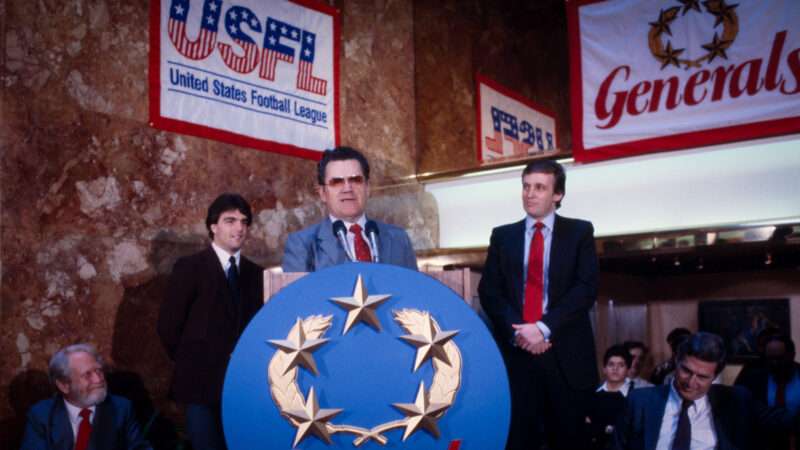
Here's the timeline of Trump and the NFL. Trump first tried to buy the Baltimore Colts from Jim Irsay in 1981, and possibly again in 1983. Then in 1984, the Cowboys went up for sale and Trump expressed interest, but decided to focus his football energies on the brand-new United States Football League (USFL). Trump had purchased the New Jersey Generals in 1983. In 1985, the USFL sued the NFL on—what else?—antitrust grounds. He hoped the lawsuit would lead to the leagues merging, with a triumphant Trump emerging as an NFL owner. The USFL won the case, but was only awarded a whopping $3.76. Apparently the check was never cashed. Trump again expressed interest in buying the Cowboys in 1988, but was unsuccessful. When the Patriots were up for sale in 1988, Trump actually "sort of…[had] the first chance to bid on the team," according to Newsweek editor Tim Marcin, but didn't want their debt, so he passed. Almost two decades later, Trump still wanted a football team, so in 2014 he bid $1 billion to buy the Buffalo Bills. But Terry Pegula got the team instead by paying $1.4 billion. Trump later said, "I bid on that team half-heartedly because I really wanted to [run for president]." (I, for one, wish Trump were currently the owner of the Bills instead of president, despite some affection for the Bills). Then, during the first Trump administration, the squabbles were more public: Trump got mad about players kneeling during the national anthem, which also led to controversies over Super Bowl champions visiting, or not visiting, the White House.
The public relationship between Trump and the NFL seems warmer during his second administration, with Trump attending multiple games, including Super Bowl LIX. But he also keeps complaining about the new kickoff rules. Perhaps the kickoffs, and not decades of failed ownership attempts, are what's really behind the Trump administration's pressure against the NFL?
Antitrust Insanity
In any case, the Justice Department's investigation and FCC request for comment might both come to nothing, and the league would fight back against any legal charges or regulatory actions.
"One central defense is that the NFL won a trial in 2024 over this topic," writes Sportico legal analyst Michael McCann, referring to the antitrust lawsuit over the league's Sunday Ticket product. The league initially lost that lawsuit, but a federal judge tossed out the jury verdict (though a federal appeals court may rule differently in the near future). McCann continued: "Another [defense] is the U.S. Supreme Court may regard pro sports leagues as unique joint ventures where individual teams should receive deference in how they collaborate."
As that last quote implies, the real issue here is that the league has 32 teams that are technically separate business entities. In theory, those businesses are supposed to be competing against each other instead of colluding.
The whole thing is a great example of how absurd antitrust law has gotten. The NFL is in the midst of negotiations with TV networks and streaming platforms for the broadcast rights of its entertainment product: football games. Like any other private, for-profit enterprise, the NFL wants to maximize its profits from those negotiations. If the Justice Department and the FCC are going to apply regulatory pressure on the NFL for doing that, it's basically attacking the foundation of the capitalist system.
The law the NFL is alleged to have broken is the Sherman Antitrust Act. This was passed way back in 1890 because people were concerned about the power amassed by John D. Rockefeller's Standard Oil, which controlled the vast majority of oil refining in the country. If one company controlled so much oil, the theory was, then it could charge obscene prices for the kerosene that people used to light their homes every night.
To go from that to using the same law to punish the NFL (or most other antitrust litigation targets) is crazy.
Legislators at the time basically had a do something! mentality that resulted in a bad law. "It was loosely worded and failed to define such critical terms as 'trust,' 'combination,' 'conspiracy,' and 'monopoly,'" according to the National Archives. The hope was that courts would figure all that out. At first, they refused to trustbust, but over time courts have seized opportunities to establish confusing, complicated precedents on market narrowness and competition.
The NFL is not a monopoly or a necessity. Even in the narrow industry of football entertainment, it competes with college football, the Canadian Football League, and the United Football League. In sports entertainment, it competes with the NBA, NHL, MLB, and every other league that is broadcast somewhere, sometime. In entertainment, it's competing with everything else trying to grab our scarce time and attention spans: movies, TV, books, video games, social media, and Sunday afternoon naps. The league dominates many of those competitors, yes, but it still competes with them on price and quality.
No one is entitled to watch the NFL. If someone decides a game is too difficult or costly to watch, no one dies or suffers anything other than very minor entertainment-related harm. (The league, it's worth noting, is actually one of the easiest to watch, "with over 87% of our games on free, broadcast television, including 100% of games in the markets of the competing teams," according to a league spokesperson.) Watching sports on broadcast TV instead of streaming platforms is not some sacrosanct human right that needs to be protected by the federal government. As we prepare to celebrate the 250th anniversary of America's founding, it is mind-boggling to be at the point where "Should a sports league be allowed to put more games on streaming platforms?" is a real question that the Justice Department and the FCC are spending their time on.
Should Golf Be Harder?
Believe it or not, deep inside the golf world some people are trying to make it even harder to play golf—for both professionals and weekend hackers.
Thanks to better technology in drivers, swing analysis, and athleticism, players are hitting it farther than ever. Some of golf's various rulemakers want to deal with that with the "rollback," basically telling ballmakers to design balls that don't go as far (roughly 10–20 yards less for a top pro).
What's funny is that scores on the PGA Tour haven't changed all that much in the last two decades, but that's because courses are lengthening their holes to compensate. There's only so much space for courses to expand into. Augusta National Golf Club, for example, has had enough of expansion.
"Until recent years golf has been a game of imagination, creativity, and variety. The game has become much more one dimensional."
Fred Ridley spoke about Augusta Nationals full support of the golf ball rollback during his press conference introduction. pic.twitter.com/xw5oW8KRHb
— GOLF.com (@GOLF_com) April 8, 2026
On the one hand, I get it. The more players drive the green on par 4 holes, the more time midrange irons spend in the bag collecting dust. If courses can't go longer, players could start mauling course records set by the game's longtime greats. On the other hand, chicks (and everyone else) dig the long ball. Watching golfers do things that have never been done before would bring new fans in. If every pro has the same access to the same drivers, then who cares? It's not going to work out every time.
Aldrich Potgieter averages 325 off the tee on the PGA Tour. Jose Maria Olazabal averages 268 off the tee on the senior tour.
JMO beat him by 10 today.
On the front nine.
— Kyle Porter (@KylePorterNS) April 9, 2026
What seems like a huge mistake is applying the rollback to amateurs just trying to break 100. Golf is hard enough as it is. When people watch Rory or Scottie save par on a tough hole, they want to think they could do that too, or at least put a respectable score together from a closer tee. But the governing bodies have this flipped—it's the playing pros of the PGA Tour and teaching pros at the PGA of America that don't want a rollback, while the USGA and the R&A (who technically "govern" most of the world's casual golfers) are the ones pushing for the rollback.
I have plenty more thoughts on golf and The Masters—if you want to chat, feel free to send me an email at [email protected].
Replay of the Week
Who says small ball is dead? The Nationals took a 9th-inning lead against the Brewers on Friday thanks to three bunts in the same inning, none of which resulted in an out.
That's all for this week. Enjoy watching the real game of the weekend—not the NBA playoffs, but the Wellington Saints against the Canterbury Rams in New Zealand's National Basketball League.
The post Is Trump Investigating the NFL Because He Failed To Buy a Team So Many Times? appeared first on Reason.com.




 Bengali (Bangladesh) ·
  English (United States) ·