
 1 day ago
1
1 day ago
1 


|

|


A number of investors recently have been shocked to receive notice from their mutual fund firm that their S&P 500 index fund or total stock market fund is no longer considered a diversified investment. In general, being diversified means that if one or even a few of your investments tank, it's not going to dramatically reduce your wealth level.
When it comes to mutual funds, a diversified fund “is an investment fund that is broadly invested across multiple market sectors, assets, and/or geographic regions.” In fact, an Investopedia article says, “Index funds are prime examples of diversified funds.” I mean, a total stock market fund might have more than 3,500 stocks in it. That's an awful lot of diversification, no? The opposite of a diversified fund is a focused or a sector fund. And those funds are required to tell you they are not diversified. Well, now firms offering S&P 500 and total stock market index funds are also required to tell you they are not diversified.
Where does this requirement come from? It comes from the Investment Company Act of 1940, the most important legislation in the mutual fund world that was passed due to the events that occurred in the Great Depression. Basically, the technical, legal definition of a diversified mutual fund is the 75-10-5 rule.
“The 75-5-10 rule is a diversification guideline for mutual funds under the US Investment Company Act of 1940, requiring at least 75% of assets in various securities, limiting investment in any one issuer to no more than 5% of fund assets, and restricting ownership to less than 10% of any single issuer's voting stock to qualify as a diversified company.”
Due to the massive outperformance of the Magnificent 7 stocks in the last few years, that is the case for even broadly diversified US index funds. Take a look at the portfolio composition of VTSAX, according to Morningstar as of March 19, 2026:
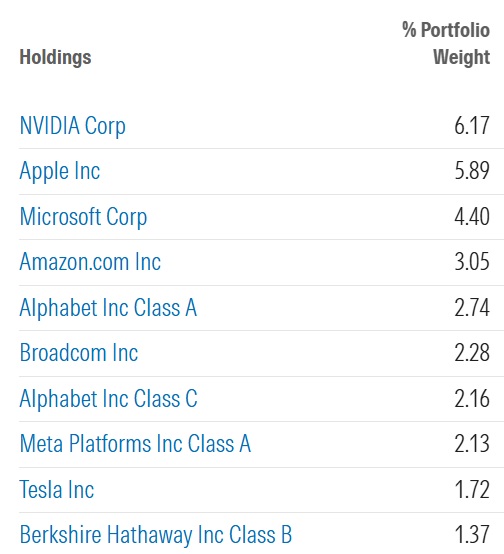
The top 10 make up 31.9% of the capitalization of the entire fund. Three of the stocks are more than 4% of the fund, and it's no longer diversified by the legal definition of a diversified mutual fund. You can either follow the index or you can be legally diversified, but right now you can't do both. So, the index funds have all decided to follow the index and then give you notice that the fund is no longer diversified.
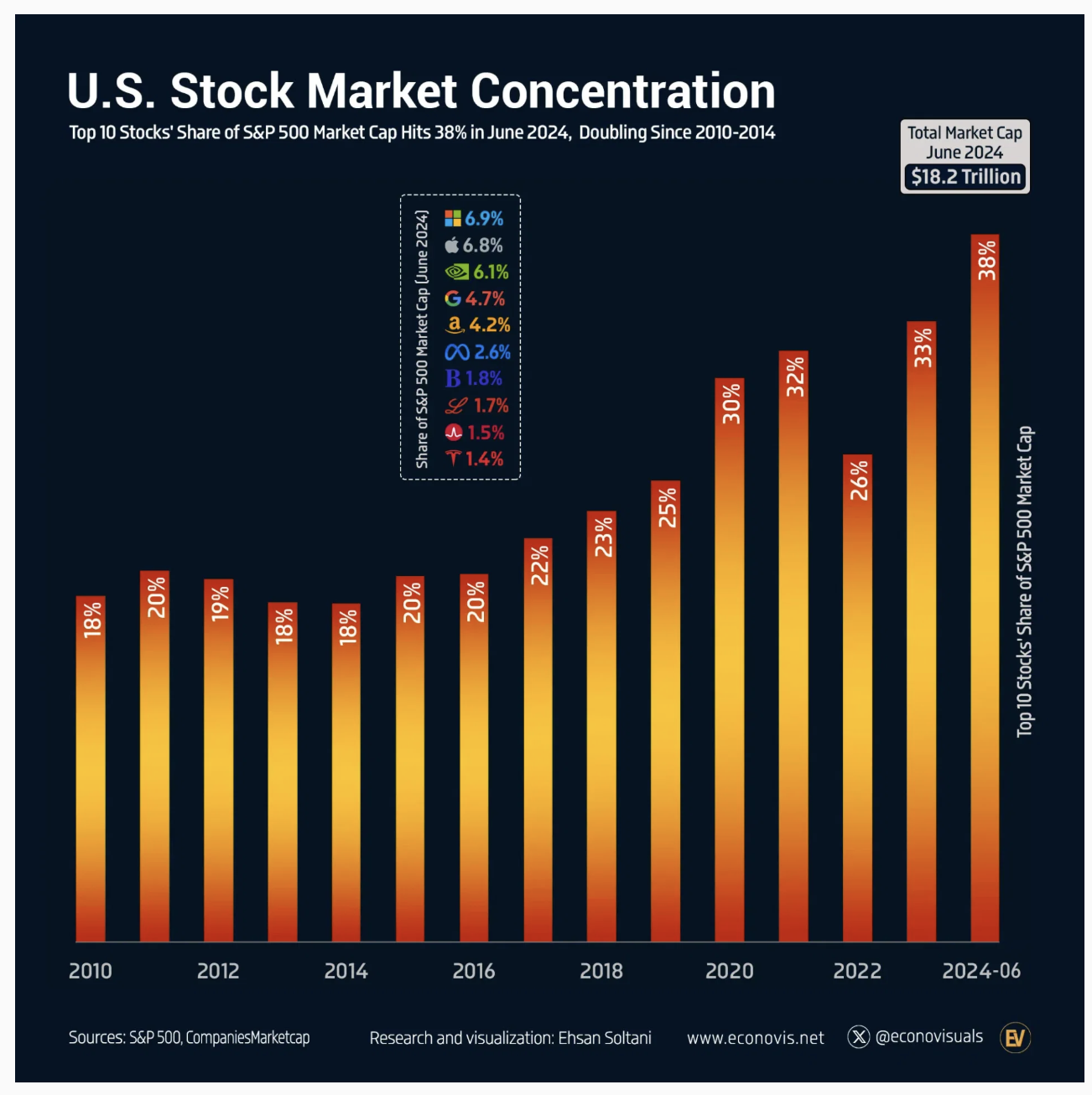
Is This Stock Market Concentration Historic?
How concentrated has the market been historically? It turns out there are many ways to look at this. Voronoi displays it like this:
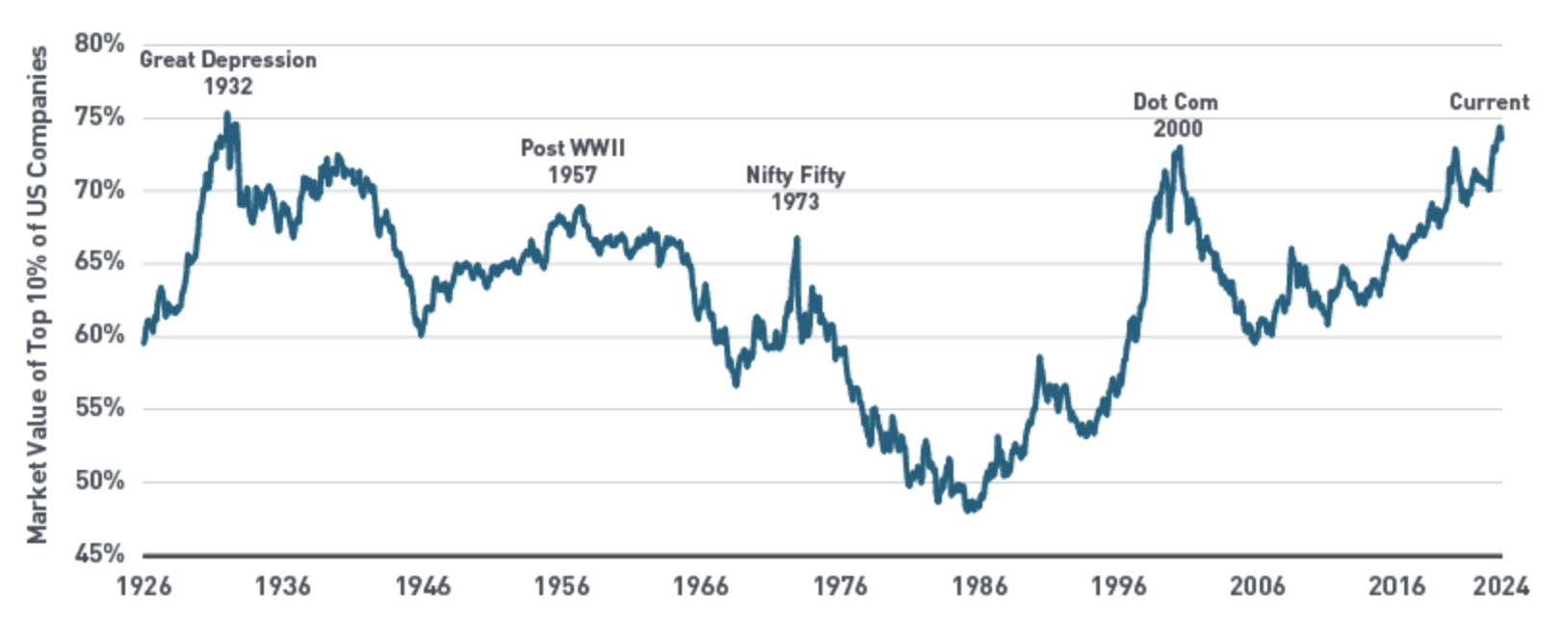
Firstlinks displays it like this:
This is an interesting one from Marketwatch comparing the market cap of the top stock to a stock at the 75th percentile.
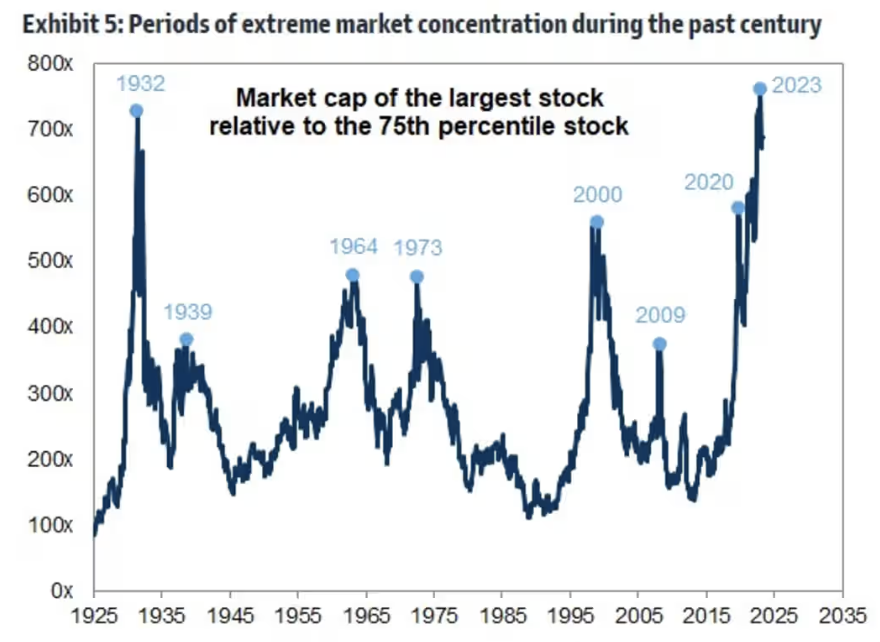
It doesn't really matter how you look at it, though. The bottom line is that the stock market is now more concentrated in its top holdings than it has ever been before. Note that the charts above stop after 2023 or even 2024. The concentration issue has only worsened in the last couple of years.
More information here:
Don’t Abandon Your Diversification
Beware of False Diversification
Is Anybody Else Getting Nervous About an AI Bubble in the Stock Market?

|

|


What Should You Do About This Concentration?
I'm now getting emails from WCIers asking if I'm worried about this? Yes, I'm worried about this. I've been worried about this for more than two decades. That's why 1/3 of my stocks are outside the United States. That's one reason why, even within the 40% of my portfolio that is in US stocks, only 25% is in the total stock market index fund while 15% is in a small value fund.
S&P 500 and total stock market funds have ALWAYS performed mostly like a large cap or even mega cap stock portfolio, because most of the money is invested in large cap/mega cap growth stocks. To counter that, I deliberately force more of my money into smaller, more valuey stocks. I “tilt” the portfolio away from large growth stocks and toward small value stocks. Of course, this worry and tilt has cost me a great deal of money over the last 15 years. Large growth stocks have simply outperformed small value stocks over the last decade and a half, which is not the case historically. But if they keep outperforming much longer, it WILL be the case historically.
So, what usually happens after the market gets this concentrated? Well, it usually reverses itself. From the peak, small and value stocks typically outperform large and growth stocks by 4%-10% per year for the next 3-10 years. The pendulum will almost surely swing. Trees don't grow to the sky. The problem is identifying WHEN the pendulum is going to swing, and I can't help you much there. The stock market can certainly stay irrational longer than you can stay solvent. The particularly challenging aspect of our era is that these big mega cap growth tech companies are making money. A lot of money. That's very different from some other eras, like the dotcom bust at the turn of the millennium.
This chart from Goldman Sachs demonstrates just how much they're making:
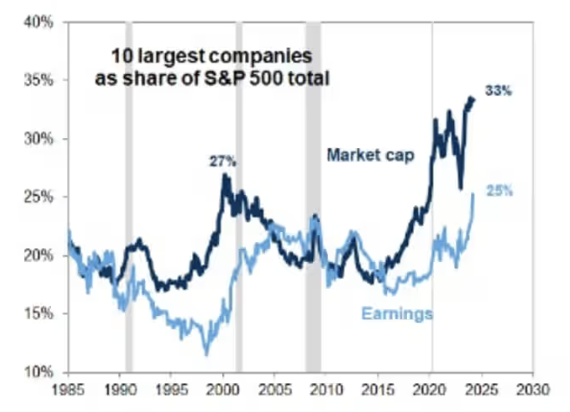
It's not just that the valuations are concentrated; it's that the earnings are concentrated, too. Not quite as much as the valuations but still to an impressive level. Those top 10 companies are making 1/4 of all the money in US publicly traded companies. Maybe that means this will go on a little longer or that the fall won't be quite as extreme as it has been historically. Or maybe it'll mean the government gets involved and starts breaking up these companies as it did after the Sherman Antitrust Act of 1890. Hard to say, and thus hard to know how to invest.
The bottom line is that you may own more than 3,500 different stocks in your total stock market fund, but it still might not be diversified, either legally or practically.
What do you think? Are you worried about stock market concentration? Are you doing anything differently because of it? Why or why not?
The post Is a Total Stock Market Fund No Longer Diversified? appeared first on The White Coat Investor - Investing & Personal Finance for Doctors.

|

|







 Bengali (Bangladesh) ·
  English (United States) ·