
 5 hours ago
8
5 hours ago
8 
TLDR
National average gas price sits at $4.12/gallon, up ~$0.53 from a month ago Trump announced a U.S. Navy blockade of the Strait of Hormuz after weekend talks with Tehran collapsed WTI crude jumped over 8% to above $104/barrel; Brent rose 7.5% to ~$102 JPMorgan warns gas could hit $5/gallon if the Strait remains blocked Dated Brent hit a record $144/barrel earlier this month; spot prices at $126 on FridayOil prices blew past $100 a barrel on Monday after President Trump ordered the U.S. Navy to blockade the Strait of Hormuz, cutting off one of the world’s most important oil shipping lanes.
WTI crude surged more than 8% to above $104 per barrel. Brent crude climbed 7.5% to around $102.
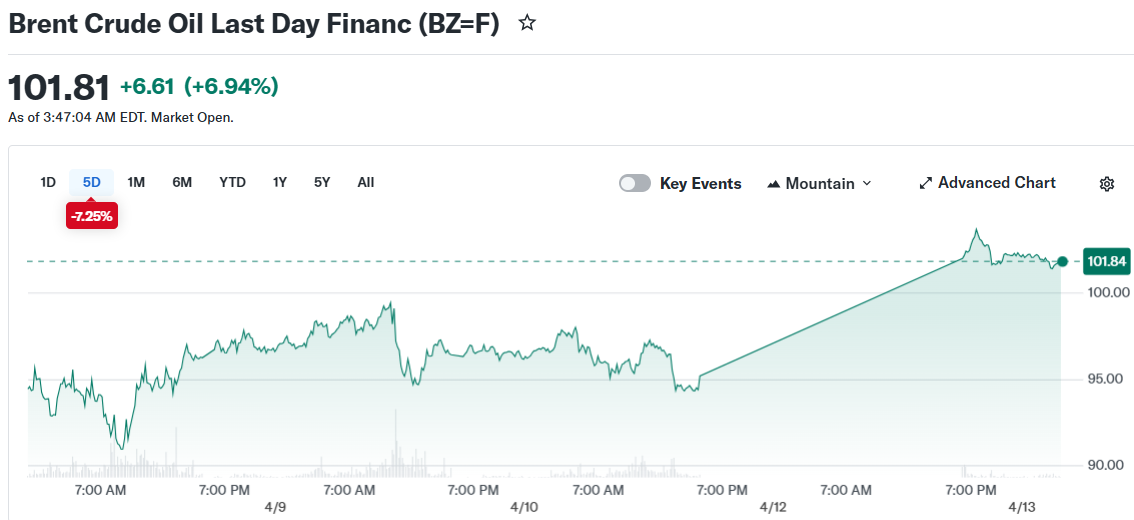 Brent Crude Oil Last Day Financ (BZ=F)
The move came after weekend negotiations between Washington and Tehran broke down. Trump posted on social media: “Effective immediately, the United States Navy, the Finest in the World, will begin the process of BLOCKADING any and all Ships trying to enter, or leave, the Strait of Hormuz.”
The announcement hit fuel markets fast. The national average price of gasoline now stands at $4.12 per gallon, up roughly 53 cents from a month ago.
Patrick De Haan, head of petroleum analysis at GasBuddy, put it plainly on Sunday: “The verdict is in — gas prices are likely to return to climbing with Trump’s new Strait block.” He pointed to gasoline futures already pricing in higher wholesale costs for retailers.
JPMorgan analysts have warned that if the Strait stays effectively closed, pump prices could reach $5 per gallon nationwide.
Physical Oil Market Under Pressure
The stress is showing up most clearly in the physical oil market. European and Asian refiners are scrambling for available cargoes, pushing spot Brent prices to record levels.
On Friday, dated Brent — the price for oil available for immediate delivery — was priced at $126 per barrel according to Platts data. Earlier this month, it hit a record $144 per barrel.
That’s a massive gap compared to normal. The spread between physical Brent and futures contracts is usually just $1 to $2 per barrel.
JPMorgan’s Natasha Kaneva noted Sunday night: “Today’s much wider gap signals a market struggling to source barrels for delivery now, even if it still assumes supply will normalize later.”
That kind of spread is a sign the market is running tight on actual supply right now, not just in theory.
What It Means at the Pump
For U.S. drivers, the math is straightforward. Higher crude means higher wholesale gasoline costs. Higher wholesale costs flow to retailers, and then to the pump.
GasBuddy’s De Haan flagged gasoline futures pointing to a coming surge in prices paid by gas stations to restock their supply.
The blockade also renewed concerns about inflation and the drag it could put on global growth, with both WTI and Brent now firmly above the $100 threshold that tends to get economists nervous.
JPMorgan’s team wrote on Sunday: “Signs are emerging that the system may be coming under increasing strain.”
Dated Brent was priced at $126 per barrel as of Friday, with the record $144 print still fresh from earlier this month.
The post Gas Prices Set to Rise Again as Crude Oil Tops $104 Per Barrel appeared first on CoinCentral.





 Bengali (Bangladesh) ·
  English (United States) ·