

Coinone exchange is a South Korea-based cryptocurrency trading platform that allows you to buy, sell, and store digital assets using Korean won.
The top features of Coinone are spot trading, staking through Coinone Plus, crypto borrowing, a simple and pro trading interface, and KRW bank integration, but it has some drawbacks, like limited global availability, and it lacks futures trading, multiple fiat support, and advanced tools compared to global crypto exchanges.
In this Coinone review, we will cover its features, fees, supported coins, and deposit methods in detail. You will also learn its pros and cons and see how it compares with top global exchanges like Binance, MEXC, and Bitget.
What Is Coinone Exchange?

Coinone is one of the best cryptocurrency exchanges in South Korea and has been operating since 2014. You can trade only on spot markets here; there is no futures or options desk. The platform supports roughly 240 cryptocurrencies and 380 trading pairs at the time of writing, and it uses the South Korean won (KRW) as its single fiat currency.
Now, only users with a verified Korean mobile phone and bank account can complete full verification, so most international traders are effectively blocked. The exchange is fully regulated under Korean law and holds a Virtual Asset Service Provider (VASP) license from the Financial Intelligence Unit (FIU).
| Launch Year | 2014 |
| Headquarters | South Korea |
| Supported Cryptocurrencies | ~240+ coins (BTC, ETH, XRP, LTC, etc.) |
| Trading Type | Spot trading only (no futures or options) |
| Trading Fees | 0.2% per trade |
| Maximum Leverage | Up to 1:4 (limited margin trading) |
| Fiat Support | South Korean Won (KRW) only |
| Deposit Methods | Bank transfer, Crypto deposits |
| KYC Requirement | Mandatory (Korean ID + phone number required) |
| Availability | Only South Korea (not available in the US) |
| Security Features | 2FA, cold storage, multi-signature wallets |
| Mobile App | Yes (Android & iOS) |
| Other Trading Options | Staking (Coinone Plus), Borrowing, Automated Trading, API, etc. |
Is Coinone Available in the US?
No, Coinone does not offer services to residents of the United States. The platform restricts users from many countries, including the US, UK, and India, and requires a Korean phone number and bank account for full verification. Hence, if you live in the US, you will need to use a global exchange like Coinbase or Korean instead.
What Popular Coins Are Available on Coinone?
You can trade over 240 different cryptocurrencies on Coinone. The platform mainly lists all the major assets like Bitcoin (BTC), Ethereum (ETH), Ripple (XRP), and Solana (SOL). Plus, it also has many “Kimchi coins”. These are tokens that are mostly popular or sometimes even exclusive to the South Korean market.
Mainly, the trading pairs are all against the South Korean Won (KRW) because the platform does not use USDT as a base currency for most pairs. You will find that liquidity is pretty high for the top coins, so you can buy and sell without much price slippage. But honestly, if you compare this to MEXC or Binance, the number of coins is actually quite small. Those global exchanges often have thousands of assets, while Coinone keeps its list much more curated.
Discover 3,000+ coins on MEXC — Sign up now for exclusive rewards!

What Are The Advantages and Disadvantages of Coinone?
Advantages of Coinone
High security: The security record is excellent because the platform has never suffered a major successful hack since its inception. User-friendly interface: You get a very clean and simple user interface that makes it easy for beginners to find their way around without getting lost. Instant fiat deposits: The partnership with KakaoBank makes depositing and withdrawing KRW very fast and reliable for local users. Passive income options: Staking rewards are available for several popular coins like Cosmos (ATOM) and Tezos (XTZ), so you can earn passive income easily. Regulated: It is a fully regulated exchange in South Korea, which means your funds are generally safer than on unregulated or offshore sites. Built‑in terminal: A simple mode for beginners and a Pro interface for experienced traders, with mobile apps on Android and iOS.Disadvantages of Coinone
Only for Koreans: You need a Korean phone number and bank account to verify, so users in the US, India, and most other countries cannot join. KRW only: The exchange supports only KRW deposits and trading pairs. Well, this is inconvenient if you want to use other currencies. No derivatives: There are no perpetual futures or options trading markets. So, if you want high leverage trading, you need to trade on MEXC or Bitget. Limited funding options: You can fund your account only through a KRW bank transfer or by sending crypto. There are no card or e‑wallet options.Best Coinone Alternatives
The top Coinone alternatives for global users are Binance, MEXC, and Bitget. Here is a quick comparison:
|
Criteria |
Coinone | Binance | MEXC | Bitget |
| Launched Date | 2014 | 2017 | 2018 | 2018 |
| Top Features | KRW trading, staking, borrowing | Futures, staking, launchpad, NFT | Zero-fee trading, copy trading, futures | Copy trading, futures, and trading bots |
| Supported Coins | ~240 coins | 500+ coins | 3,500+ coins | 1,600+ coins |
| Trading Fees | 0.2% | ~0.1% (discount with BNB) | 0% / 0.05% | ~0.1% (lower with BGB) |
| Maximum Leverage | Up to 4x | Up to 125x | Up to 200x | Up to 125x |
| Fiat Support | KRW only | USD, EUR, INR, etc. | Multiple via card, P2P | 40+ fiat currencies |
| KYC Mandatory | Yes (strict Korean KYC) | Yes | Optional | Yes |
| U.S. Availability | No | Limited (Binance.US separate) | No | No |
| Open Account | Open Coinone Account | Open Binance Account | Open MEXC Account | Open Bitget Account |
Coinone vs. Binance
Coinone is clearly a local Korean exchange, while Binance is a global powerhouse, and that difference shows up in almost every aspect. You get only spot trading on Coinone, but Binance offers futures, options, staking, an NFT marketplace, and even launchpad projects. Honestly, that already puts Binance way ahead.
Now look at fees and liquidity. Binance keeps fees around 0.1% and even lower with BNB discounts, and more importantly, it has massive liquidity. Well, that means your trades execute faster and at better prices. Again, the biggest difference is accessibility. Binance supports multiple fiat currencies and global users, while Coinone only supports KRW and requires Korean verification. So yeah, if you are outside Korea, Coinone is not even a real option.
Unlock exclusive rewards on Binance — Sign up now!
Coinone vs. MEXC
MEXC is a global no-KYC crypto exchange. The first thing you notice is the huge difference in coin listings. Coinone offers around 247 coins, but MEXC lists thousands of tokens, including new altcoins that you won’t find anywhere else. You can even trade without ID verification on MEXC and withdraw up to 10 BTC per day.
Also, MEXC offers 0% maker fees and around 0.05% taker fees. You know, that is honestly one of the lowest in the industry. Coinone, on the other hand, charges up to 0.2%, which feels expensive once you compare. Also, MEXC supports global users and multiple deposit options like card, P2P, and bank transfer. Coinone is stuck with KRW bank transfers.
Trade with 0% fees on MEXC — Sign up now and unlock exclusive rewards!
Coinone vs. Bitget
Bitget sits somewhere between Binance and MEXC, but is still far ahead of Coinone in terms of features. The biggest highlight of Bitget is its copy trading and futures trading ecosystem, which Coinone completely lacks. Leverage is again a big difference. Bitget offers up to 125x leverage, which is standard for professional trading.
Now, when it comes to fees, Bitget offers competitive pricing around 0.1% with additional discounts via the BGB token. Plus, in some cases, it even goes lower depending on trading volume. Coinone does not offer any fee reduction system like that.
Trade smarter with Bitget — Sign up now for exclusive rewards!
Coinone Exchange Review: Fees and Deposit Methods
Coinone charges 0.2% transaction fees per trade, whereas there are no deposit fees, and crypto withdrawal fees depend on the network congestion. Here are the full Coinone fees details:
Coinone Transaction Fees
You will pay a standard trading fee of 0.2% on the main market for both maker and taker orders. Well, this is actually a bit expensive when you compare it to Binance, where fees start at 0.1% or even lower. Some specific markets on Coinone might have different rates, but for the majority of users, 0.2% is the number you will see. There are no VIP tiers or native token discounts because Coinone lacks a platform token.
Coinone Deposit and Withdrawal Fees
Depositing KRW into your Coinone account is usually free if you use their partner bank, KakaoBank. But, withdrawing your money back to your bank account will cost you a flat fee of 1,000 KRW per transaction.
Also, for crypto withdrawals, the price depends on the specific coin and how busy the network is at that moment. So, for example, withdrawing Bitcoin might cost you around 0.0008 BTC (subject to change).
Coinone Deposit Methods
Coinone accepts funding in two forms: KRW bank transfer and crypto transfer. You link a Nonghyup Bank account to deposit won quickly, or you send coins from an external wallet and pay only the network fee. There are no card, P2P, or e‑wallet options, so international users often pick another exchange with more payment methods.
Coinone Exchange Review: Key Features and Tools
The top features of Coinone are borrowing, smart trading, staking, advanced trading charts, automated trading, and an open API for developers.
1. Coinone Borrowing
You can borrow cryptocurrency by pledging your KRW as collateral directly on the platform. You can only borrow Bitcoin (BTC) at the moment. Well, the rules are quite clear: the minimum collateral you need to put up is 50,000 KRW, and your maximum borrowing limit is capped at 30 million KRW. Plus, the system is quite strict about safety, so you can only borrow up to 82% of your collateral value.
The loans usually last for a period of up to 30 days, and you will be charged a daily interest rate of 0.05% during that time. Also, right before you start using this service, Coinone requires you to complete a short quiz to make sure you understand how the risks work. They also have auto margin calls in place to help reduce the risk of liquidation if the market suddenly moves against you.
2. Coinone Smart Trading
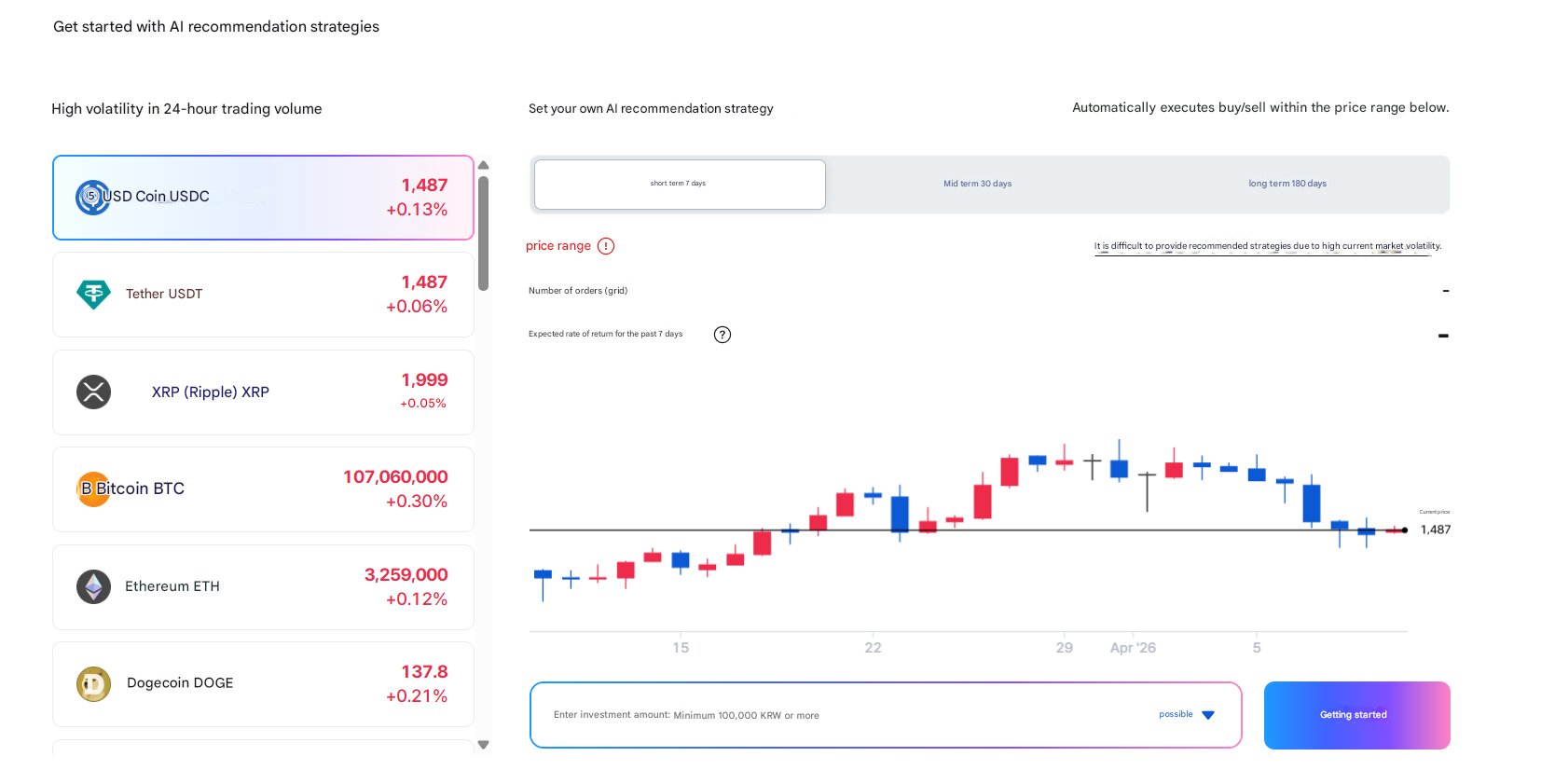
Coinone’s trading interface has a Simple mode for newcomers and a Pro mode for experienced traders. Here, Simple mode shows only the basic fields, while Pro mode adds an order book, charts, and limit or market orders. You cannot connect to TradingView, but the built‑in charts include basic indicators. It also offers AI recommendations and trading setups.
3. Coinone Staking
The Coinone exchange lets you stake selected coins to earn passive yields on your holdings, and rates vary significantly depending on the asset you choose, but you can generally expect ETH to pay roughly 3-4% APR, while ATOM can reach double-digit returns.
Well, some of these staking offers are flexible, which allows you to move your money at any time, but others require you to lock your coins for a set period. Plus, the platform also runs occasional promotions for new traders that can boost these rewards.

4. Coinone Advanced Trading Charts
Coinone offers basic candlestick and line charts with both short and long timeframes. You can find simple indicators like moving averages, and you can easily resize panels to customize your view. The interface also lets you see your order history and the live order book in one place.
Honestly, it lacks some advanced features like order flow analytics or backtesting tools, so professional traders might still prefer the deeper TradingView integrations found on global exchanges. So, I guess it is enough for casual analysis, but it won’t replace a pro setup.

5. Coinone Automated Trading
Coinone offers automated trading on its main interface for regular users. You have to generate API keys and connect external bots if you want to automate your strategies, as providers like Zenport and HummingBot offer things like grid and DCA bots that integrate with the platform.
6. Coinone Open API
The Coinone Open API lets developers pull market data and manage their trades programmatically. It offers public endpoints for things like price history and order book data, as well as private endpoints for account management.
You need to generate secure keys to access the private parts of the system. Also, documentation is available directly on the site, and you can even request higher rate limits through support if you are a high-volume trader.
How To Open A Coinone Account and Start Trading?
Step 1: Create an Account
You need to visit the official Coinone website or download their app and sign up using a valid email address and a Korean mobile phone number for mandatory SMS authentication.

Step 2: Complete KYC
You must undergo the Know Your Customer (KYC) process by uploading a government-issued ID card and performing a biometric facial recognition scan to prove your identity.

Step 3: Deposit Funds
Now, you can link a verified South Korean bank account, as this is currently the only supported method for depositing KRW into your exchange wallet for local trading.

Step 4: Start Trading
Finally, once your identity and bank connection are approved, you can easily navigate to the spot market to place your first limit or market order for Bitcoin, Ethereum, or other supported assets.
How Much Can You Withdraw From Coinone?
The Coinone exchange’s daily fiat withdrawal limit is 100 million KRW, with the option to raise it to 500 million KRW after enhanced verification. Now, for cryptocurrency, each withdrawal is limited to 20 million KRW worth of coins, and the daily limit may increase after additional checks.
The platform also places a 72‑hour lock on withdrawals after your first deposit or when you change security settings, such as your password or 2FA device.
Coinone Customer Service
Customer support on Coinone is mostly decent, but it has some big limitations for people outside Korea. You can reach them through an online ticket system or a live chat available on their website during business hours. The response time is usually within 24 hours during business days, which is standard for the industry.
Coinone maintains a YouTube channel and a KakaoTalk community where announcements are posted, and informal support is sometimes offered. However, the biggest issue is that they primarily speak and write in Korean. So, if you send a message in English, it might take much longer to get a helpful answer.
Coinone App and User Experience
The Coinone mobile app is available for both Android and iOS users. Most users like the clean interface and the ability to set up real-time price alerts for their favorite coins. You will also find solid security features like biometric login, 2FA, and optional restrictions that limit account access to specific devices.
But yes, there are some notable complaints that you should be aware of before you download it. Some traders report that the app freezes during high market volatility and that orders sometimes fail to execute quickly when the servers are under heavy load. Also, you might find that the app is primarily in Korean and that the English translations are often incomplete or confusing. So, the app works adequately for basic trading, but global users usually find the experience cumbersome compared with global exchanges.
Conclusion: Is Coinone a Safe South Korean Exchange or a Scam?
To sum up our Coinone exchange review, it is one of the safest Korean exchanges as the platform has not suffered a major hack and implements several strong security measures. It holds most of its users’ assets in cold wallets, uses multi‑signature technology, requires two‑factor authentication for all withdrawals, and stores customer KRW deposits in segregated accounts at Kakao Bank. The company also maintains ISO 27001 and ISMS‑P certifications.
Honestly, while the safety features are top-notch, the exchange has significant cons for anyone living outside of Korea. The biggest drawbacks include the strict requirement for a local bank account, the lack of futures trading, and an interface that is mostly optimized for Korean speakers. Hence, if you are an international user, you will find it much more practical to use global giants like Binance, MEXC, or Bitget. These platforms offer thousands more coins, 24/7 English support, and advanced features like high-leverage trading that Coinone simply cannot provide.
Go global with Binance — Unlock exclusive rewards today!
Start trading on Bitget — Unlock exclusive rewards!
The post Coinone Exchange Review 2026: Features, Fees, and Is It Legit? appeared first on CryptoNinjas.



 Bengali (Bangladesh) ·
  English (United States) ·