

For the first time, scientists have measured metal pollutants leaching from a piece of space junk in the atmosphere. They caught a burst of lithium as a SpaceX rocket burned up high above Earth’s surface. Such pollutants can damage the ozone layer and may impact global climate.
Humans have been launching metal things into orbit around Earth for nearly 70 years. But the pace of launches has skyrocketed in the past decade. And private companies plan to boost the number of launches in the near future. Consider SpaceX’s Starlink system. This system provides internet to far-flung places. It will eventually consist of more than 40,000 satellites. Already, nearly 10,000 Starlink satellites orbit Earth.
Each piece of Starlink equipment has a planned life of about five years. After that, the satellite burns up in the upper atmosphere. This releases metals. They include lithium, aluminum and copper. Those metals may speed up chemical reactions that destroy ozone. That’s a problem, because the ozone layer of Earth’s atmosphere protects life on Earth from getting too much ultraviolet (UV) light from the sun.
Metal pollution from space junk may also affect Earth’s climate. Such metals could change the balance of light that reaches the ground or gets bounced back to space.
The stratosphere is the layer of the atmosphere that extends from 14 to 64 kilometers (9 to 31 miles) above Earth. A 2023 study found that about 10 percent of particles there contain pollutants from burnt-up satellites and rocket parts.
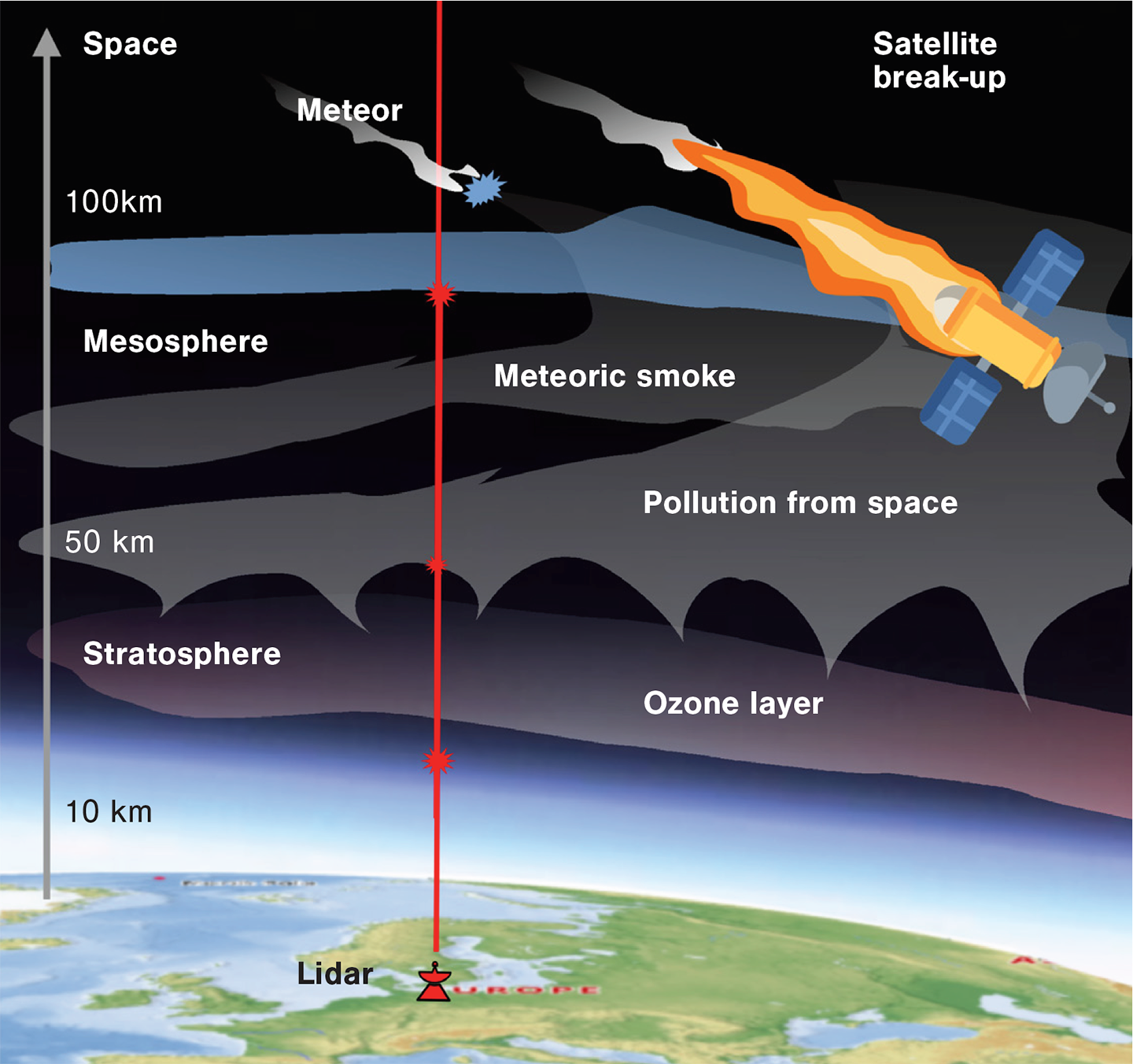 This diagram shows different layers of the atmosphere. The breakup of meteors forms natural metal layers. But space junk can also cause pollution in the upper atmosphere that may mess with the ozone layer. R. Wing et al/Communications Earth & Environment 2026
Scientists wanted to see if they could directly trace such particles to a piece of space debris. They got their chance on February 19, 2025. That day, the researchers observed a cloud of lithium about 100 kilometers (60 miles) above Germany. It was blowing away from the upper stage of a Falcon 9 rocket. This rocket part contains fuel and an engine. The rocket part made a fireball as it broke apart over Ireland and the United Kingdom.
“A few hours after the reentry of this rocket, we could see 10 times more lithium than we would have observed otherwise,” says Claudia Stolle. She’s a meteorologist at the Leibniz Institute of Atmospheric Physics. That’s in Germany.
Explainer: What are lidar, radar and sonar?
The measurements relied on lidar. Lidar sends out laser pulses and detects the light that bounces back. The laser light is tuned to specific wavelengths that reflect off particular materials, such as lithium.
The team also ran computer models of the atmosphere. These showed that the wind had carried the lithium from the spot where the rocket came down to the area over Kühlungsborn, Germany. That’s where the lidar was located.
The researchers shared their findings February 19. The work appeared in Communications Earth and Environment.
The technique could help monitor potential harms from space debris. Meteorites — space rocks that fall to Earth — bring metals into the atmosphere. But falling space junk may one day boost metal pollution by around 40 percent, Stolle’s team estimated. Tracking such contaminants and their effects will become increasingly important.
More companies and countries are planning to launch satellites into orbit, Stolle notes. “All of them will burn up sooner or later.”
Leaching lithium
 R. Wing et al/Communications Earth & Environment 2026
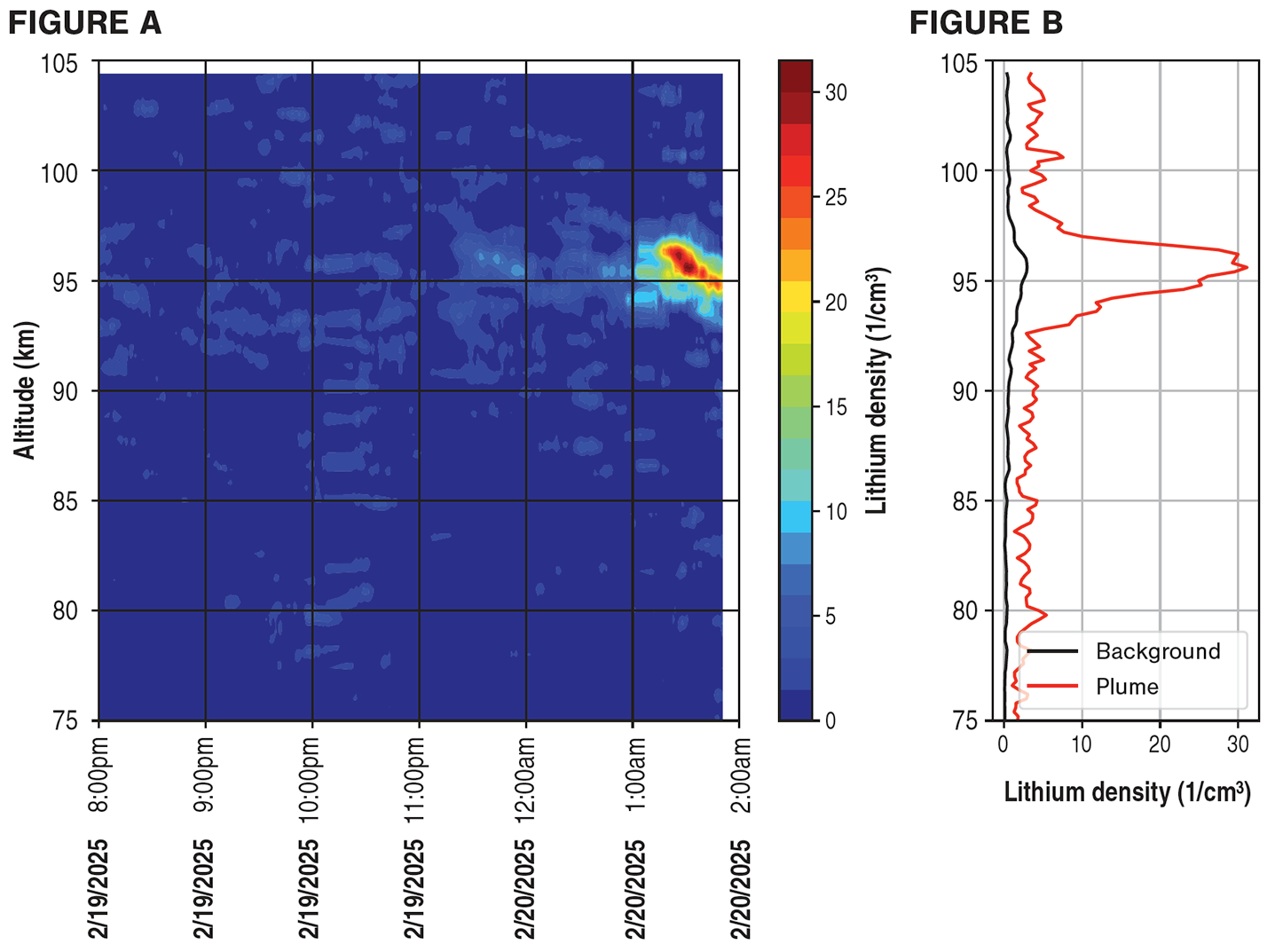
Using a technique called lidar, researchers in northern Germany caught a burst of lithium in the upper atmosphere. The lithium came from a piece of a Falcon 9 rocket. Carried by the wind, the lithium spread from one point to a wider area. This type of spread is called a plume. The figure on the left is a heat map. It shows the density of lithium (per cubic centimeter) at different altitudes over time (shown in local German time). The plot on the right shows the lithium density at different altitudes at 1:30 a.m. on February 20. The amount of lithium is higher in the center of the plume and lower at the plume’s edges.




 Bengali (Bangladesh) ·
  English (United States) ·