

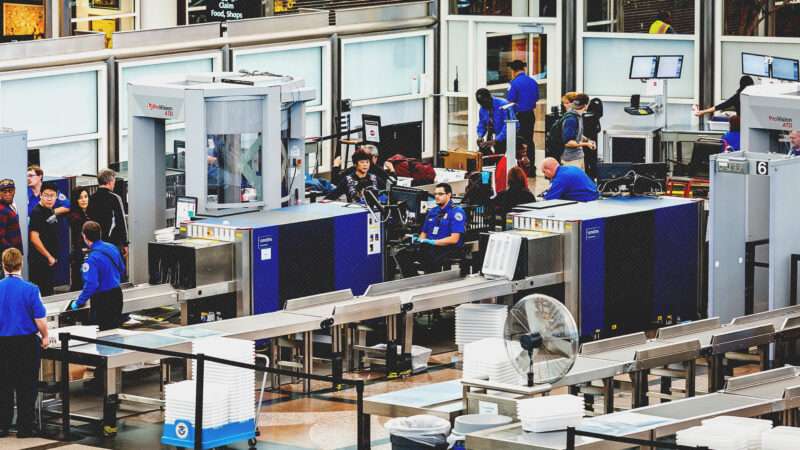
The union for Transportation Security Administration (TSA) employees is worried about the agency's turn toward privatization.
Earlier this week, the American Federation of Government Employees (AFGE)—which represents 47,000 Transportation Security Officers at 400 airports across the country—issued a press release calling the Trump administration's "push" to put airport security screening in the hands of private contractors a threat to its members' jobs and public safety.
The statement came after three airports—Tampa International Airport, Des Moines International Airport, and Charleston International Airport—announced that they would join the TSA's Gold+ program, a "public-private partnership" initiative by the Trump administration soft-launched in May. The program allows any of the 440 commercial airports under TSA control to voluntarily opt in to a "tailored security screening service" based on their needs.
Airports in the program can either work with private contractors or bid to provide security screenings themselves, with "staffing, technology, and maintenance" and oversight provided by the TSA at "no additional cost." Gold+ operators will be responsible for checkpoints, baggage screening, cybersecurity requirements, and "workforce management" in accordance with TSA's standards, but the agency will not mandate specific "staffing levels or ratios."
The program is an expansion of TSA's Screening Partnership Program, which outsources security screening services at commercial airports to private companies. There are 20 airports nationwide currently in the partnership program, ranging from small to mid-size, including one of the country's busiest airports, San Francisco International.
AFGE President Everett Kelley says the Gold+ program represents a "major departure and step backwards" from post-9/11 security, which is untrue, given that the TSA will require employees of its private contractors to adhere to its training and background-check requirements.
He's likely more worried a lack of staffing quotas will mean fewer jobs for union members working in airports that are part of the Gold+ program.
But Kelley should take heart in how difficult it is to fire government employees. The Trump administration has tried—and failed—to fire thousands of TSA workers since the start of the president's second term. In February 2025, former Department of Homeland Security (DHS) Secretary Kristi Noem sent out a memo canceling the TSA's collective bargaining agreement. A federal judge later issued an injunction prohibiting the government from enforcing the memo.
And even though in its FY 2027 budget the DHS has proposed a staffing reduction of 8,385 positions and 9,439 full-time TSA employees, David Cummins—the president's nominee to lead the TSA—said this month in his confirmation hearing that current TSA employees will have "right of first refusal" for jobs at airports in the program.
Still, even if any fears about job losses were warranted, it would be current TSA agents who would stand to benefit from higher-paying, more competitive salaries. As Cummins noted in his confirmation hearing, Kansas City International Airport—one of the 20 airports operated by private contractors—offers higher pay than the federal government for its entry-level security screeners, and from a "benefit standpoint," he added, "it's very comparable."
Importantly, more private security jobs would mean that security officers would get paid even when the government shuts down.
During the 76-day government shutdown that began in February and ended in April, security screeners at the 440 TSA-operated airports went without pay. Meanwhile, Nat Carmack—president of BOS Security, a private screening company—told CNN employees at Tupelo Regional Airport in Mississippi "never missed a paycheck." Consumers at those airports were also spared the long lines and frustration faced by others at nonparticipating airports around the country.
Fliers at Gold+ airports can expect to experience the same benefits. In a statement to Reason, the Des Moines International Airport says its inclusion in the Gold+ program will "improve the passenger experience."
According to the DHS' FY 2027 budget proposal, the shift to privatization could save the government $52 million by increasing funding for the Screening Partnership Program by $477.3 million and offsetting it with $529.3 million in savings from personnel cuts. However, TSA also says it will not provide the "specific mix" of appropriations and fee sources used to fund the Gold+ program.
The agency issued a request for proposals for Gold+ in July, with applications due by the end of the month. TSA projects an effective start date for contracts in September with a $12.9 billion ceiling across all awards over 10 years.
With federal dollars backing the program and the government's fingers very much in the pie, the Gold+ program can hardly be considered real privatization. Still, it's a small, meaningful step toward a market solution, and it puts the U.S. more in line with the rest of the world, where privatized airport security is the norm.
The post Airports Are Opting for Private Security Over the TSA. The Union Says That's a Public Safety Threat. appeared first on Reason.com.




 Bengali (Bangladesh) ·
  English (United States) ·