
 1 month ago
32
1 month ago
32 
We were at Carter Road, fingers still sticky from the Belgian waffles we’d just demolished, when Bani admitted she’d been forbidden from drinking water at my house. “Because you’re a Muslim and eat meat,” she added guilelessly. Bani and I went to school together in Mumbai, and had been friends for nearly seven years at that point. When my parents couldn’t pick me up from a birthday party a few years earlier, hers had offered to take me in until I got a ride home. At lunch, when Bani needed someone to accompany her to the school gate, where she’d collect her lunch box from the dabbawala, she’d tilt her head at me, wiggle her fingers in a walking motion, and mouth, ‘Coming?’ It was Bani who introduced me to Retrica, the vintage-inspired camera app that was all the rage in middle school, and appeared in almost every selfie of mine thereafter.
So really, it should’ve stung—should’ve smarted—that someone I’d grown up with could even bear to nurse a thought so acrid, so casually cruel. But at thirteen, in the greenness of teenagehood, I took great pride instead in being the Muslim that could stomach an insult, proffer a critical remark with no hint of defensiveness, brag about never having kept a fast during Ramadan—so I merely shrugged and nodded in acquiescence. By the time we’d left the waffle shop and stepped into the mugginess of Mumbai, the sky was tinged with magenta and Bani’s remark had already faded from consciousness. This was in 2014, shortly after the right-wing Bharatiya Janata Party rose to power in India in a landslide victory, ushering in a new era of Hindu nationalism which sought to sweep religious minorities to the sidelines.
Twelve years on, Bani’s remark seems to have foreshadowed a chain of events unfurling in the political landscape of India: reports of cow vigilantes lynching Muslims on suspicion of eating beef, non-vegetarian renters being denied housing in major Indian cities, beef being banned in twenty out of twenty-eight states. What is it about food, I wonder, that can drive one to murder, to be entirely stripped of remorse? Why does the aroma of a certain meal feel like an insult so personal, so scathing, that the only acceptable response is hot, vicious rage?
The answer lies in the fact that food and politics are immersed in a strange dance, of sorts, where one not only informs but also augments the other—a fact reinforced by political scientist Gopal Guru, who argued that food is a “site of humiliation” for Dalits in a caste-based system like ours. In 2011, the India Human Development Survey found that women in about a quarter of Indian households eat last, stoically gleaning the remnants once the men had eaten their fill. For those hovering at the margins—women, Muslims, Dalits, Adivasis—these facts underscore a jarring truth: food isn’t merely fuel, it determines if they get to survive at all.
The seven books below encapsulate this sentiment by asking questions that are as jarring as they are necessary: what is acceptable to eat, who is handed the leftovers, whose meals are considered dirty, who toils in the kitchen. And somewhere in between stories of vengeful women, debates about inter-dining, and ethnographic accounts of the beef ban, we stumble upon the realisation that food can be both life-affirming and life-destroying, all at once.
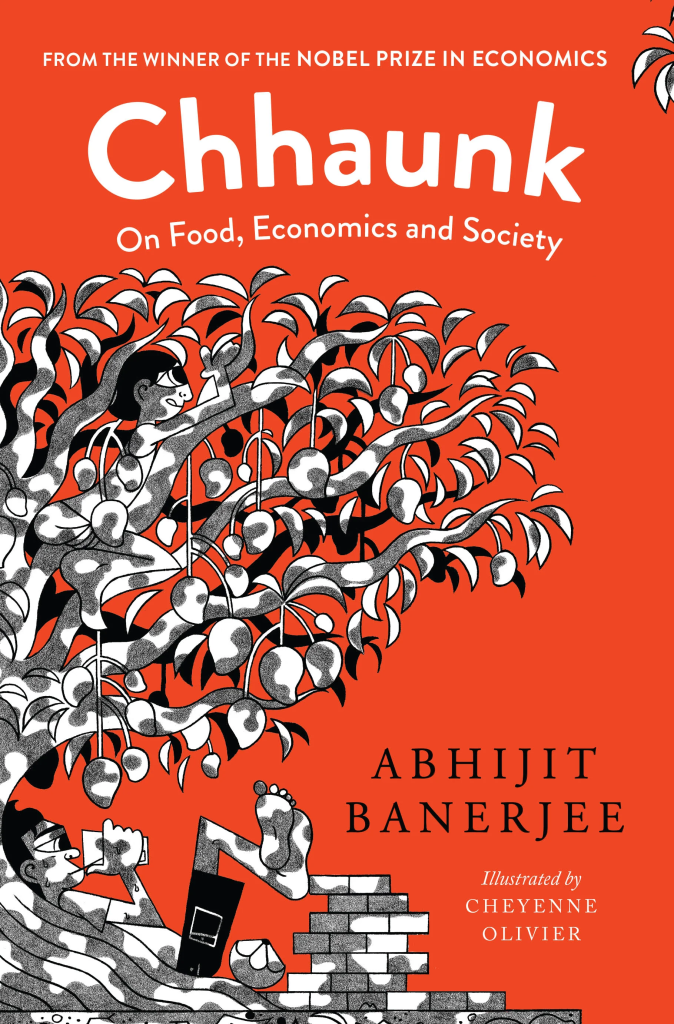
Chhaunk by Abhijit Banerjee
How are roadside chowmein and foreign policy related? What does a disappointing New Year’s Eve have in common with Universal Basic Income? Few authors can extrapolate the dreary slog of everyday life to economic theories without being overly didactic, but Banerjee suffers from no such predicament. Every chapter begins with a juicy anecdote about food—in one, a sanyasi suckles lasciviously at a ripe mango on a crowded train, putting on a show for his scandalised audience; in another, a group of friends skip lunch to make their evening meal of sutli kebabs feel more rewarding, only to find that hunger has fettered every ounce of their mental energy.
Then, almost as if by chance, Banerjee begins to drift away—drawing unexpected parallels to Xi Jinping’s domestic policy, India’s malnutrition problem, the erosion of democracy, undertrial prisoners. Nothing is too frivolous, everything is related, and it almost always circles back to food. But while Chhaunk is a sobering reminder that the personal has always been political, Banerjee’s writing is laced with levity, making it an easily digestible read in spite of its heft.
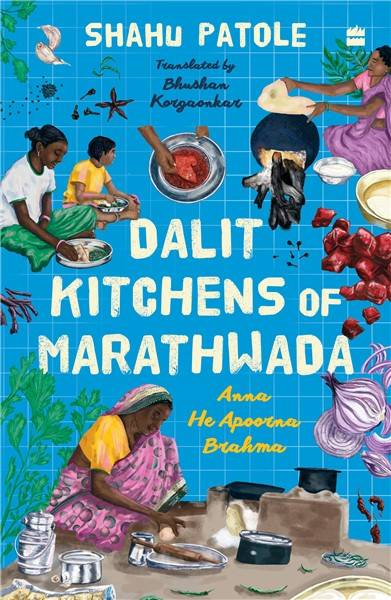
Dalit Kitchens of Marathwada by Shahu Patole
Amidst an ever-swelling pile of desi cookbooks, Shahu Patole’s memoir stands out, not only for the age-old recipes etched into its pages, but because its very existence is an act of subversion. It is true, after all, that Dalit recipes never wriggle their way into the mainstream, into the glossy cookbooks that sit smugly on front-facing displays in bookstores; that has long been a feat reserved only for the upper-caste. “Even my own siblings didn’t like my writing this book in such great detail,” Patole admits in the preface. “But this is the story of the food my parents ate and their parents ate—an acquired taste, one acquired through centuries of discrimination.”
Through a series of vignettes, we learn how Dalit communities—often driven by paucity—use every part of the animal in their cooking, how non-vegetarianism is weaponised to uphold caste hierarchies in India, how some ingredients have historically only been available to the upper caste. And upon reaching the raw, tender marrow of the book, we find ourselves stumped by a more rudimentary question: why has nobody even noticed that Dalit recipes are missing from mainstream media?
Eating Women, Telling Tales by Bulbul Sharma
If Patole’s work has a grim undercurrent, this cheeky collection of short stories pivots sharply, with plotlines that are as piquant as Indian cooking. At first, the characters seem run-of-the-mill, unassuming. But a sardonic tone runs through the book, coaxing a self-conscious giggle out of the oblivious reader, and eventually, giving way to a sticky, viscous malaise that lingers for days after. Perhaps it’s the realization that the mother trying to ‘earn’ her son’s love by cooking for him feels oddly familiar, as does the wife attempting to clog her good-for-nothing husband’s arteries by glutting him with rich, greasy food.
After all, the women in this book are women we recognise—mothers, daughters, aunts—who spend their lives toiling in the kitchen, their worth forever hinging on how aromatic their tadka is, how thinly they can slice a radish, how swiftly they can plump up a too-thin husband. It is through food that these women are controlled, tyrannised, shown their place. But it’s also through food that they find solace, validation, and sometimes even revenge.
Sacred Cows and Chicken Manchurian by James Staples
Emerging out of two decades of ethnographic research in South India, Sacred Cows and Chicken Manchurian takes a long, hard look at what it means to consume beef in a country where cows have historically been considered sacred. Within the first thirty pages, Staples gently tosses aside the cut-and-dried way in which we usually speak of the beef issue—as a clash between the cow-slaughtering Muslims, Dalits, and Christians and the cow-worshipping Hindus.
While there is, of course, some truth to this notion, Staples brings in a more nuanced view, acquainting us with cow slaughterers who refuse to eat beef, Dalit cattle herders who feel a sense of kinship with their animals, upper caste Hindus who devour beef in secret, and those that wilfully turn a blind eye to the exploitative practices of the meat industry. It is through these encounters that he makes a case for the messy complexity of beef-eating. Especially now, at a time when gau rakshaks are lynching religious minorities on suspicion of eating beef, a book as nuanced as this one feels like a welcome respite, an oasis in drought.
Fasting, Feasting by Anita Desai
In the initial segment of this book, we meet Uma, a spinster who spends her days at the beck and call of her parents, only to be met with vitriolic remarks in return. Despite feeding those around her, Uma’s life in India is one of fasting—starved of freedom, education, new experiences. The latter half follows Uma’s brother, Arun, who moves in with an American family, the Pattons, after he enrolls in a college in the United States. The Pattons lead a life of excess—they buy an obscene amount of groceries, have a freezer crammed with meat, and their daughter Melanie obsessively snacks on candy bars only to vomit everything back up.
While their circumstances are unalike, Uma and Melanie are similar in that they’re both unhappy with their lives, which has the effect of thwarting their appetite, both literal and symbolic. There is, after all, a sense of aliveness to hunger—a reaching outwards, a wish for nourishment, the sign of a body functioning as it should. What can be understood of a hunger that is quashed, diminished like theirs? Does it point to a barren inner world? A belief that one’s needs will forever remain unmet? A quashing of desire itself?
The Flavours Of Nationalism by Nandita Haksar
The urge to pen this book came to Haksar as early as the 1980s, while attending a human rights conference in Amritsar, Punjab. There, a South Indian delegate asked for rasam (a dish typically only prepared further South) despite the conference having a lavish spread of local Punjabi food. This interaction first annoyed and then amused Haksar—who’d grown up with “the Nehruvian idea that we must appreciate the cultures and cuisines of others”—and eventually inspired her to work on a book she imagined would be titled ‘Rasam in Amritsar’.
Only, what set out to be a light-hearted work grew progressively more dismal once the culinary tastes and recipes of India revealed themselves to be mired in socio-political strife. It is with this understanding that Haksar unpacks the Gandhi-Ambedkar debate on inter-dining, the impact of privatisation on the Goan food industry, and the ban on eating beef. But while it unfolds as a narrative, The Flavours of Nationalism is, at its heart, an act of questioning: where do our meals come from? Who is permitted at the table? What food provokes violence? What doesn’t? And more importantly, perhaps, what does that mean for us as a people?
Khabaar by Madhushree Ghosh
Reviving India’s Heroes & Heroines
Sunil Khilnani on breathing new life into a nation’s icons.

Whether it’s buying meat and fish at Chittaranjan Park in New Delhi or watching her mother fry rohu in mustard oil, Ghosh, the daughter of Bengali refugees, nurses her memories of India with utmost fondness after immigrating to the United States for graduate school. In the decades after, she finds herself oscillating between past and present, rootedness and adriftness, belonging and alienation—as is a rite of passage for most immigrants.
It’s only in the aftermath of her baba’s death, and eventually ma’s, as well, that she tries to keep alive her Indian heritage and the memory of her parents, through Bengali food: preparing goat curry in remembrance of her childhood meals, making a “bastardised version” of raita with kefir instead of yogurt, haggling with a local fisherman while buying fresh fish the way her father had taught her to. (“We absorb the fish’s life. We live because they did… Never forget, Puchkey, fresh fish. For fresh life. Always.”) As much as Khabaar is a tale of grief and cultural identity, it is also one of vitality, of recognizing that there is presence even in absence, and that memory—of those departed, of homes left behind—does not have to destroy us.
The post 7 Books About the Messy Politics of Indian Meals appeared first on Electric Literature.




 Bengali (Bangladesh) ·
  English (United States) ·