

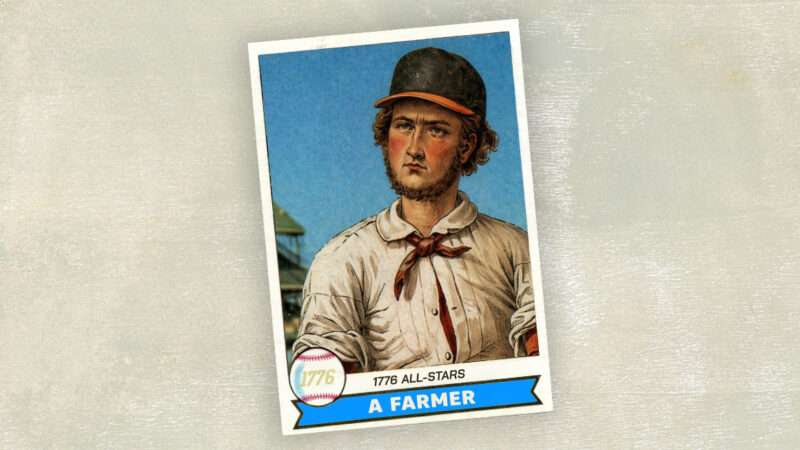
This is part of 1776 All-Stars, a series about Reason's favorite American Founders. Read more here.
 Joanna Andreasson
I do not know my favorite Founder's name. I just know that in 1788 a Baltimore newspaper published a series of pseudonymous essays where he warned against standing armies, called for a bill of rights, and declared, paraphrasing Jonathan Swift, that "laws are cobwebs, catching only the flies and letting the wasps escape." See-sawing between fears of an aristocratic legislature and a tyrannical executive, he argued that we'd be best off with the highly decentralized democracy found in certain Swiss cantons. "If I am told that the people are incapable of governing themselves" like the Swiss, he wrote, "I shall answer that [it has] never been tried in America, except among the native Indians, who are free and happy, and who prove that self-government is the growth of our soil." He signed these articles "A Farmer."
The essayist was an Anti-Federalist, part of that band of skeptics who thought the proposed Constitution granted too much power to the federal government. I do not share some of his opinions—he liked sumptuary laws, for example, and would have limited the vote to property holders. And yes, his idealized vision of rural Swiss life missed the ways that even that system restricted liberty. Well, no one's perfect. He still wrote one of the era's most spirited attacks on concentrated authority.
His series' high point was its third installment, which rejected the idea that a national regime would ensure domestic peace. The "sword of government," A Farmer argued, was more likely to inflict one group's preferences on another, bringing "that series of desolation, which France, Spain, and the other great kingdoms of the world have suffered, in order to bring so many separate States into uniformity." Better, he wrote, to let Americans "separate and divide as interest or inclination prompted."
Nor did A Farmer accept the idea that a national government would better protect us from foreign subversion or invasion. "The only foreign, or at least evil foreign influence, must be obtained through corruption," he argued—and the "facility of corruption is increased in proportion as power tends…to a concentration in the hands of a few."
After offering reasons to doubt a confederation would be more attractive to invaders, his essay warned of the opposite danger—that America itself would become an empire. "It was the extensive territory of the Roman republic that produced a Sylla, a Marius, a Caligula, a Nero, and an Elagabalus," he wrote. Decentralism magnified not just the power of voice but also the power of exit: "In small independent States contiguous to each other, the people run away and leave despotism to reek its vengeance on itself."
It's a fiery anti-authoritarian jeremiad, and part of me wants to learn more about the man who wrote it. Did he fight in the Revolution? Was he politically active in other ways? Was he actually a farmer, or was that just a convenient mask?
But another part of me prefers not to know how much this man's life matched his rhetoric. Some historians have guessed that A Farmer was future Maryland Gov. John Francis Mercer, a planter who owned slaves and eventually joined the centralizing Federalist Party. The evidence for Mercer's authorship is pretty thin, though, basically coming down to the fact that he offered some overlapping arguments elsewhere. So I'll take these essays on their own. If their author enslaved people, joined the Hamiltonian coalition, or otherwise departed from the ideals in these editorials, the uncertainties of history have severed such unhappy facts from the words on the page.
Of all those words, my favorite passage comes in that third essay, when our farmer-writer addressed those who think a national government is better suited for "cutting a figure in history." They are correct, he conceded. But "the silence of historians is the surest record of the happiness of a people. The Swiss have been four hundred years the envy of mankind, and there is yet scarcely an history of their nation. What is history, but a disgusting and painful detail of the butcheries of conquerors, and the woeful calamities of the conquered?"
1776 All-Stars, a series about Reason's favorite American Founders:
Benjamin Franklin Samuel Adams Thomas Jefferson George Mason A Farmer George Washington Patrick HenryThe post 1776 All-Stars: Why a Pseudonymous Anti-Federalist Is My Favorite Founder appeared first on Reason.com.




 Bengali (Bangladesh) ·
  English (United States) ·